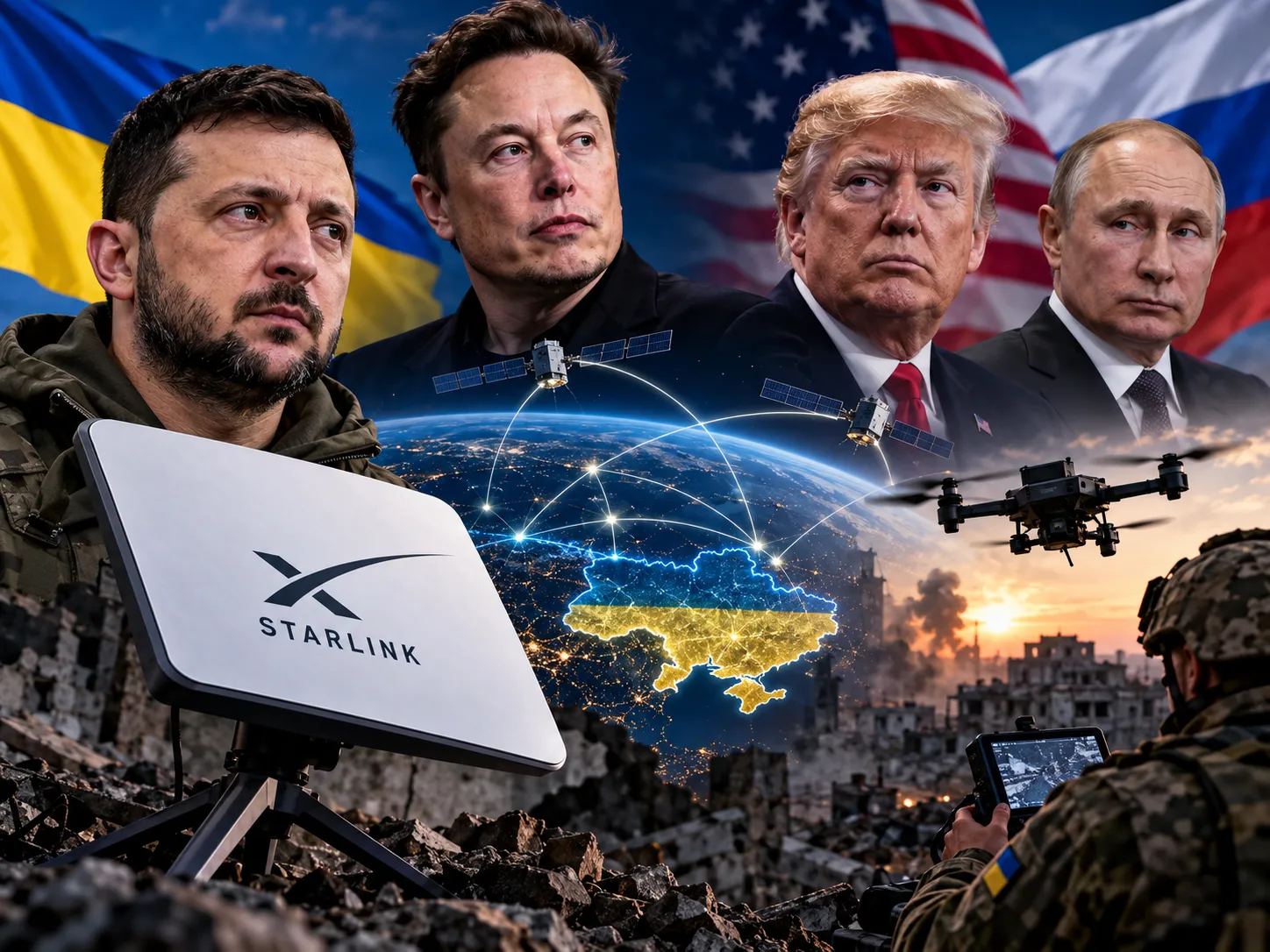
Reported restrictions on satellite communications used by Ukrainian drones have intensified tensions between Kyiv and Washington, exposing the risks of relying on privately operated technology for critical military functions.
 Brajesh Mishra
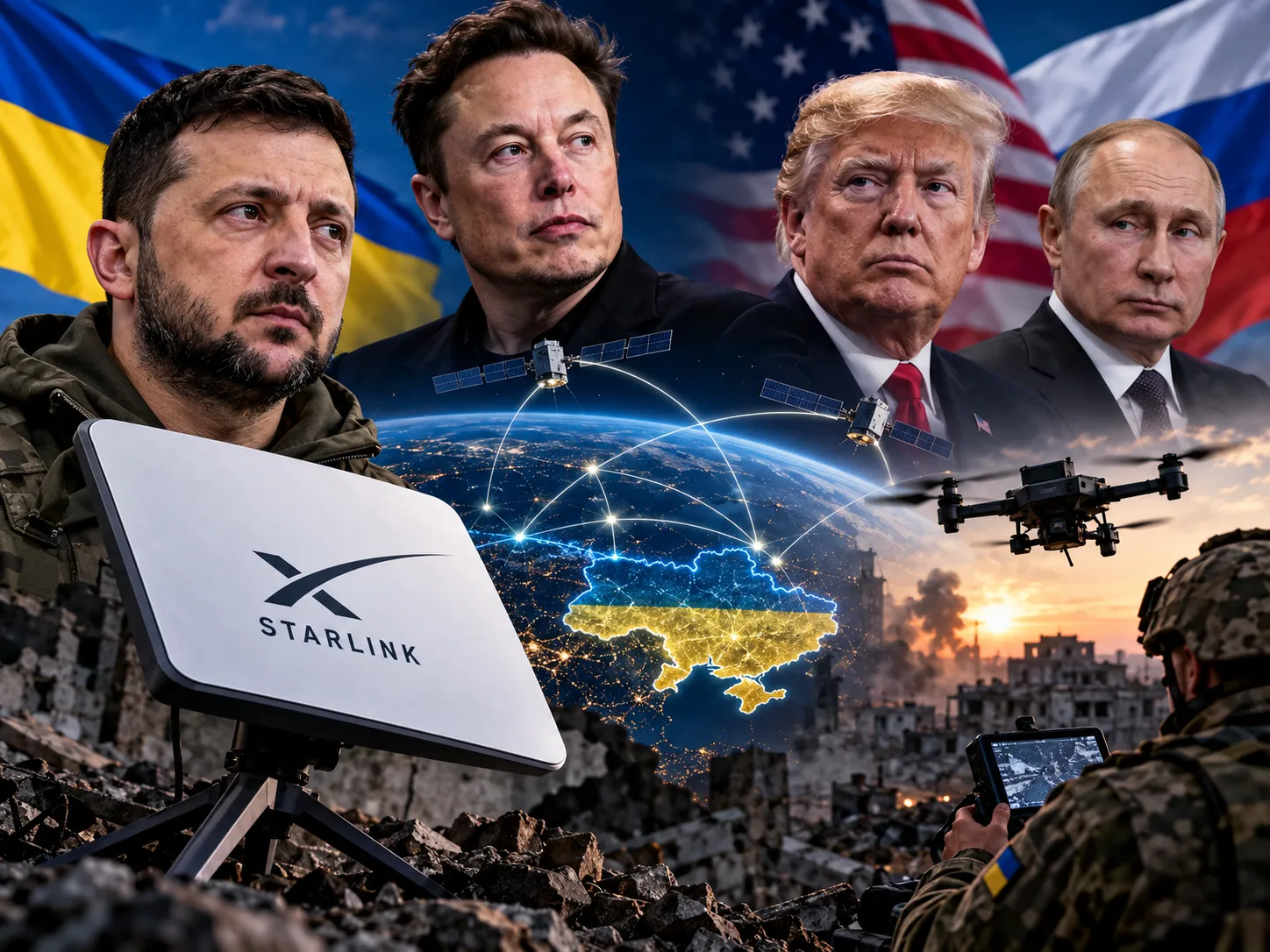
Ukraine’s reported loss of reliable satellite connectivity during military drone operations has exposed a strategic vulnerability in its war against Russia: a critical battlefield capability depends on technology operated by a private company in the United States.
The dispute intensified on 15 October after SpaceX chief Elon Musk said restrictions on its government-oriented Starshield system are decided by the US military and ultimately the president. His comments followed reports from Ukrainian officials that limitations affecting Starlink services had disrupted military missions.
The episode has raised a larger question for Ukraine and its European partners: how can a country maintain essential military communications when access to a crucial technology depends on decisions made outside its control?
On 14 October, Reuters reported that Ukrainian military officials said SpaceX had introduced limitations affecting some Starlink services in Ukraine. The officials linked the changes to disruptions in military drone operations, which depend on satellite connectivity for communications and guidance.
Serhiy Beskrestnov, an adviser to Ukraine’s defence establishment, said Ukrainian forces had not received advance warning and that several missions were disrupted. Reuters also cited Ukraine’s 7th Rapid Reaction Corps, which reported that connections could drop for 10–20 seconds during flights at speeds of around 110–120 kilometres per hour.
Those interruptions matter because a drone may remain physically airborne while losing the connection required for effective control. A brief disconnection can complicate guidance, coordination and mission execution, particularly when a system is moving quickly or operating under combat conditions.
According to Reuters, some missions were cancelled. The report also described broader complications for Ukrainian logistics and drone operations.
The exact scale of the disruption remains uncertain. The available reporting does not establish a complete count of affected terminals, the total number of cancelled missions or the precise operational consequences across Ukraine’s military.
The immediate issue is therefore clear, even if its full extent is not: Ukrainian officials say a change in satellite-service restrictions interfered with equipment used for military operations.
The public debate has often used the terms Starlink and Starshield together, but they describe different services.
Starlink is SpaceX’s commercial satellite internet network. Starshield is designed for government and national-security users, including secure communications and other defence-related applications.
SpaceX’s official Starshield documentation says the system uses the company’s satellite technology and launch capabilities to support national-security missions. It describes applications including communications, Earth observation and hosted payloads.
The systems are related, but that does not mean every restriction affecting a Starlink terminal is necessarily a Starshield decision. The specific service, terminal configuration and authority responsible for a particular restriction need to be established before drawing that conclusion.
Musk addressed this distinction on 15 October. He said Starshield systems are owned and controlled by the US government and that limits on their speed or usage are decided by the US military and ultimately the president. He separately described Starlink as a commercial service whose use is limited to civilian or defensive activities.
His comments clarify his stated position on government control of Starshield. They do not, by themselves, prove that the US president or a specific government agency ordered the restrictions reported by Ukrainian officials.
That distinction is central to understanding the dispute. The reported technical disruption is one question; who authorised it, under what policy and for what reason is another.
Satellite internet has become an important part of Ukraine’s communications infrastructure since Russia’s full-scale invasion in 2022. It allows military units to communicate across dispersed positions and supports operations where conventional networks may be damaged, unavailable or vulnerable to interference.
For some Ukrainian drone systems, connectivity is more than a convenience. It can form part of the control and guidance chain that allows an operator to direct a drone during a mission.
This creates a dependency with strategic consequences. A country may control its military objectives and personnel while depending on a foreign company’s infrastructure, service policies and technical decisions to carry out some operations.
That arrangement can deliver capabilities quickly. Commercial satellite networks can provide coverage and capacity that would be difficult for a country at war to build independently in the short term.
But it also introduces a point of vulnerability. If service rules change, a network becomes unavailable or access is restricted, the consequences may extend beyond ordinary communications to logistics, coordination and military operations.
The risks are not limited to political disputes. Technical failures, interference, cyber threats, congestion and changes to service configuration can also affect reliability. Resilience therefore requires planning for several kinds of disruption rather than assuming that a single provider will always remain available.
The timing has intensified scrutiny of the relationship between Kyiv and Washington. The restrictions were reported amid wider disagreements over Ukraine’s military strategy, US policy towards Russia and Washington’s pressure on Kyiv to limit attacks on Russian oil infrastructure.
However, timing alone does not prove that the restrictions were imposed as political retaliation.
Reuters reported that the reason for the service limitations was not immediately clear. The Guardian’s 15 October explainer reported Musk’s statement about US government control of Starshield and noted that the White House had not confirmed or denied his assertion.
The public evidence reviewed for this article does not conclusively identify who authorised the specific restrictions affecting the Ukrainian terminals, nor does it establish a definitive motive.
It is therefore important to distinguish three things: the disruption reported by Ukrainian officials, Musk’s statement about government control of Starshield, and the political interpretations surrounding the timing. They are related, but they are not interchangeable forms of evidence.
A definitive assessment would require further clarification from SpaceX, the relevant US authorities and Ukrainian officials about the affected service, the technical change and the decision-making process.
The dispute has wider implications for European security because it illustrates how dependence on external technology can become a strategic concern during a conflict.
Europe has satellite operators, space programmes and defence technology companies. But an alternative to a system already integrated into military operations cannot be judged by the existence of satellites alone.
A credible substitute would need sufficient coverage and capacity, compatible terminals, secure communications, dependable performance and integration with existing equipment. It would also need to be available at the scale and speed required by the operational situation.
Replacing one system can involve changes to hardware, software, training, supply chains and operating procedures. A service that works for one type of mission may not meet the requirements of another.
That is why technological independence is not achieved simply by announcing a new satellite programme. It requires the infrastructure, manufacturing capacity, interoperability and operational arrangements that make the alternative usable when it is needed.
The European Council’s 15–16 October summit agenda includes continued support for Ukraine, the needs of critical infrastructure ahead of winter and progress on European defence readiness. The official agenda also identifies critical military capability gaps as an issue for EU leaders.
The meeting provides a relevant setting for discussing these dependencies. However, its published agenda does not establish that European leaders will approve a specific Starlink replacement programme or commit to a particular timeline.
Ukraine’s immediate priority is to maintain reliable communications for its forces while protecting military personnel and civilians from continuing Russian attacks.
Potential risk-management measures include clarifying restrictions with the service provider, reviewing how affected systems are used, improving redundancy and diversifying communications suppliers where technically feasible.
These are possible approaches, not a confirmed list of measures Ukraine has already implemented in response to this incident.
Alternative systems cannot necessarily be substituted overnight. Their suitability depends on coverage, bandwidth, latency, terminal size, power requirements, security and integration with the equipment already in service. Military planners must also consider whether a backup system can function under the same operating conditions as the primary network.
Diversification can reduce reliance on a single provider, but it introduces its own costs and complexity. Different networks may require different terminals, software and training. Maintaining several systems also requires procurement, testing and support.
The broader objective is not necessarily to abandon one network. It is to ensure that a disruption to one provider does not automatically disable a critical capability.
Three developments will help clarify the significance of the dispute.
First, SpaceX and the relevant US authorities need to clarify the restrictions. A clear account of the affected service and the authority responsible would help distinguish a technical or service-policy change from a government-directed decision.
Second, additional reporting is needed to establish the operational impact. Details about affected terminals, cancelled missions and any workarounds would help assess the scale of the disruption without relying solely on political claims.
Third, European governments will need to decide how quickly they want to reduce strategic dependencies in satellite communications and other critical defence technologies. That involves more than funding new infrastructure: it requires systems that can be delivered, integrated and maintained at operational scale.
The European Council’s meeting on 15–16 October is one near-term development to watch because Ukraine support and European defence readiness are on the agenda. Any new commitment should be assessed against the official conclusions and subsequent implementation, rather than inferred from the agenda alone.
The Starlink dispute illustrates a defining feature of modern warfare: military capabilities increasingly rely on technology developed and operated by private companies across national borders.
These partnerships can provide speed, scale and capabilities that governments would struggle to build independently. But they can also create dependencies that become visible when service access changes during a crisis.
For Ukraine, reliable communications remain an immediate operational concern. For Europe, the longer-term challenge is to build credible alternatives and continuity arrangements for essential technologies.
The evidence reviewed establishes that Ukrainian officials reported disruption and that Musk described US government control over Starshield restrictions. It does not yet settle who authorised the specific Starlink limitations or why they were introduced.
That uncertainty is itself strategically important. In a prolonged conflict, access to critical technology is not merely a technical matter. It can shape operational choices, diplomatic relationships and the ability of a country to sustain its defence.
 Exclusive Content






Sign up for the Daily newsletter to get your biggest stories, handpicked for you each day.



 Trending Now! in last 24hrs