Discover the story of Ashwini Asokan, the designer and former Intel executive who co-founded Mad Street Den and Vue.ai to revolutionize retail with computer vision.
 Rashmeet Kaur Chawla
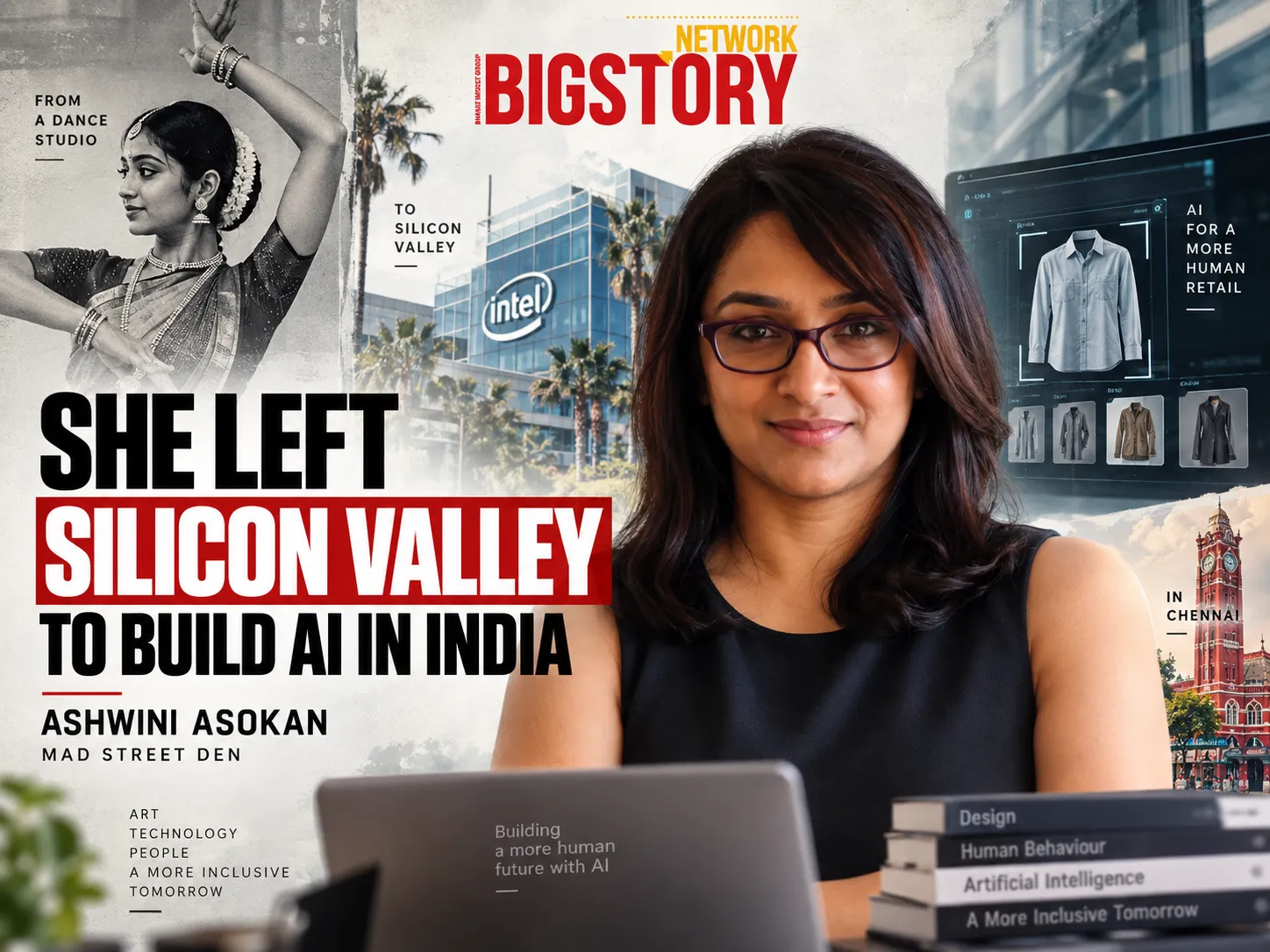
She was supposed to be a dancer. But the same woman who once trained for the stage is now the person whose technology decides how a shirt gets labelled, styled, and recommended to a shopper in Mexico City, Manila, or Mumbai. That mix an artist who became an engineer is the real story of Ashwini Asokan, and of the company she built, Mad Street Den, to show that art and technology don't have to be opposites.
Ashwini Asokan was born into a family of professors and computer scientists. So when she chose to study dance, art, and visual communication instead of coding, some people saw it as a rebellious choice. It wasn't. It was the first sign of something she believed in strongly: that technology and human behavior should never be treated as two separate things.
This belief stayed with her at Carnegie Mellon University, where she did her master's in product and interaction design a course that treats design as serious thinking, not just decoration. It stayed with her again in Silicon Valley, where she spent almost ten years at Intel, leading a team that studied how people actually use mobile technology, not just how engineers assumed they would.
While Asokan was studying human behavior, her husband, neuroscientist Anand Chandrasekaran, was working on the other side of the same problem building AI systems that could understand that behavior. Most couples in their position would have stayed right where they were comfortable, well-paid, and settled in the world's most famous tech hub.
In 2013, they didn't. They left Silicon Valley and moved to India to start again from nothing.
Chennai, Not Bengaluru
Most people expected them to choose Bengaluru or Mumbai. Instead, Asokan and Chandrasekaran picked Chennai, setting up their first office in a home in Abiramapuram. Mad Street Den was launched publicly at YourStory's Mobile Sparks conference that same year not a quiet, secret launch, but a public announcement, made in front of an audience that, as Asokan has said, barely knew what "deep learning" meant back then.
The early years were quiet and slow on purpose. There was no product for a long time — just research. That patience, choosing to build carefully instead of rushing to launch, became the foundation the company still follows today.
In 2016, Mad Street Den launched Vue.ai, an AI platform built to automate and personalize retail things like product tagging, visual search, styling suggestions, and merchandising decisions. The system had to learn to "see" a piece of clothing the way a stylist would: its cut, its color, its overall look.
Asokan explains the company's core idea in simple terms: organise a business's data, learn from it, and automate the decisions that don't need a human's judgment. It sounds easy, but building a computer-vision system that can actually understand clothing at that level is very hard.
What made Mad Street Den succeed commercially, not just technically, was a clear split in roles Chandrasekaran handled the deep research as CTO, while Asokan focused on turning that research into a real product people would pay for. Today, their clients include Tata Cliq and Kapiva in India, and Macy's and Mercado Libre abroad.
She almost became a professional dancer, singer, or musician before she changed direction toward design and, eventually, AI.
Bloomberg once named Mad Street Den one of the "50 Most Promising Startups You've Never Heard Of."
The company wasn't launched quietly it was announced on stage at YourStory's Mobile Sparks conference in 2013.
Vue.ai wasn't the company's only product. Mad Street Den also built Blox.ai, which used the same image-recognition technology in healthcare, education, finance, and media.
At Intel, she led a team that mixed designers, anthropologists, and software engineers together an unusual setup for a hardware company back in the 2000s, and an early sign of how she would later build Mad Street Den.
Asokan didn't build her reputation by promoting herself. She built it through consistency showing up again and again in profiles, lists, and conversations about the future of AI in India and beyond. She has also been open about disagreements, including a well-known story of going against her own board's cautious plan to enter the American market. She believed the company would get its first international clients faster than the board expected. She was right.
The results have supported that instinct. Starting as a self-funded venture, Mad Street Den has raised more than $35 million from investors, including Sequoia Capital India and Exfinity Venture Partners. Growth picked up sharply during the pandemic, as retailers rushed to move their operations online.
The one idea Asokan repeats most often is trust trust in what her company's technology can do, and trust in what she believes AI's real role should be. Her message is simple: AI should add to human decision-making, not replace it. Her goal, she says, is to remove the low-value tasks that keep people from doing the work only they can do.
She has also used her visibility to speak openly about the lack of women in AI and tech. She treats it as a serious issue, not a side topic which matters even more given that she runs a deep-tech company in an industry still dominated by men.
Building what's easy was never the goal. Building what nobody else would attempt that was.
The move was from comfort into uncertainty no plan, no resources, no guarantee any of it would work. Trusting ourselves was the only option, especially when no one else did.
Technology should serve people, not the other way around. A machine that cannot understand why someone reaches for one dress and not another is not intelligent at all
Expertise doesn't come with a title. It has to be earned through every product, every client, and every failure until explanations are no longer needed.
The boardroom isn't always right. Sometimes the faster path is to say six months instead of two years and then deliver it.
AI that replaces judgment was never the goal. AI that gives people more of it that's the point.
Coming back meant building what the world said could only be built somewhere else. That belief was wrong and so was everyone who believed it about us.
That's what it means to question not just the market, but the idea that innovation only belongs to certain places. This isn't on that list.
Once in a while, a founder's story stops being just inspiring and becomes something more useful real proof of how ambition works under pressure. Ashwini Asokan's story is that second kind. When she and Anand Chandrasekaran left stable, well-paying jobs in Silicon Valley to start over in a small house in Chennai, most of India's tech world had barely heard the term "deep learning." Ten years later, the systems built in that house influence retail decisions across three continents.
What makes her story worth telling isn't the technology itself it's the discipline behind it. A founder who chose research over a rushed launch. Who chose Chennai over the obvious big city. Who chose to go against her own board when she trusted the facts more than their caution. That kind of discipline is harder to teach than any algorithm and it's really what this piece is about.
She didn't get into artificial intelligence through a computer science degree. She got there through dance, design, and a strong belief that technology should never forget who it's meant to serve. That belief, in the end, is the harder problem to solve and it's exactly why her story belongs in this series.
 Exclusive Content


Sign up for the Daily newsletter to get your biggest stories, handpicked for you each day.



 Trending Now! in last 24hrs