In 2001, a few women in Odisha began saving Rs 5 a week. Twenty-five years later, 70 lakh of them sit inside one of India's largest state-backed women's collectives. This Challengers case study looks at how Mission Shakti turned savings groups into bankers, brand-builders and business owners.
 Rashmeet Kaur Chawla
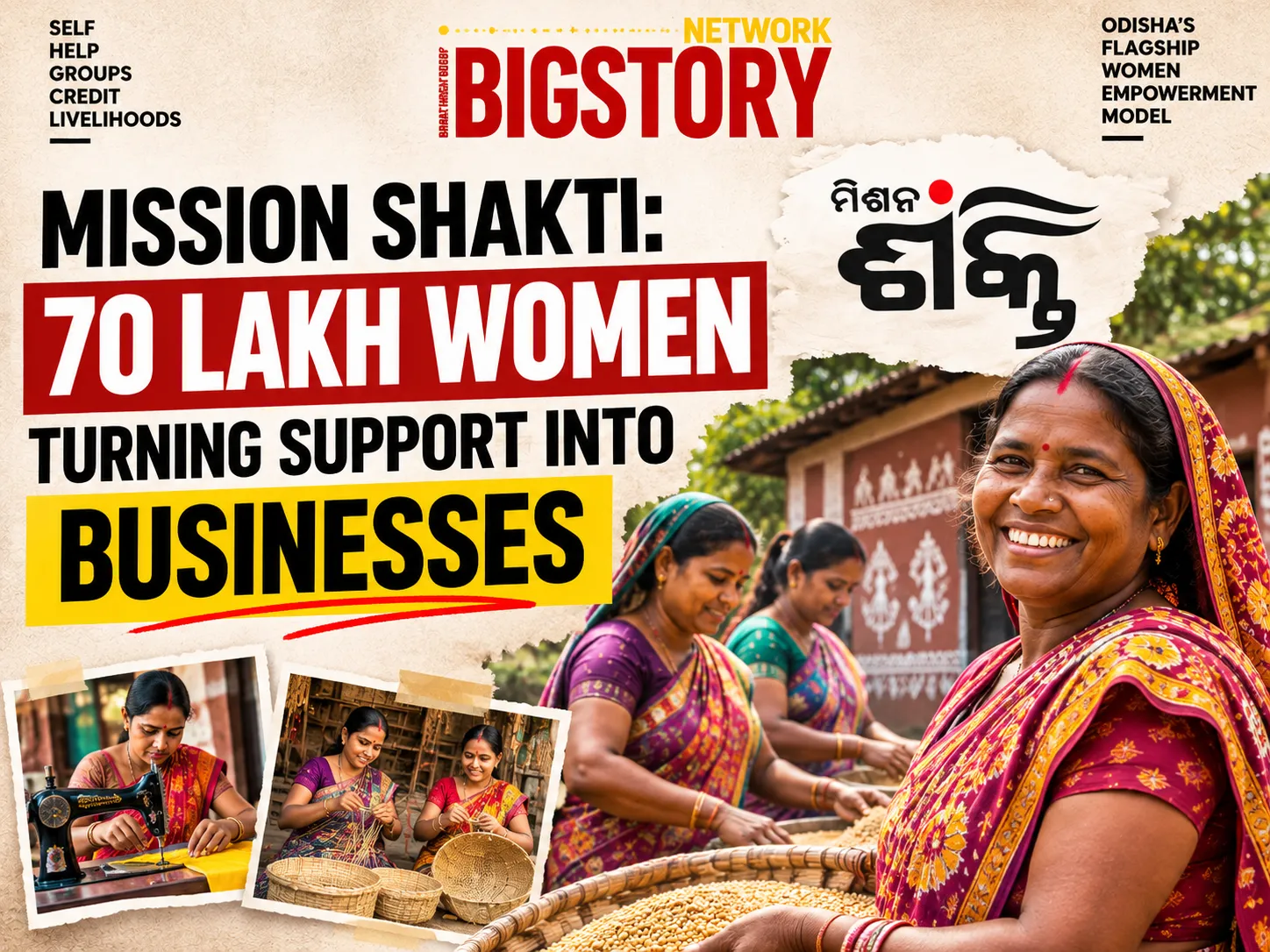
Not many welfare schemes in India have been running for more than two decades, evolved with changes in governments and yet continued to remain as models to be emulated. One such scheme is Mission Shakti of Odisha. Mission Shakti was initiated on 8 March 2001, on the eve of International Women’s Day, as a state-level scheme for the empowerment of women through Self Help Groups (SHGs). The mission targets at empowering the women socially, economically, and politically. This case study deals with the actions of the state, the model that has evolved, the evidence available and the areas where it needs validation.
- What is Mission Shakti in Odisha, and who can join?
- How do Mission Shakti SHGs get loans, and what is interest subvention?
- Is Mission Shakti the same as Odisha Livelihoods Mission?
- How many women are in Mission Shakti?
- What is a Lakhpati Didi?
The SHGs by women had been in existence in Odisha since the 1990s, but these had not been receiving the kind of attention and institutional support necessary to scale up. A collection of women contributing small sums of money can remain weak if not supported by a bank which trusts them, a market which buys their products, and a government office which backs them. The very idea of the formation of Mission Shakti was to bring backbone to this grass roots movement.
It all began with a pilot project where 58 SHGs comprising of 20 members each were established, and each member saved either Rs. 5 or Rs. 10 per week.
THE SCALE OF GROWTH
Numbers give an indication of how far-reaching the concept was. The scheme started with just 41,475 units in 2001-02 and has risen to 6,02,013 in 2020-21, almost a fourteen times increase. The department itself categorizes it as around 6 lakhs units with around 70 lakhs female members. In 2022, the state government approved the extension of the scheme for another five years, till 2026-27, so the present tenure is almost ending. Thus the year ahead is quite crucial for any future decision.
HOW THE MODEL WORKS
Four pillars hold the programme together.
The institutional support is the first pillar. An entire department was established in Odisha for the mission, which the state considers unique in the country.
Credit is the second pillar. Linkages with banks exist, and the state provides interest subsidies to groups repaying their loans on time. The Mission Shakti Loan Scheme makes the annual interest rate for a group at 1 percent, but only on prompt and timely repayment. The design motivates groups to repay on time rather than giving them funds easily.
In February 2024, the government announced interest-free loans worth up to Rs 10 lakh as well as a bank loan facility of Rs 75,000 crore in five years. Delivery is tracked, and the credit goal of 2021-22, for instance, is 2,80,150 SHGs with Rs 6,000.52 crore. The subsidy remains available. In June 2026, the Deputy Chief Minister released interest subvention worth Rs 147.76 crore to 2,88,198 SHGs.
The third element is physical infrastructure. The government sanctioned Mission Shakti Gruha in each Gram Panchayat and ward as a place of meeting, training, and marketing. The activity report of the department for the year 2024-25 shows that 7,812 Gruhas have been sanctioned in the panchayats out of which 6,479 have been completed, while in urban wards out of 1,489 only 553 have been completed. An illustration of the functioning of this model can be cited from a panchayat located near Bhubaneswar, where the sound of sewing machines in the Gruha signifies that here women are undertaking their business enterprise.
Market comes next. The Mission Shakti Bazaar was started in Bhubaneswar in 2024 which provides products from the SHGs both farm and non-farm through an e-commerce portal. The state government has also opened up its procurement system to the SHGs. Some of the activities performed by them in the process of procurement are providing pre-school uniforms to anganwadi centres and participating in paddy procurement.
WHAT THE EVIDENCE SAYS
It is always best to verify statements made by the government by referring to external sources of information. In this case, the report used is one that was carried out specifically for the department. The assessment of Mission Shakti in the KBK districts which are some of the poorest districts in the state showed that more than 80 percent of the members were from below poverty line or very poor Antyodaya households. This shows that the programme is reaching its target audience. Furthermore, the report also stated that there was a marked increase in the income levels of the members since they became members of groups although over half were still earning less than Rs 5,000 a month.
In a summary of another research, it has been observed that one-third of the members are aged between 18 and 30.
THE NEWER DIRECTION: FROM SAVINGS CLUBS TO ENTERPRISES
Whereas the mission aimed at keeping women out of poverty before, today's aspiration lies in transforming groups into businesses. According to senior members of government, there will be a total of 50,000 small and medium enterprises within three years based on upscaling Mission Shakti SHGs. An article that appeared in 2024 in an agricultural sector magazine explains how the state is transforming SHGs into SMEs and states that the units have generated employment of 6.28 lakh jobs.
The support structures are expanding further. A dedicated call centre helpline (155276) for women-led SHGs was established in 2024-25. In April 2026, the state began its self-defense training program for 5,000 SHG women in collaboration with the National Commission for Women. One must also understand the structural weakness pointed out by one of the analysts, which is the fact that Mission Shakti groups rely much more heavily on state intervention in terms of both decision-making and financing than some other models even as it is clear that the program has given grassroots women economic power.
- The scheme began with an announcement on a date, not a budget line: Women's Day 2001.
- Odisha's 2026-27 Gender Budget allocates Rs 1,22,764.56 crore, and the state links Mission Shakti and the Odisha Livelihoods Mission to helping women reach sustainable incomes above Rs 1 lakh.
- Mission Shakti is not the same as Odisha Livelihoods Mission. They work in tandem: Mission Shakti is the state's SHG department, and OLM is the livelihoods arm that appears alongside it in programmes like the IIT Bhubaneswar tie-up.
- Federation office bearers at gram panchayat, block and district levels receive designation incentives from the department. The federations (GPLF, BLF, DLF) form a three-tier ladder of women's institutions.
- The state set a target of providing Rs 6,600 crore of government business to Mission Shakti SHGs and federations through convergence with different departments.
Three key questions will determine how the programme progresses in the future. Will this programme continue beyond FY 2026-27 in the current form? Will the target levels of credit like Rs 20,000 crore for SHG bank linkage be achieved by banks or just announced? And lastly, will the federations and enterprises be self-reliant in the long run? The answers to these questions will indicate whether Mission Shakti becomes an institution or remains a programme dependent on its donors.
Raimati Ghiuria, known as the "Queen of Millets," overcame doubts about millet's profitability and now preserves 30 rare varieties while training hundreds of women in sustainable farming. Sasmita Mangaraj founded the Sai Shakti Mahila Samiti, an SHG of 400 members from Bhubaneswar's slums and settlements. Two women, two very different corners of the state, one shared engine.
The story of Mission Shakti is no tale of instant metamorphosis. It is the story of perseverance; weekly saving since 2001, special department for the purpose, interest concession on timely repayment, buildings in the panchayats and a growing market. With more than 70 lakh women participants, it continues to be one of the biggest state-sponsored women’s collectives in India.
Mission Shakti is not a single founder's story, and that is precisely why it belongs in The Challengers. Programmes are sometimes made with much fanfare and then forgotten after a year. Not so, Mission Shakti. Begun in Odisha on 8 March 2001, it started from scratch – small weekly savings by groups of women based on the assumption that they could together transform the economics of their households and village economies. Twenty years down the line, there are about 6 lakh groups and 70 lakh women involved in this assumption.
We consider the programme in all its complexity in the manner of a case study, looking at both the successes and also the issues. We look at how interest-free loans incentivised on-time repayments; how panchayat-level Gruhas institutionalised the work being done by women; how marketing and procurement efforts have been making savings schemes enterprises; and how the findings of independent research have questioned the assumption behind it.
What we are trying to do in this series is neither to praise nor condemn, but to examine. And we believe that lessons learned from this case would be relevant to all those working on livelihoods, finance and policy.
Department of Mission Shakti: Frequently Asked Questions (FAQs) https://missionshakti.odisha.gov.in/en/more/msd-FAQs
About the Department of Mission Shakti, Government of Odishahttps://missionshakti.odisha.gov.in/about-us/about-department
Department of Mission Shakti Activity Report 2024–25https://missionshakti.odisha.gov.in/sites/default/files/2026-02/Activity%20Report%202024-25_0.pdf
Indian Institute of Public Administration (IIPA): Assessment Study on Mission Shaktihttps://www.iipa.org.in/publication/public/uploads/article/28881684491573.pdf
Honing Decision-Making Power and Managerial Skill Key to Strengthening Mission Shakti in Odishahttps://odishatv.in/news/opinion/honing-decision-making-power-and-managerial-skill-key-to-strengthening-mission-shakti-in-odisha-123390
Mission Shakti Loan & State Interest Subvention Programmehttps://missionshakti.odisha.gov.in/en/programme/mission-shakti-loan-state-interest-subvention
Interest-Free Loans Up to Rs 10 Lakh Announced for SHGs in Odishahttps://knnindia.co.in/news/newsdetails/state/interest-free-loans-upto-rs-10-lakh-announced-for-shgs-in-odisha
Information & Public Relations Department, Odisha: Mission Shakti Press Release (June 2026)https://inpr.odisha.gov.in/sites/default/files/2026-06/News%20Missio%20Shakti-24062026AAAA.pdf
Odisha Releases Rs 147.76 Crore Interest Subvention to SHGshttps://www.orissapost.com/odisha-releases-rs-147-76-crore-interest-subvention-to-shgs/
Dy CM: Women to Lead Odisha’s Developmenthttps://www.orissapost.com/dy-cm-women-to-lead-odishas-development/
Odisha Govt Extends Mission Shakti Scheme for Five Yearshttps://zee5.com/articles/odisha-govt-extends-mission-shakti-scheme-for-five-years
 Exclusive Content



Sign up for the Daily newsletter to get your biggest stories, handpicked for you each day.

 Trending Now! in last 24hrs