Explore the structural failures behind Delhi's winter smog, from the CAQM's limited mandate and DPCC staff vacancies to the agricultural calendar crisis.
 Brajesh Mishra
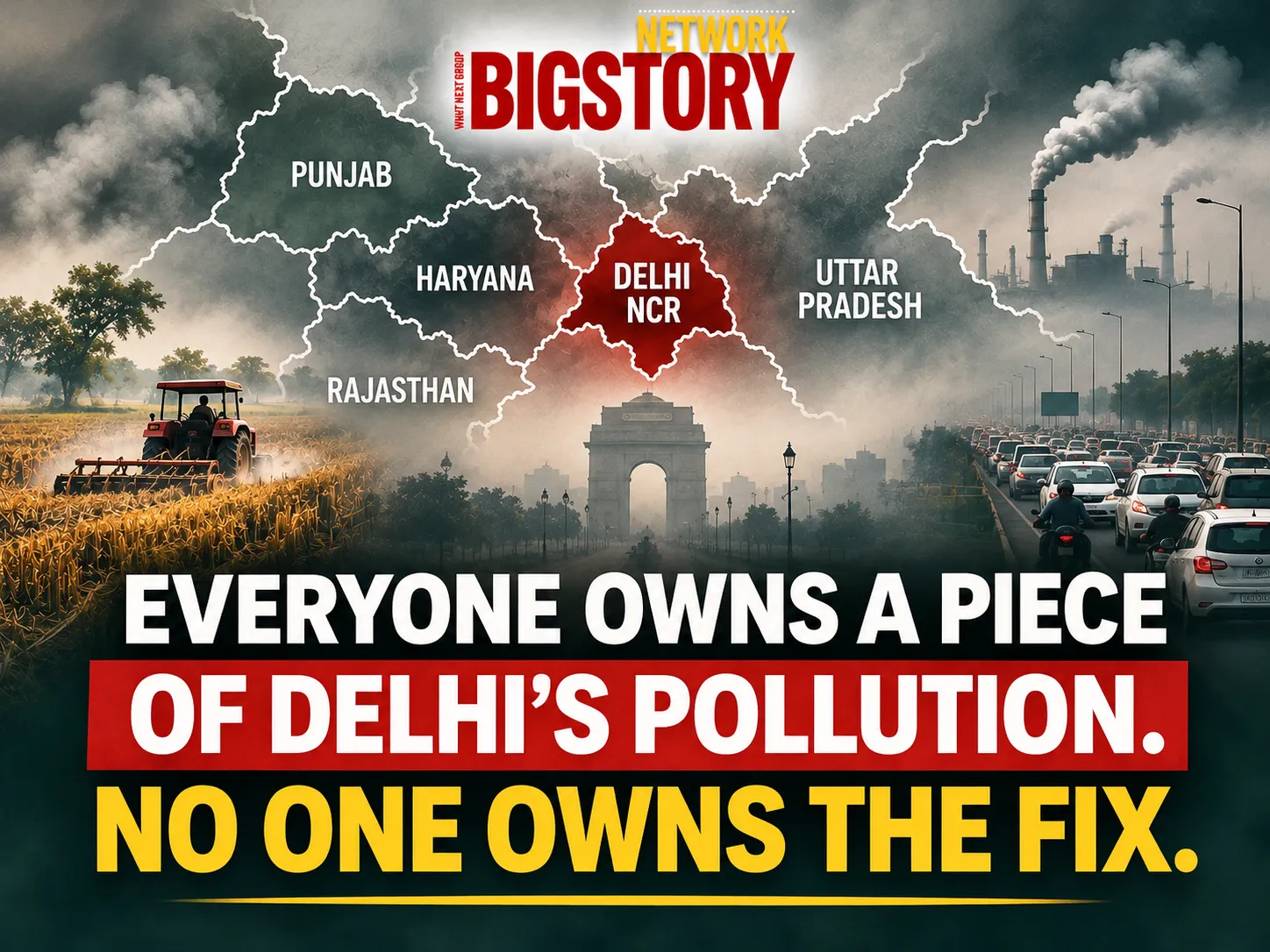
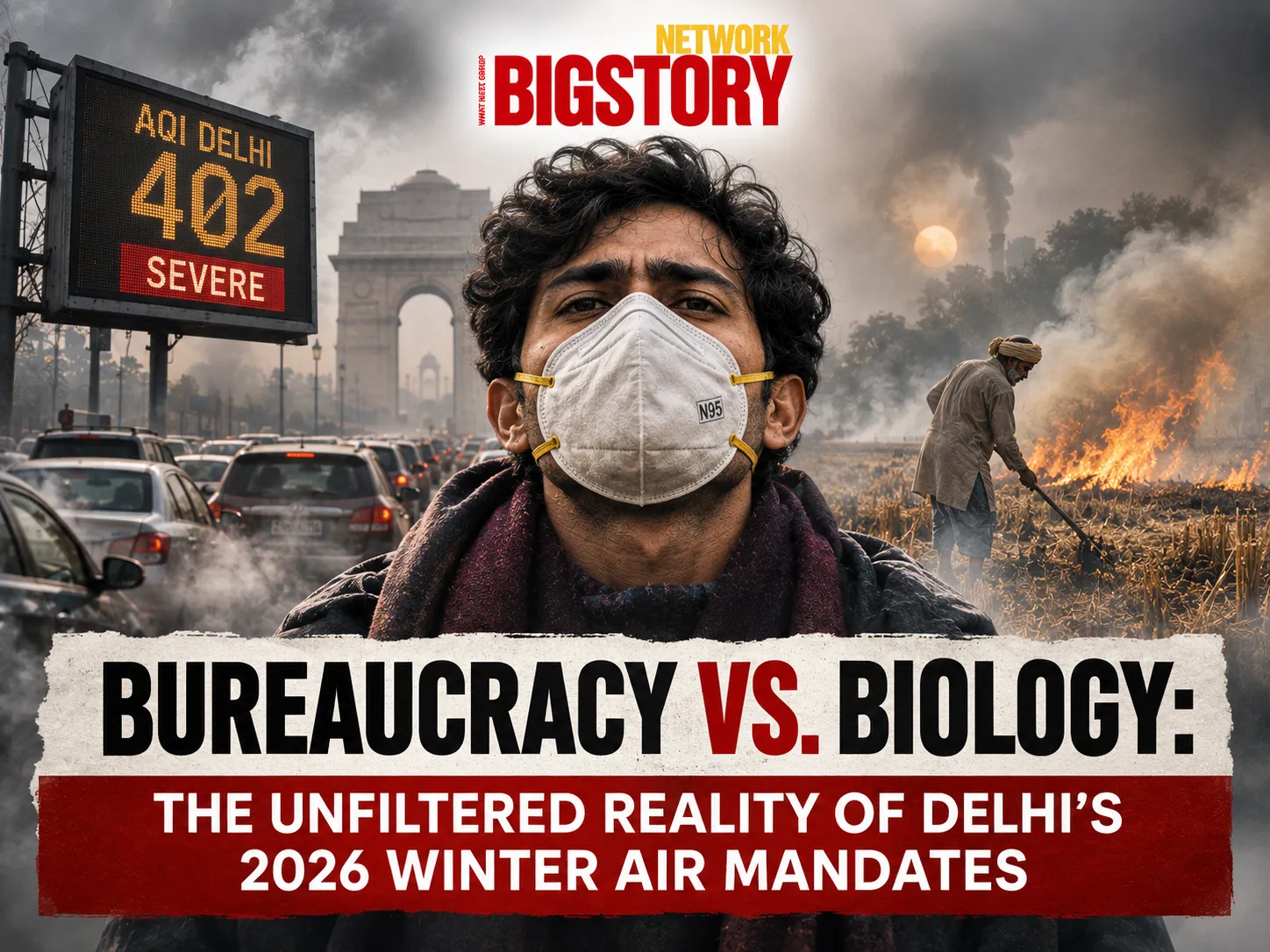
Every winter, Delhi’s air turns into a daily calculation. Families check pollution readings before sending children outside; governments announce restrictions; and public debate returns to familiar culprits, from traffic to crop-residue burning.
Those sources matter. But the crisis is also a question of scale: the air moves across administrative borders, while many of the institutions meant to manage it remain tied to them. The result is a mismatch between a shared airshed and fragmented responsibility.
That mismatch does not explain every bad-air day, and it does not make weather irrelevant. Winter conditions can worsen pollution by limiting atmospheric mixing and keeping emissions close to the ground. Research on the Indo-Gangetic Plain also describes the role of secondary particles, which form in the atmosphere from precursor gases. Pollution is therefore not only a collection of visible plumes from individual sources; it is also the product of emissions interacting across places and over time. Research on seasonal particulate pollution in the Indo-Gangetic Plain
The policy question is whether institutions can respond at the same scale as the problem.
Parliament created the Commission for Air Quality Management (CAQM) in 2021 to coordinate air-pollution action in Delhi-NCR and adjoining areas. The law gives the Commission authority across the National Capital Region and adjoining areas in Punjab, Haryana, Rajasthan and Uttar Pradesh. That is a regional mandate, but it does not cover the full Indo-Gangetic Plain, which extends beyond those jurisdictions. Commission for Air Quality Management Act, 2021
This is a boundary of the statute, not proof that every pollutant reaching Delhi originates outside the Commission’s area or that expanding its jurisdiction alone would solve the problem. It does raise a practical question: how should policy coordinate across a wider airshed when emissions, weather and transport do not follow the same map as the agency responsible for Delhi-NCR?
The CAQM Act also treats agricultural residue burning differently from other offences under the law. Section 14’s criminal provisions do not apply to farmers for stubble burning or mismanagement of agricultural residue, while Section 15 allows the Commission to impose and collect environmental compensation. That is a statutory choice to use a compensation mechanism for farmers; it is not the same as a blanket legalisation of crop burning. Whether compensation deters burning depends on its rate, enforcement and the practical alternatives available to farmers. Commission for Air Quality Management Act, 2021
Crop-residue burning cannot be understood only as an individual decision to ignore the rules. Punjab’s groundwater-conservation law restricts when paddy can be transplanted, with dates notified by the state. The policy aims to reduce groundwater extraction before the monsoon. But later planting can also push the harvest later, narrowing the time available to clear fields and prepare for the next crop.
A 2025 parliamentary committee report records the Punjab government’s explanation that delayed harvest leaves farmers with a short window before wheat sowing and that residue burning can be the fastest and cheapest option. That account points to a policy trade-off: conserving groundwater and preventing smoke require solutions that work together in the same cropping calendar. Parliamentary Standing Committee report on crop-residue management
The answer cannot rest on telling every farmer to buy machinery. A fair assessment needs current, district-level evidence on machinery access, rental prices, fuel and labour costs, crop timelines, and the support actually received by different kinds of farmers. Those details matter because a measure that works for a large farm may be unaffordable or impractical for a small one.
In May 2025, the Supreme Court recorded serious staffing gaps in several pollution-control bodies in Delhi-NCR. It said around 55 per cent of posts at the Delhi Pollution Control Committee were vacant, alongside vacancy rates of 35 per cent in Haryana and 45 per cent in Rajasthan and Uttar Pradesh. The Court described the DPCC as virtually defunct and directed Delhi to fill its vacancies by September 2025. Supreme Court of India, order dated 19 May 2025
The order is a dated snapshot, not proof of present staffing levels. A current account should establish what happened after the deadline. Still, the figures show why enforcement capacity matters: agencies need trained staff to inspect sites, investigate violations, manage data and follow through on directions. A sensor or camera can collect information, but it cannot replace a staffed regulator capable of checking whether the information reflects conditions on the ground.
The National Clean Air Programme (NCAP) is intended to support pollution-control work in cities. The January 2026 progress report from the Centre for Research on Energy and Clean Air (CREA) assesses city-level targets and spending. Its findings can help test whether spending matches the sources that matter in different places. CREA, Tracing the Hazy Air 2026
The report’s findings and tables should be cited precisely when comparing funding categories: a share allocated to a category is not automatically the same as money spent, and a national or programme-wide percentage cannot by itself establish what happened in NCR. The accountability questions are straightforward: what was allocated, what was actually spent, where did it go, and what measurable air-quality change followed?
CREA’s report notes uneven progress among NCAP cities against particulate-matter targets, as well as gaps in monitoring coverage. That makes transparent, comparable reporting important. Spending on road dust may be warranted in some cities; the issue is whether the mix of interventions follows local evidence and whether results are measured.
People do not experience polluted air on equal terms. Outdoor workers may have little choice but to spend long hours in it. People without secure housing or adequate heating can face additional exposure to cold and smoke. At the other end of the income scale, access to private vehicles, cleaner indoor spaces and the ability to absorb penalties can shape how restrictions are experienced.
The broader accountability question is whether rules impose comparable obligations on powerful commercial actors and ordinary residents—and whether workable alternatives are available to people who would otherwise bear the greatest costs. Answering that requires enforcement records, penalty data, court and agency documents, and interviews across affected groups.
The Indo-Gangetic Plain is not a single source of pollution, and no one administrative change can deliver clean air. But the problem it reveals is national: air pollution crosses boundaries, while responsibility is divided among agencies and governments with uneven resources and capacity.
India’s response should match that complexity. Governments need to coordinate across airsheds, give pollution-control agencies the staff and technical capacity to enforce existing rules, and design measures around the conditions people actually face—from crop calendars to the sources driving pollution in each city. Public reporting should show not only what was allocated, but what was spent, where it went and whether emissions fell.
Delhi’s winter smog is one visible test of that system, not the whole story. Across India, clean-air policy will be judged by whether it can move beyond emergency restrictions to consistent coordination, credible enforcement and measurable results. Until then, each winter—and each regional pollution crisis—will raise the same question: can public institutions act at the scale of the air people breathe?
 Exclusive Content



Sign up for the Daily newsletter to get your biggest stories, handpicked for you each day.

 Trending Now! in last 24hrs