Fairfax's proposed ₹52,878 crore acquisition of IDBI Bank does rises a lot of speculations and questions, so, explore IDBI's financial recovery, the Go Digit integration, and valuation concerns.
 Minaketan Mishra
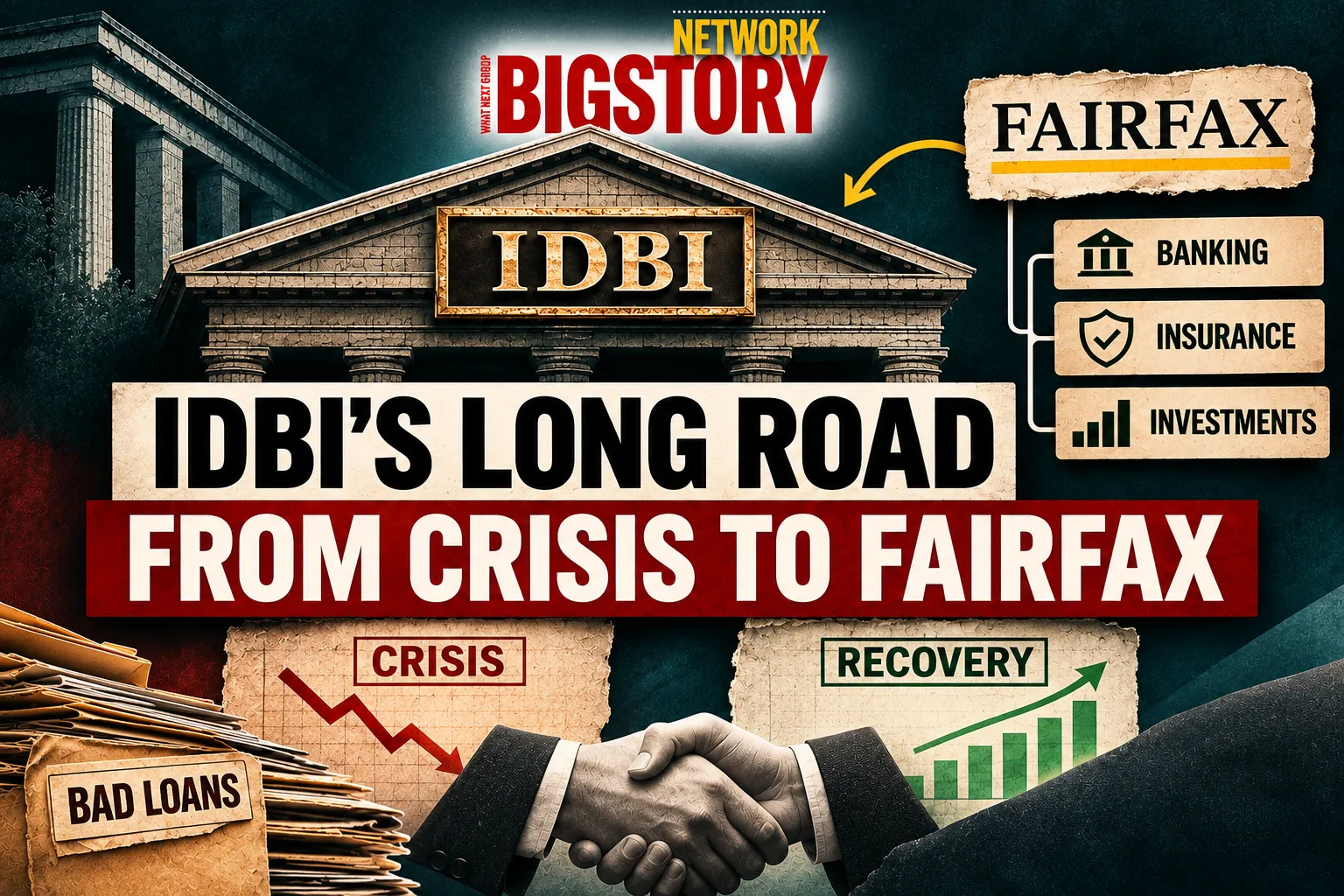
A bank deposit, a motor-insurance policy and an investment account are usually handled by different companies, but Fairfax Financial Holdings wants to bring those businesses under a group built around IDBI Bank.
On October 14, 2026, the government selected a Fairfax subsidiary to buy 60.72% of IDBI for ₹81 a share, or about ₹52,878 crore. Fairfax has also proposed transferring its interests in Go Digit’s life and general insurance businesses, and Fairfax India’s interest in IIFL Capital Services, to IDBI at their market prices. (Fairfax announcement; Finance Ministry FAQ)
The sale has not closed yet: Fairfax said no binding final agreements had been signed and that the IDBI purchase could go ahead without either or both proposed asset transfers. So this is not a completed merger. It is a proposed change in who controls IDBI, alongside a separate proposal to place insurance and investment businesses under its wider corporate umbrella. (Fairfax announcement)
Fairfax’s pitch is that customers could get banking, insurance and investment services through one group. In simple terms, IDBI takes deposits and makes loans; Digit sells insurance; IIFL Capital offers broking, investment banking, wealth management and related services. (IIFL Capital business overview) The promised convenience and business gains remain to be tested. So does the question at the heart of the deal: why sell a bank that has recovered from a severe crisis, and what will the new owner ask it to do?
The numbers from 2018 show how far IDBI had fallen. In the financial year ended March 2018, it reported ₹55,588 crore in gross non-performing assets, equal to 27.95% of its gross advances. Net NPAs stood at ₹28,665 crore, or 16.69%. The bank reported an operating profit of ₹7,905 crore, but provided ₹16,142 crore against bad loans and ended the year with a net loss of about ₹8,238 crore. (IDBI Bank analyst presentation; Ministry of Finance data)
Those figures show why the problem could not be reduced to whether the bank was still earning money from day-to-day operations. Loan losses and the provisions needed to recognise them overwhelmed that operating profit.
The pressure was building across India’s banking system. The Reserve Bank’s 2015 Asset Quality Review pushed banks to recognise stressed loans that had previously benefited from restructuring flexibility. The Finance Ministry later described the review as revealing losses banks had not fully provided for. That is sector-wide context; IDBI’s figures show the scale of its own problem. (RBI Financial Stability Report; Ministry of Finance data)
On May 5, 2017, the RBI placed IDBI under its Prompt Corrective Action framework, citing the bank’s non-performing assets and losses. The framework monitors indicators such as capital, asset quality, profitability and leverage, and can require corrective steps when a bank crosses risk thresholds. It is a supervisory intervention, not a bank closure. IDBI remained under PCA until March 2021. (RBI PCA framework; RBI on IDBI’s exit)
In January 2019, LIC acquired a 51% stake in IDBI, after which the RBI classified the bank as a private-sector bank for regulatory purposes. That classification did not mean the government had ceased to own shares: the government and LIC remained major shareholders. By the time the sale process advanced in 2026, they were proposing to sell a combined 60.72% stake. (RBI classification notice; Finance Ministry FAQ)
The ownership change was accompanied by capital support. In September 2019, the government said LIC would infuse ₹4,743 crore and the Union government ₹4,557 crore, bringing the announced support to ₹9,300 crore. The government described its contribution as recapitalisation through bonds and said the transaction would be cash-neutral for that year’s budget liquidity. That description does not erase the public commitment: it records the form the government said the support would take. (Cabinet decision)
IDBI’s own sale document also records earlier LIC infusions and a subsequent capital raising. It says the bank received ₹21,624 crore from LIC in FY2018-19, another ₹4,743 crore in September 2019, ₹4,557 crore from the government and ₹1,435 crore through a qualified institutional placement. These figures describe different funding events, so they should not be collapsed into one “taxpayer bailout” total: LIC’s share purchase, capital infusions, government recapitalisation and market fundraising have distinct sources and mechanics. (DIPAM information memorandum)
By March 2021, IDBI’s capital adequacy ratio had risen to 15.59%, from 10.41% in March 2018. Its net NPA ratio had fallen to 1.97%, from 16.69%. The RBI removed the bank from PCA in March 2021, while saying it would remain under monitoring. The turnaround is visible in those measures; explaining precisely how much came from fresh capital, loan recoveries, write-offs, improved recognition or other changes requires keeping each measure separate. (IDBI Bank March 2021 presentation; RBI PCA exit notice)
The more recent accounts show a bank in a very different position from the one placed under PCA. IDBI reported a net profit of ₹9,513 crore for FY2025-26, gross NPAs of 2.32%, net NPAs of 0.15% and a capital adequacy ratio of 26.65% at March 31, 2026. These are the bank’s reported figures; they do not by themselves establish what its future capital needs will be or whether private ownership will improve performance. (IDBI Bank FY2025-26 results)
The government’s case is broader than saying IDBI was once distressed. In its 2021 in-principle decision, it said a strategic buyer could bring capital, technology and management practices, and reduce the bank’s reliance on government and LIC support. It also said disinvestment proceeds would be used for development programmes. Those are the government’s stated aims, not evidence that the sale will achieve them. (PIB, May 5, 2021)
There is also an important distinction between the money received by the government and the money received by LIC. The proposed ₹52,878 crore consideration covers the combined sale of 30.48% held by the Union government and 30.24% held by LIC. The Finance Ministry says proceeds will be divided proportionately. LIC is a public-sector insurer, but its sale proceeds are not the same as direct Union government revenue. The government says it will retain 15% and LIC 19% after the sale, with no board nominees. (Finance Ministry FAQ)
The IDBI sale also sits against a policy plan that went only part of the way. In the 2021 Budget, the government proposed taking up privatisation of two public-sector banks besides IDBI. That proposal is not evidence that two other banks were put on sale or privatised. A December 2025 parliamentary answer said no proposal for PSB merger or disinvestment was then under consideration. IDBI is therefore a specific strategic sale, not proof that a broad bank-privatisation programme is currently under way. (Union Budget 2021-22 speech; Rajya Sabha answer, Dec. 2, 2025)
The sale raises a policy question the old crisis cannot answer on its own: if IDBI has recovered, what is private ownership meant to change now? The government points to capital, technology and management. Fairfax points to a broader financial-services group. The effect will depend on the terms, the safeguards and how the bank is run after control changes.
The transaction has two connected but legally distinct parts. First, a Fairfax subsidiary has been selected to buy the government and LIC shares. Second, Fairfax has proposed transferring its interests in Go Digit’s life and general insurance businesses, and Fairfax India’s interest in IIFL Capital Services, to IDBI at market prices. The government lists RBI and SEBI approvals for the proposed contributions and IRDAI approval for the insurance businesses. Fairfax says the share purchase could proceed even if one or both contribution proposals do not. (Fairfax announcement; Finance Ministry FAQ)
In plain language, the proposal could put a bank, an insurer and an investment-services company under a larger group. It does not mean that the three businesses have already merged into one company or that their services will automatically be bundled. Fairfax has said it does not expect the businesses’ management and operating structures to change. Its commercial argument is that IDBI could offer more products through its customer reach, while Digit and IIFL could gain access to the bank’s distribution. That is a business proposition to test, not a proven customer benefit. (Fairfax announcement)
IIFL Capital should not be confused with IIFL Finance. The proposed interest is in IIFL Capital Services, whose businesses include retail and institutional broking, investment banking, research, wealth and asset management, and financial-product distribution. Put simply, it helps clients invest and supports companies seeking capital. (IIFL Capital business overview)
This is where the most consequential unanswered questions sit. Fairfax’s public announcement describes the proposed asset contributions as being made at market prices, but as of the latest public disclosure reviewed for this article, binding final agreements had not been announced. The public material does not yet set out the final asset-by-asset consideration, the precise entities transferring each interest, the independent valuation process, or how each contribution would affect IDBI’s capital. (Fairfax announcement; Fairfax India Q3 results, Nov. 3, 2026)
Fairfax chairman Prem Watsa said on an investor call that IDBI could pay cash at market prices for Digit using what he described as excess capital. That makes the meaning of “excess” a key question: what would remain after regulatory capital requirements, lending plans and stress scenarios? And if IDBI pays a Fairfax-linked seller for an asset after Fairfax takes control, who independently tests the price and the terms? The call transcript is a secondary record of his remarks; the final agreements and regulatory filings will matter more than shorthand descriptions of the proposal. (Investor-call transcript)
That is not evidence that Fairfax is buying IDBI with a loan from IDBI. Fairfax’s announcement says the share-purchase funding may come from its cash, credit sources and potential asset sales. The proposed IDBI purchase of Fairfax-linked businesses is a separate transaction, and its exact payment mechanics remain to be disclosed. Fairfax India also reported a temporary increase in a revolving credit facility to support its separate additional investment in IIFL Capital; that disclosure does not establish that the facility is funding the IDBI share purchase. (Fairfax announcement; Fairfax India Q3 results)
The distinction matters. A bank buying assets from a company linked to its incoming controller would raise questions about conflicts, valuation and the use of capital. But without final documents, the article cannot say whether the arrangement creates a circular flow of funds, whether any money supports the share purchase, or whether the terms are fair. Those are reporting questions, not conclusions.
For IDBI’s customers, the practical test is not whether the group can list more products. It is whether customers receive suitable options, clear explanations and a real choice. Cross-selling can make access more convenient; it can also create pressure to buy products that do not fit. What happens will depend on sales incentives, data use and consent, complaint handling, and how regulators supervise conduct across the businesses.
For IDBI itself, the central test is whether any asset purchase strengthens the group without weakening the bank’s ability to lend and absorb losses. That calls for clear valuations, transparent related-party approvals, independent board scrutiny and a public account of the capital impact. Minority shareholders will need to understand what IDBI is buying and at what price. Depositors will want the bank’s core stability protected. LIC policyholders and the public have a stake in how the proceeds from the sale are managed, though they are not the same stakeholder group.
The Finance Ministry has also said the winning bidder will undergo the RBI’s fit-and-proper assessment and present its roadmap. The government says the sale can improve efficiency and bring new technology and products; those benefits remain expectations until they can be measured. At the time of the announcement, the buyer had been selected, but the final structure, approvals and closing conditions were still ahead. (Finance Ministry FAQ)
The story of IDBI is now at a different point from the crisis that began this long transition. A bank once burdened by bad loans has returned to profit and exited the RBI’s corrective framework. The government and LIC are preparing to give up control, while Fairfax is proposing a wider group that could include insurance and investment businesses. Whether that becomes a durable expansion or a costly complication will depend on the agreements still to be signed, the valuations still to be tested and the protections that customers and shareholders can see.
 Exclusive Content





Sign up for the Daily newsletter to get your biggest stories, handpicked for you each day.



 Trending Now! in last 24hrs