Discover how Manish Chandra reimagined what online shopping could feel like social, personal, human. From a garage idea to a Nasdaq listing to a quiet exit fifteen years later, this is the story of a founder who built something bigger than a business.
 Rashmeet Kaur Chawla
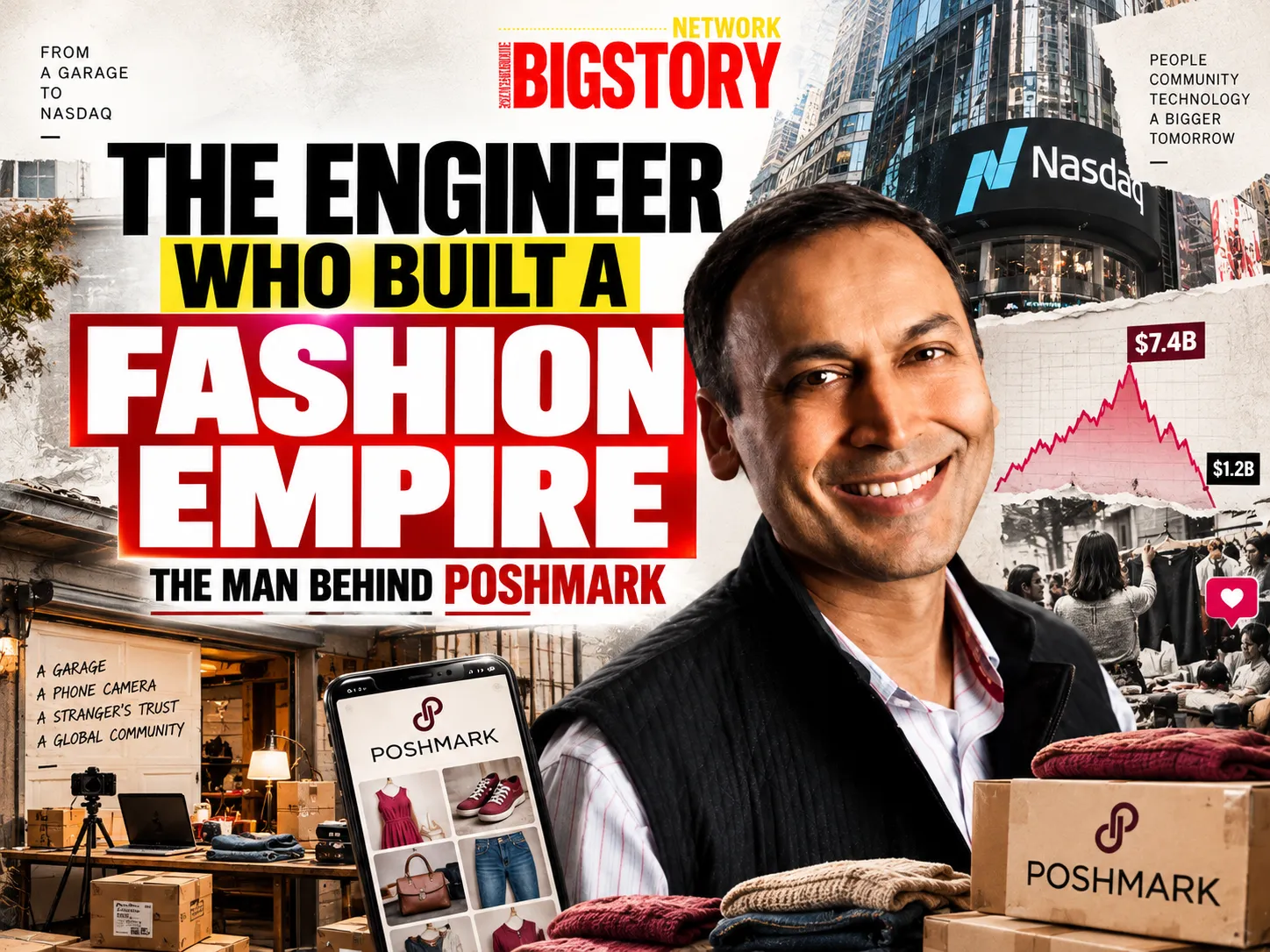
Most founder stories are told backwards: victory first, reasons later. Manish Chandra’s refuses that shape. He was an enterprise-software engineer who walked into fashion, an industry with every reason to shut the door on him. He built anyway. He is a Challenger because he never waited to look like the obvious choice.
He turned a garage, a phone camera and a stranger’s trust into a Nasdaq-listed company, then handed over the keys with grace.
Ask people how to sell clothes they no longer wear and you get the same answers: a crowded closet, a weekend yard sale, a listing site that feels like paperwork.
Chandra saw the gap at home. The idea started with the unopened shopping bags his wife had lying around, and the arrival of the iPhone 4 turned that into an opportunity. The phone’s picture quality, released in 2010, convinced him that a new kind of mobile marketplace was possible.
The problem was really two problems. Selling second-hand clothes online was tedious, and trusting a stranger’s photos, measurements and shipping promises was harder still. Chandra’s answer wasn’t a better catalogue. It was a conversation.
Manish Chandra is an Indian-born, Bay Area-based entrepreneur and co-founder of Poshmark, the social marketplace for fashion resale. He founded Poshmark in February 2011 and led it as CEO until October 2025, building a community the company puts at more than 150 million. He remains on the board and as an investor.
Poshmark was founded in 2011 in Chandra’s garage, with co-founders Tracy Sun, Gautam Golwala and Chetan Pungaliya. The model is simple to say and hard to copy. The company holds no inventory, so it carries no unsold-stock risk, and it earns a 20% fee on sales of $15 or more, plus a flat $2.95 below that.
What sets it apart is the behaviour around the transaction: following, sharing, commenting, negotiating. Fortune reported that active users spent about 27 minutes a day on the site. In November 2017 it raised $87.5 million in a Series D led by Temasek, at a valuation near $600 million. By 2021, it had more than 80 million registered users and about $2 billion in gross merchandise value. In April 2023 it added Posh Shows, letting sellers showcase items through livestreams.
Chandra pairs an engineer’s discipline with an unusual instinct for people. He read mobile early: his investor Navin Chaddha recalls that in 2010 Chandra said he would give up his laptop and work only on his iPhone. He treats loyalty as strategy, too. Golwala and Pungaliya worked under him at Kaboodle before joining him at Poshmark.
He also built culture around a creed. His stated mantra is that focusing on love makes everything happen, while focusing on money makes nothing happen. A technologist who designs for feelings is rare.
Chandra grew up in India, where he spent summers in his grandfather’s wholesale shop, packing boxes and watching deals get made. He earned a B.Tech in Computer Science and Engineering from IIT Kanpur, then an M.S. in Computer Science from the University of Texas at Austin in 1987.
His enterprise career ran through Sybase, Versata and Versant. Then came Kaboodle, an early social-shopping site he led as CEO until Hearst Communications acquired it in August 2007. Every stop was a rehearsal for Poshmark.
1. Credibility. By his own account, investors backed him as a technology founder but hesitated over fashion. His past success had become his limit.
2. Near-collapse at Kaboodle. Growth stalled in 2006 and cash ran thin, forcing him to narrow the company’s focus to helping women discover fashion. That pivot planted the seed of Poshmark.
3. Selling an unproven habit. In 2011, few people trusted a stranger’s photos, sizing and shipping for used clothes.
4. Community backlash. When your users are your business partners, every decision is personal. When Poshmark raised shipping fees, users lobbied furiously to lower them, and won.
5. Loneliness at the top. On an alumni podcast, Chandra described a stressful stretch, the best and worst of times, when he didn’t know who would understand. He walked around the building and had a good cry, then went back to work. Founders don’t have to cry. But it helps to know the good ones sometimes do.
6. Public-market whiplash. Poshmark priced its IPO at $42. Less than two years later, the company agreed to sell at a much lower price.
Manish Chandra’s goal was never just a marketplace. In his own words, it was to bring the social and personal feel of in-person shopping into a vibrant digital space.
The public proof came on January 14, 2021. Poshmark priced its IPO at $42, an initial valuation above $3 billion, and closed its first day up more than 141%. AP put its market value at $7.4 billion.
The story didn’t end at the peak. In October 2022, Naver agreed to buy Poshmark for $17.90 a share in cash, an enterprise value of about $1.2 billion. The deal closed in early 2023. The valuation fell from the IPO high. The community he built did not.
On October 1, 2025, Namsun Kim, previously executive chairman, took over as CEO, and Chandra moved to a strategic board role. The company said that with the Naver integration complete, he was closing the chapter to focus on family. He said he’d stay on as a board member and investor, and as Poshmark’s biggest cheerleader. The founder becomes the patron. That is a harder pivot than any product launch.
The typical story celebrates the one born for the industry. Manish Chandra wasn’t. He was an engineer from India, fluent in databases and enterprise software, who entered fashion when others said he didn’t belong.
He worked out of a garage. He trusted people over products. He made strangers’ closets into a community. Other stories stop at the valuation. His includes the near-miss at Kaboodle, the angry sellers and the quiet walk around the office.
The outsider is never behind. The outsider just sees what everyone else has stopped seeing.
There's a certain kind of clarity that only comes when you watch something you made slip out of your hands.
Manish Chandra didn't wake up one day wanting to build a marketplace. He wanted to bring back a feeling the small, human moment when a seller and a buyer actually connect, even if it's just through a phone screen. That kind of idea usually doesn't come from a business plan. It comes from something personal. Maybe a memory of a real shop, a real conversation, a sale that felt like more than just money changing hands. You don't chase "social commerce" because it sounds good on paper. You chase it because you remember what buying and selling used to feel like before everything became fast, cold, and automatic.
And then the market takes that simple, personal idea and puts a price on it. $42 a share. Over $7 billion. A number so big that it stops feeling personal. It becomes a headline. A milestone. Something other people talk about.
But numbers don't stay still. They rise, and they fall. When Naver offered $1.2 billion years later, it wasn't proof that the original idea was wrong. It wasn't a judgment on Chandra's vision. It was just the market reacting to timing, to conditions, to a hundred things that had nothing to do with whether his instinct was right in the first place.
Here's the real lesson: the valuation was never the vision. It was only ever the market's opinion of it and opinions change. What stayed the same was the community. The people. The connection he actually set out to build.
That's the part that mattered. That's the part that lasted.
 Exclusive Content






Sign up for the Daily newsletter to get your biggest stories, handpicked for you each day.



 Trending Now! in last 24hrs