Discover how a simple kitchen question and a teenage patent led to FreshPaper—a revolutionary, low-cost fix for global food waste. Explore the inspiring journey of Kavita Shukla, turning sharp observation into a sustainable movement. Read the full story on BIGSTORY.
 Rashmeet Kaur Chawla
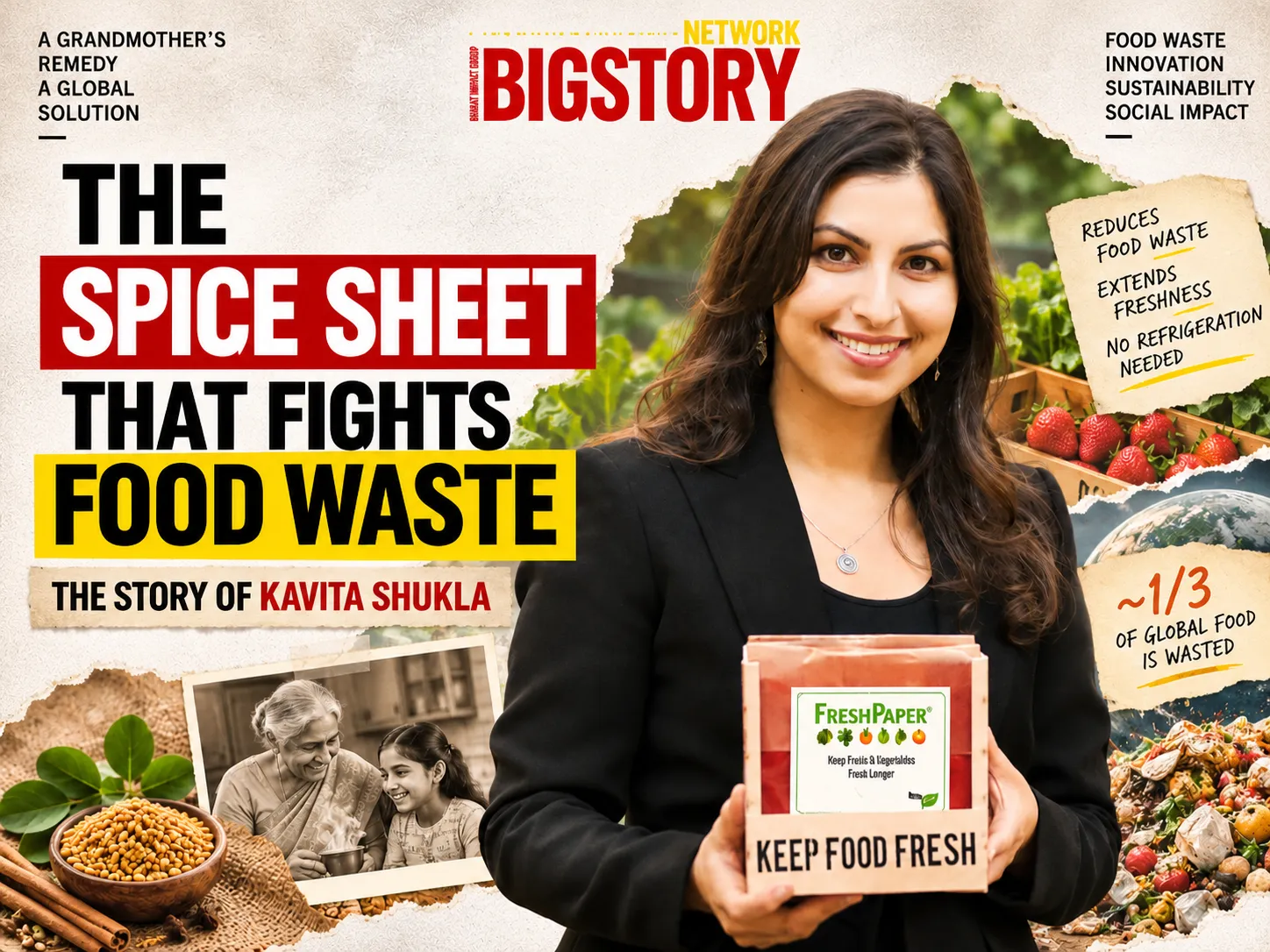
She drank tap water. Visiting her grandmother, she rinsed her mouth with it, and the family braced for a stomach illness. Her grandmother did not run for a pharmacy. She brewed a tea of spices, fenugreek among them, and made sure the girl drank it. Shukla did not fall sick. Most children file that away as a family story. She asked a question instead: why did it work?
Here is the problem her question eventually collided with.
According to the UN Food and Agriculture Organization, roughly one third of the food produced for human consumption is lost or wasted globally. Meanwhile, about 1.6 billion people have no reliable access to refrigeration, the figure Shukla has cited in her own advocacy.
Food does not only go missing because we grow too little. It goes missing because we cannot keep what we grow. Strawberries soften, greens wilt, and a farmer's season of work rots in a crate. That gap, between hunger and waste, is where Kavita Shukla built her career.
Kavita Shukla is the inventor of FreshPaper, a spice and-botanical infused sheet that slows spoilage in fruits and vegetables. She is the founder and CEO of The FRESHGLOW Co., the company formerly known as Fenugreen. She holds four patents and a Harvard BA, and her work has been recognised by the INDEX: Design to Improve Life Award, widely described as the world's largest design prize.
Kavita was born in Germany and grew up in the United States, in Ellicott City, Maryland. Her extended family lived in India, so trips to see her grandmother were precious and infrequent. That distance mattered. Her grandmother's kitchen was less a place of recipes than a living archive of remedies passed down by habit.
She was not a one-note science student. The Lemelson-MIT programme profiled her as a violinist and Indian dancer as well as an inventor, a reminder that curiosity rarely comes in a single subject.
Shukla was born in Germany and grew up in the United States, in Ellicott City, Maryland. Her extended family lived in India, so trips to see her grandmother were precious and infrequent. That distance mattered. Her grandmother's kitchen was less a place of recipes than a living archive of remedies passed down by habit.
Shukla was not a one-note science student. The Lemelson-MIT programme profiled her as a violinist and Indian dancer as well as an inventor, a reminder that curiosity rarely comes in a single subject.
A discovery is not finished when it works. It is finished when it reaches someone who needs it. That belief shaped everything, including the company's mission, "Fresh for All."
The public version of this story skips a painful middle chapter.
After high school, well-meaning people advised Kavita to let the idea go.
She took a research job and tried to move on, but, as profiles of her journey note, she could not get FreshPaper out of her mind.
In her TEDx talk, she has spoken openly about how her own doubt, more than any competitor, kept the invention out of the world for years.
That is worth sitting with. Many founders imagine their biggest obstacle is money or market. For her, the first obstacle was permission she was waiting to give herself.
The turning point was not a funding round. It was a kitchen table. Together with Dr. Swaroop Samant, a physician friend and co-founder, Shukla made roughly 1,000 sheets by hand and took them to farmers' markets in the Cambridge and Boston area. Reported start-up spend was around $150 for spices and papermaking supplies.
She listened more than she sold. Growers told her what spoiled first. Shoppers told her what they would pay. Fenugreen was formally founded in 2010, and the product began to take shape through that feedback.
Simple products face a strange problem. They are easy to dismiss. Kavita had to prove that a sheet of paper could change the shelf life of produce, and she had to do it without revealing the recipe that made it work.
There is also a claims problem. The company states FreshPaper can keep produce fresh two to four times longer, but that is the company's own figure. Results vary by produce type, and FreshPaper is not a replacement for refrigeration. BigStory notes this clearly because trust is part of the story.
Then there is distribution. Getting a low-cost product from a farmers' market into retail shelves and into regions like Malawi and Haiti, where Fenugreen worked with farmers, takes patience that no patent can supply.
A good story is not automatically a true one, so here is what independent records support:
• 2002: Lemelson-MIT High School Invention Apprenticeship winner.
• 2011: Fenugreen named grand prize winner of the Kauffman Foundation's Startup Open competition.
• 2013: Winner of the INDEX: Design to Improve Life Award, with prize money of 100,000 euros.
• 2014: Named to Forbes' 30 Under 30 list, and featured by Fast Company among entrepreneurs changing the world.
• 2016: Invited to the Nobel Prize Dialogues in Sweden to speak on the future of food.
• Today: Founder and CEO of The FRESHGLOW Co., a social enterprise whose products are sold online and through major retailers.
Most start-up stories chase scale, speed and spectacle. Kavita built on restraint.
• No electricity, no app. FreshPaper costs a few dollars and works by dropping a sheet into a produce drawer or fruit bowl. It does not need to touch the produce.
• A trade-secret formula. The exact recipe is not public, though fenugreek is hinted at in the original company name. The sheet is compostable and lasts roughly two to three weeks.
• Buy-one-give-one. For every pack sold, the company donated another to food banks and non-profits.
• Bootstrapped on purpose. Reports note she preferred to keep the company independent so the social mission would not be diluted by investor priorities.
Her approach turns a traditional Indian household insight into a modern consumer product, and credits the source openly.
A twelve-year-old's question over a cup of tea became a patent.
The sharpest minds notice what everyone else overlooks. Spoiled strawberries, limp vegetables, and bare cupboards are usually dismissed as everyday inevitabilities until someone decides they shouldn't be.
Great ventures begin with curiosity, not a business plan. Kavita Shukla didn't set out to launch a company; she just wanted to know why a simple spice tea worked.
True innovation respects inherited wisdom enough to test it. Kavita honoured her grandmother's remedy through rigorous experimentation, while remaining grounded enough to acknowledge where it began.
Meaningful success is measured in meals saved, not merely revenue generated. An affordable sheet of paper that extends shelf life holds more value than countless billion-dollar pitches.
Builders don't wait for permission, titles, or credentials. Kavita secured a patent at seventeen proving it was never about age, only nerve.
In an ecosystem obsessed with complex tech stacks and billion-dollar valuations, it is easy to miss the fact that world-changing innovation often begins with a single superpower: sharp observation.
Most people accept everyday problems as background noise, yet she noticed a simple truth in her grandmother’s kitchen and had the conviction to pursue it. Securing a patent at just seventeen proves that breakthrough thinking does not wait for degrees, grey hair, or industry permission. When sharp observation meets relentless curiosity, age becomes completely irrelevant.
We also chose to share the unvarnished parts of her journey the years of self-doubt, the manual labor at a kitchen table, and the honest limits of her product because real impact deserves real context, not hype.
https://lemelson.mit.edu/resources/kavita-shukla
https://news.mit.edu/2002/lemelson-0605
https://www.kavitashukla.com/
https://www.forbes.com/profile/kavita-shukla/
https://www.coca-colascholarsfoundation.org/blog/december-2016-accolades/
 Exclusive Content


Sign up for the Daily newsletter to get your biggest stories, handpicked for you each day.


 Trending Now! in last 24hrs