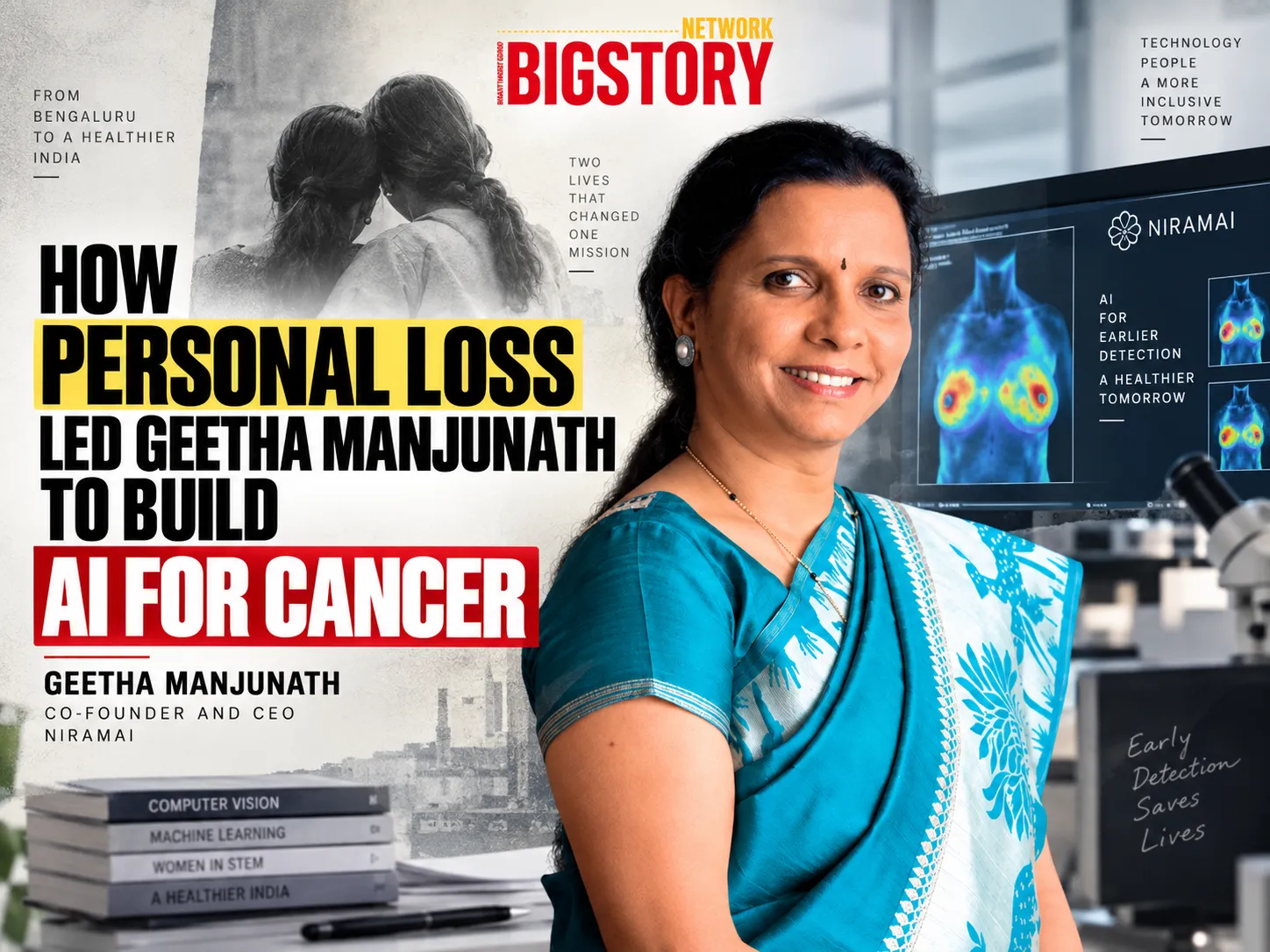
Two people she loved died of breast cancer diagnosed too late. So a computer scientist with no medical background built the machine that could have caught it in time. This is the story of Dr Geetha Manjunath and NIRAMAI.
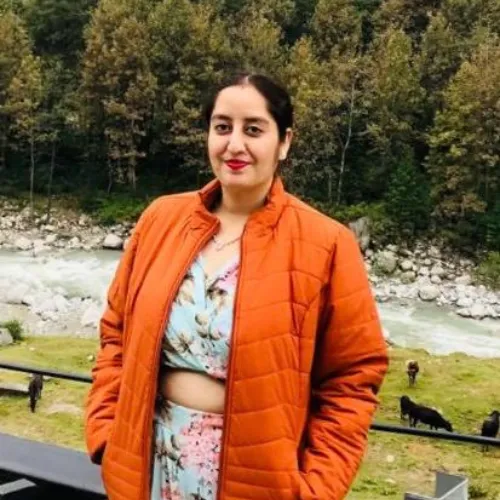 Rashmeet Kaur Chawla
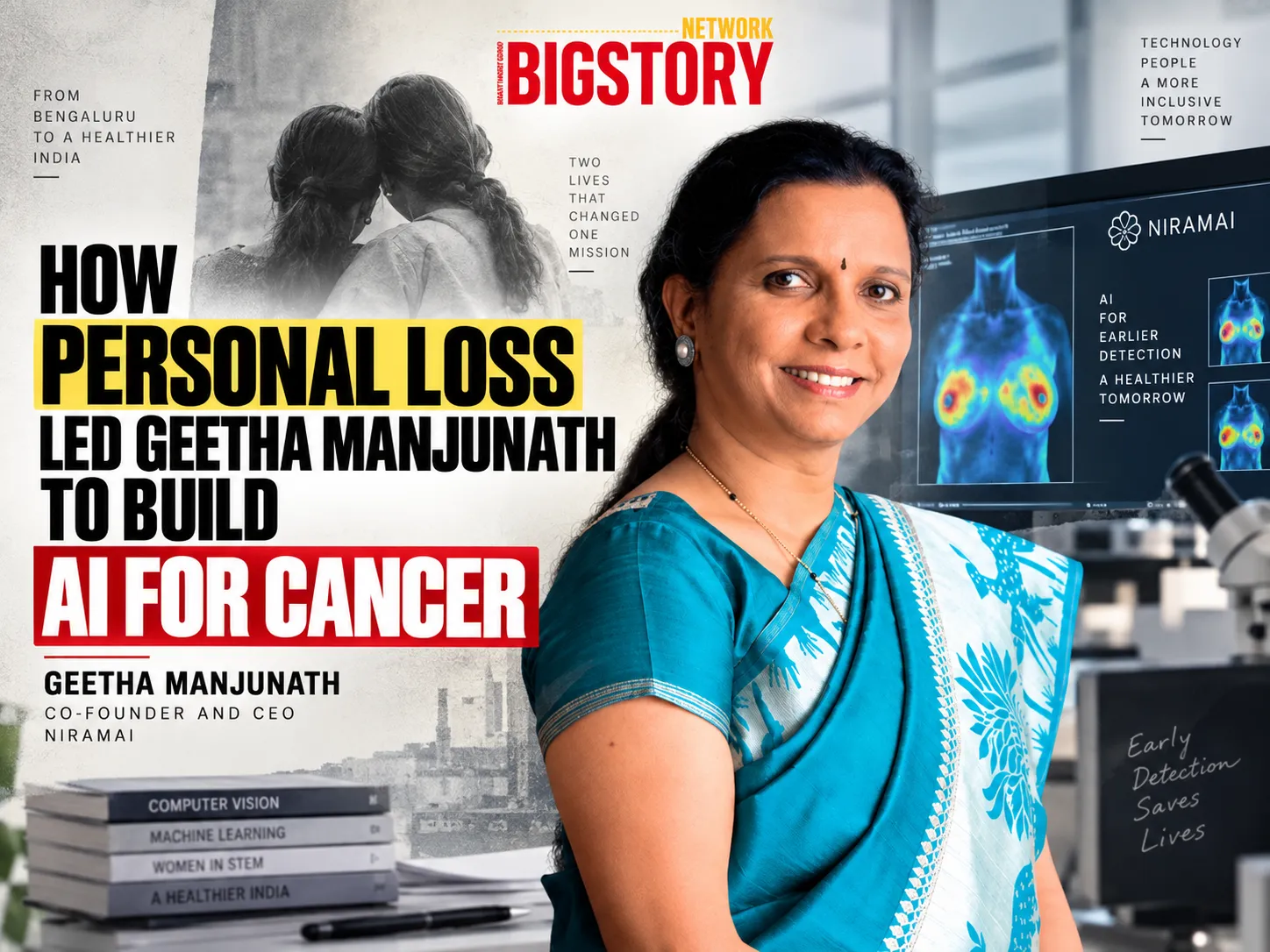
In a laboratory in Bengaluru sometime in 2014, a computer scientist with decades of experience building AI systems for smart cities and customer analytics sat down to analyze a problem she had never analyzed before: breast cancer. She wasn't a doctor. She wasn't an oncologist. She had no formal training in medicine at all.
What she had was a PhD in computer science, a fellowship pedigree from Hewlett Packard Labs, and two people she loved who had just been diagnosed with the disease. By the time she left her job to build a solution for them full-time, both had already passed away.
That loss, filtered through decades of engineering rigour, became NIRAMAI — one of India's best-known health-tech startups. Its founder, Dr Geetha Manjunath, is now regarded as one of the country's most closely watched deep-tech entrepreneurs.
Long before NIRAMAI existed, Geetha Manjunath had already lived a career that no engineer would call unfinished. Born and raised in Bengaluru, she earned her bachelor's degree in computer science from UVCE before moving to the Indian Institute of Science (IISc) for her master's and PhD, where she won the Computer Society of India Gold Medal in 1991 - a marker, even then, that she was one of the sharpest minds of her generation. She later added a management education from Northwestern University's Kellogg School of Management to that foundation.
Her professional path reads like a tour of India's most serious computing institutions. She was part of the C-DAC team that built India's first commercially viable supercomputer. She then spent seventeen years as a Principal Research Scientist at Hewlett Packard Labs, where one of her inventions — a mobile web platform called SiteOnMobile — was internally declared an "HP Legend."
In 2010, years before NIRAMAI was even an idea, she won the MIT Technology Review Grand Challenge Award in the Healthcare Technologists category, a strange piece of foreshadowing for a woman who wasn't yet working in healthcare at all. From there she moved to Xerox India, where she led the Data Analytics Research Lab more than twenty-five years spent solving hard computing problems across transportation, customer experience, and emerging markets, none of it in oncology.
All of it, as it would turn out, was exactly what breast cancer screening in India needed.
Few of her profiles mention this: at eighteen, Manjunath was good enough at both streams to have become a doctor instead of an engineer, ranking in the top twenty of Karnataka state in both the engineering and medical entrance exams. Medicine, at the time, was the more prestigious and more pressured choice. She chose engineering anyway, with her father backing her decision against considerable social pressure to pick a medical seat. Three decades later, she built a company that sits precisely at the intersection of the path she chose and the one she didn't using engineering to do what a doctor's stethoscope alone cannot.
The origin of NIRAMAI is simple to state and hard to sit with. While running an AI healthcare project at her workplace, two people close to Manjunath were diagnosed with breast cancer. In interviews since, she has described one of these as a 38-year-old cousin whose cancer was caught only at a late stage a detail that would go on to shape everything about how NIRAMAI was eventually designed.
She threw herself into research on the disease, consulting friends and colleagues in medical imaging. With her employer's support, she assembled a small team and began working on the problem on the side. Within about a year, the early results looked promising. Around the same time, both people she had watched go through the disease died.
Most researchers would have closed the file at that point published a paper, filed the learnings, moved on. Manjunath didn't. Her decision wasn't about turning a promising dataset into a startup opportunity; it was about getting an unfinished solution out of the lab and into the hands of women who hadn't been diagnosed yet. That single decision is the hinge on which this entire story turns.
NIRAMAI Health Analytix was co-founded in 2016 by Manjunath and Nidhi Mathur, both veterans of HP Labs and Xerox Research. Even the company's name carries a double meaning: it's an acronym for "Non-Invasive Risk Assessment with Machine Intelligence," and also the Sanskrit word for "disease-free."
The company's Thermalytix technology uses high-resolution thermal imaging, interpreted by proprietary machine learning algorithms, to screen for early breast cancer without radiation, without physical contact, and without a radiologist needing to be present during the scan.
That third point matters more than it first appears. Standard mammography is usually recommended only for women over 45, requires expensive equipment and trained technicians, and performs poorly on the denser breast tissue common in younger Indian women. Thermalytix was built specifically to route around all three limitations. According to Manjunath, the system can detect tumours as small as 4 millimetres roughly five times smaller than what a clinical exam can catch at around a fifth of the cost.
The company's growth has tracked its clinical credibility rather than its headlines. A roughly $1 million seed round came in 2017 from Pi Ventures, Ankur Capital, Axilor Ventures, and Flipkart co-founder Binny Bansal. A Series A of over $6 million followed in 2019, led by Japan's Dream Incubator with participation from BEENEXT, taking total funding past $7 million. By that point, NIRAMAI's screening systems were deployed across more than twenty hospitals and diagnostic centres in nine Indian cities, and the company became the only Indian startup to make CB Insights' AI 100 list that year. When the pandemic hit in 2020, the team adapted Thermalytix to detect fever and respiratory illness proof the underlying technology could flex without losing its purpose.
NIRAMAI's patent portfolio didn't stop at cancer detection. One of its granted Indian patents extends Thermalytix to assess breast health and lactation readiness in pregnant and new mothers a use case that has nothing to do with the company's founding tragedy and everything to do with how far the core technology can reach once it exists.
From researcher, to healthcare entrepreneur, to public voice on a problem most people would rather not discuss. She won the BIRAC WinER Award in 2018, made Forbes' Top 20 Self-Made Women in India list in 2020, was named Women Entrepreneur of the Year by BioSpectrum India, and received the Accenture Vahini Innovator of the Year award from The Economic Times. She has also won the Women Health Innovation Showcase Asia award in Singapore a detail that rarely makes it into her more widely circulated bios.
Go back further and the pattern holds: she won Karnataka's TR Shamanna State Award in 1989 and was named among NASSCOM's Top 50 IT Innovators in 2009 seven years before NIRAMAI existed, evidence that the recognition wasn't new, only redirected.
She holds more than fifty US patents, is a Senior Member of the IEEE, and a Fellow of the Indian National Academy of Engineering one of the most selective honors available to a practicing engineer in the country. These aren't the credentials of someone who stumbled into a good business idea. They're the record of a scientist who spent a career building an exact skillset, then chose, quite late, to point it at a single disease.
Speaking at YourStory's SheSparks event in Bengaluru in 2025, Manjunath opened not with a technical point but a conviction-driven one: where there's a way and passion, things get done, she told the audience. It's a quieter version of the entrepreneurship myth than Silicon Valley usually sells no garage, no manifesto, no dramatic pitch deck. Just a scientist who watched a disease take people she loved, and decided her years of building intelligent machines weren't going to sit unused.
Most founder stories move down one of two roads: the dropout who spots a market gap, or the executive who trades security for scale. Geetha Manjunath's story does neither. She didn't walk away from a secure job chasing a dream she walked away because of two names she couldn't save in time, and built a company so that list would never grow. Her authority in this space doesn't come from an entrepreneur's instinct to disrupt; it comes from more than two decades spent mastering the exact discipline her company now depends on. And her credibility, in an industry full of unproven claims, rests on clinical validation, hospital adoption, and recognition from an international AI research body not on a pitch.
India needs more of a specific kind of founder: someone who never planned to start a company, and did it anyway because leaving a solvable problem unsolved wasn't an option. Geetha Manjunath is that founder. NIRAMAI's success isn't just a health-tech win story - it's what happens when someone spends a career building a very specific set of tools, and then finally finds the one problem worth pointing them at.
Every profile in this series asks the same question: What part of reality was this person unwilling to accept?
For Geetha Manjunath, it was a diagnosis that arrived too late, twice over. Most startup stories begin with an opportunity. Hers begins with a loss she couldn't undo, and a resolve that it wouldn't repeat itself for anyone else. That contrast is exactly what this series exists to surface.
What sets this story apart from the others we've told isn't the funding raised or the awards won — impressive as both are. It's the order in which they happened. Manjunath didn't go looking for impact. She created it first, quietly, in someone else's lab, long before there was a company name, a pitch deck, or a founder identity attached to any of it.
Most founders in this series made a smart decision. Manjunath made a promise she never said out loud.
She watched two people she loved go through breast cancer. She watched them get diagnosed too late for it to matter. And instead of grieving quietly and going back to her research, she built the thing that could have saved them if it existed sooner.
Her seventeen years at HP Labs, her decades in engineering none of that is background information. It's the reason NIRAMAI works at all. She didn't become an entrepreneur because she wanted to build a company. She became one because she couldn't sit with a solvable problem and do nothing.
Very few people in this series came to this work so late, so reluctantly, and so ready.
 Exclusive Content



Sign up for the Daily newsletter to get your biggest stories, handpicked for you each day.



 Trending Now! in last 24hrs