From flipping burgers in the UK to challenging McDonald's in India. Read how Kabir Jeet Singh built Burger Singh into a national brand with 175+ outlets.
 Rashmeet Kaur Chawla
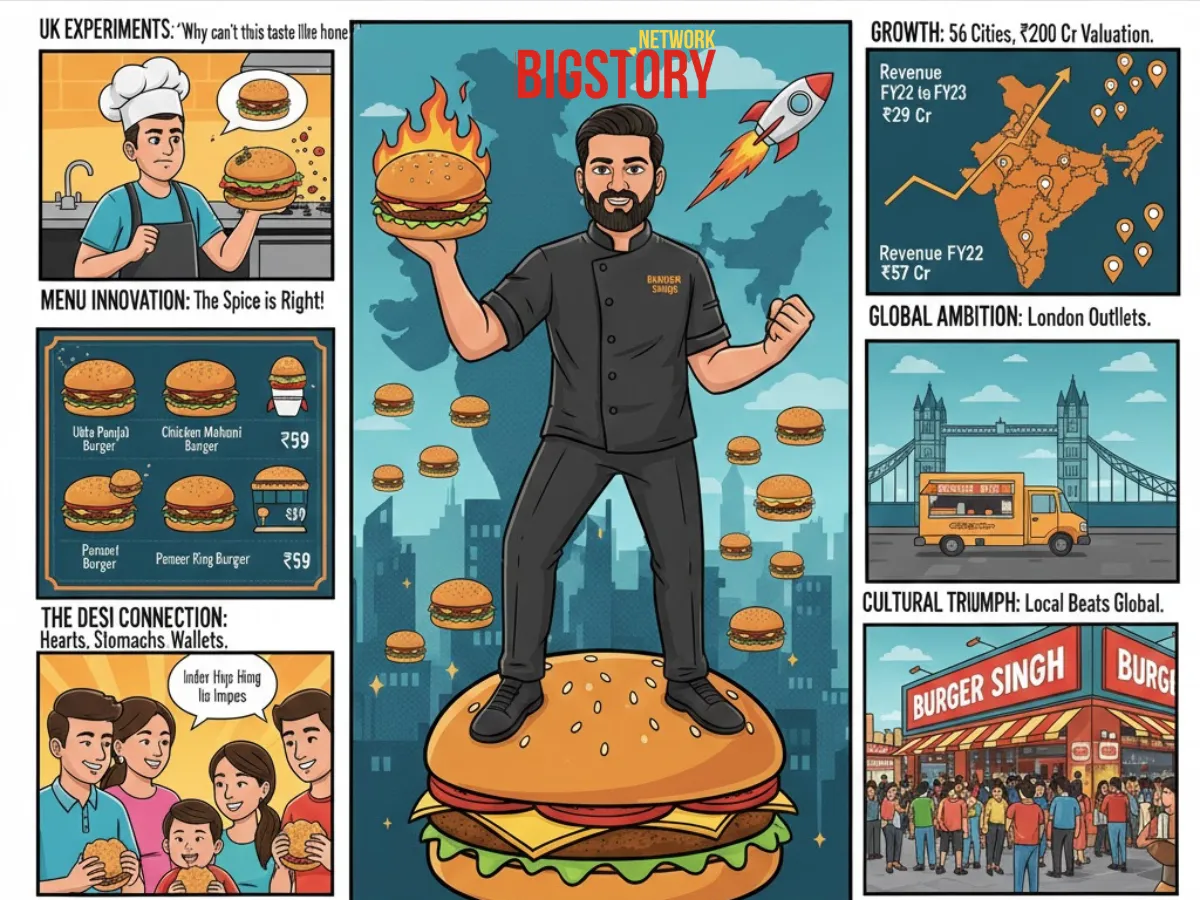
“Why can’t this taste like home?” That question haunted Kabir Jeet Singh as he flipped bland patties at a UK burger joint during his student days.
While most students were content with part-time paychecks, Kabir saw something deeper—a massive gap in the fast-food market that giants like McDonald’s and KFC hadn’t filled. In India, Burger King was at a critical turning point 2019. Store closures accelerated, customer footfall plummeted, and the brand that once promised flame-grilled superiority was getting torched by competitors. The Indian market, with its complex tastes and ruthless competition, had chewed up and spit out multiple international brands. But Kabir Jeet Singh wasn’t thinking about rescue plans—he was orchestrating a revolution.
One Man’s Refusal to Let India’s Appetite for Innovation Go Unfed
While McDonald’s dominated with localization and KFC conquered with chicken, India’s burger landscape needed a homegrown disruptor. Kabir Jeet Singh didn’t just save a struggling franchise concept — he created Burger Singh, India’s boldest desi burger rebellion that rewrote the rulebook on how Indian brands could challenge global giants and win hearts, stomachs, and wallets.
Kabir Jeet Singh is the founder and CEO of Burger Singh, India’s homegrown QSR challenger that turned Indian-spiced burgers into a national phenomenon across 56 cities. A former General Manager at Pint Room with degrees from a top UK university, Kabir represents the middle-class dreamer who revolutionized India’s burger game through spices, strategy, and sheer audacity.
His journey began not in boardrooms, but flipping burgers at a part-time job in the UK during his student days. While his father warned him about “flipping burgers for the rest of your life” if he didn’t focus on his master’s degree, Kabir saw something different—an opportunity to transform the monotonous, bland burger experience into something authentically Indian.
That simple observation during his UK stint would eventually birth a ₹200 crore brand challenging billion-dollar multinationals.
Currently, as Burger Singh CEO, he leads India’s most authentic challenger to global fast-food dominance, proving that homegrown doesn’t mean inferior—it means understanding your market better than anyone else.
When Singh was working his part-time gig in the UK, he inherited a different kind of nightmare — daily monotony. Kabir bagged his degrees from a top UK university, but the idea of burgers still lingered in his mind—not the bland ones he was forced to serve, but something revolutionary.
The numbers told a brutal story back in India: international chains had inconsistent quality across outlets, menus that felt alien to Indian palates, pricing that missed the mark for value-conscious consumers, and marketing strategies that spoke American to an Indian audience. The fundamental question haunting aspiring entrepreneurs was simple yet existential: Could an Indian brand compete with billion-dollar QSR giants, or was the market already lost?
That nagging voice whispered constantly: “Am I crazy competing with giants?”
Singh’s belief system became the foundation of what would become Burger Singh. He operated on three unwavering principles that would define his entire strategy.
First, he believed that Indian consumers didn’t want diluted American experiences—they craved authentic desi flavors delivered through a brand that understood them. Second, he understood that affordability wasn’t about being cheap; it was about delivering uncompromising value. Burgers under ₹39 weren’t just affordable—they were democratizing premium taste. Third, and perhaps most revolutionary, he believed that local innovation could beat international imports.
As he would later say: “Craft burgers: similar to craft beer, but we put some spice in it.”
These weren’t just business philosophies; they were battle cries. When everyone told him to stay safe, when giants controlled the QSR market, Kabir inquired: “What if the Indian touch wins hearts?”
The UK Experiments: Where Revolution Was Born
During his UK stint at the burger joint, Kabir got down to experimenting—he sprinkled Indian spices on the patties. The transformation was electric. Friends loved it so much they started calling him “Burger Singh.” That nickname would become a brand worth ₹200 crore.
Being a thorough researcher, Kabir studied taste profiles, pricing psychology, and the gaps in India’s QSR landscape. He realized desi flavors might just trump McDonald’s — but could he do it with limited capital? The idea simmered until he made his mad dash back to India.
Singh’s strategy unfolded like a military campaign with precision strikes across multiple battlegrounds.
With ₹40 lakh in initial investment and a powerhouse team, Burger Singh launched in 2014. His focus was laser-sharp: bold flavors, vegetarian options, and prices under ₹39. They concocted tikka patties with makhani sauce, cheesy Udta Punjab burgers, and later even innovated with momos — unusual, reasonably priced, and pleasing to Indian palates.
Kabir built a founding team that brought together deep, complementary expertise across operations, marketing, finance, and execution. Nitin Rana contributed 14 years of experience from global QSR giants like KFC and Pizza Hut, embedding operational discipline and scale-ready systems. Rahul Seth led marketing and technology, decoding digital-first consumer behavior in a rapidly evolving food economy. Ajaypal Rathore ensured financial rigor through sustainable unit economics, while Ayush Kumar, an IIT Delhi alumnus, streamlined operations with process-driven efficiency. This was not merely a founding team—it was a deliberate challenge to conventional wisdom in the QSR ecosystem.
The BK Veggie and Chicken Makhani concepts weren’t afterthoughts they were flagship innovations. The Paneer King and Tandoori Grill range weren’t compromises; they were celebrations of Indian flavors. Pure veg options in Gujarat showed hyperlocal understanding. This wasn’t fusion; it was fusion done right with Indian soul at its core.
The introduction of aggressive value offerings under ₹39 positioned Burger Singh as accessible premium. Singh understood the Indian consumer’s psychology — they wanted to feel smart about their spending, not just satisfied with their meal. This pricing strategy delivered more value than McDonald’s while maintaining quality.
Against conventional advice to consolidate, Singh chose speed over caution, pushing Burger Singh into rapid expansion across the country. From a single outlet, the brand scaled its presence to 56 cities across 14 states, deliberately entering tier 2 and tier 3 markets where larger competitors were still assessing risks. Strategic warehouses on the east and west coasts strengthened supply chains and accelerated deeper market penetration. The brand also tested its global appeal with an international launch in London, opening three outlets and a food truck to validate overseas demand. A franchise-heavy model enabled swift scaling in the early years, followed by a strategic pivot to an asset-light approach that balanced growth with sustainability. This geographical audacity gave Burger Singh a foothold in markets where established giants hesitated to tread.
Branding became one of Burger Singh’s sharpest weapons. With fun, irreverent, and unmistakably Indian campaigns, the brand rejected safe, generic messaging in favor of cultural confidence. From “Udta Punjab” burgers to Bollywood-inspired product names, Burger Singh built an unapologetically desi voice while retaining a premium feel. This out-of-the-box, low-cost branding strategy cut through the clutter, proving that authenticity and cultural resonance could outperform large advertising budgets.
Singh’s most significant achievement wasn’t any single strategy—it was proving Indian innovation could challenge global dominance.
He shut down the nagging voice of doubt by accumulating solid, indisputable evidence. By his actions, he demonstrated that desi innovation is superior to imports—a difficult but correct path.
Franchisees who initially hesitated began demanding expansion opportunities. Employees became brand evangelists. Investors who saw saturated markets started seeing blue ocean opportunities. This mindset shift rippled across India’s startup ecosystem.
By 2022-23, Burger Singh had achieved remarkable financial momentum:
- Revenue doubled: ₹29.1 crore (FY22) to *₹57.92 crore (FY23)
- Series A funding (July 2022) at valuation of *₹200 crore*
- Expanded from single outlet to *56 cities across 14 states*
- International presence with London outlets proving concept portability
But beyond metrics, Singh had achieved something more valuable: cultural relevance. Burger Singh became synonymous with desi pride in fast food. It became the credible Indian alternative in what had been a foreign-dominated market.
The journey wasn’t linear. The franchise model experienced supply chain issues causing some store closures. Unit economics faced cash burn challenges. But every setback became a learning opportunity. The pivot to an asset-light strategy—owning fewer outlets, partnering more—represented strategic maturity. Instead of trying to beat giants at their own game, Singh created a new playbook: franchise-efficient growth with tight supply chain control.
Currently moving towards profitability through smarter expansion, focusing on sustainable unit economics rather than vanity metrics.
Today, Burger Singh stands as India’s homegrown QSR challenger with:
- National footprint across diverse markets from metros to tier 3 cities
- Menu innovation continuing with momos and seasonal specials
- Strong unit economics in optimized locations
- Proven model for hyperlocal adaptation (pure veg in Gujarat, regional flavour variations)
- International validation through London presence
Employee morale transformed. Franchisee satisfaction grew. Consumer perception shifted from “experimental startup” to “credible national brand.”
Singh’s journey was marked by a series of hard, often unforgiving challenges that tested both strategy and resilience. Early franchise-led expansion exposed cracks in the supply chain, leading to store closures and forcing painful recalibration. The response was structural—establishing warehouses on the east and west coasts and tightening franchise controls to restore operational stability. Competing against billion-dollar giants like McDonald’s, KFC, and Burger King meant going up against virtually unlimited resources, which Singh countered with speed, cultural intelligence, and sharp pricing advantages. At the same time, the constant tension between rapid growth and sustainable unit economics demanded careful course correction, culminating in a strategic shift toward an asset-light model that reflected maturity and long-term thinking.
Another persistent challenge lay in people, perception, and brand integrity. Building teams that could balance quality standards with local consumer expectations required creating training systems from scratch. Market skepticism—from investors, landlords, and customers—meant the brand had to repeatedly prove that an Indian burger concept could compete at scale. Perhaps the most delicate challenge was maintaining brand consistency while still allowing room for local innovation. Too much standardization risked alienating Indian consumers, while excessive localization threatened to dilute the core identity. Walking this tightrope required constant feedback loops, decisive leadership, and the courage to make unpopular but necessary decisions.
“Craft burgers: similar to craft beer, but we put some spice in it.”
“In India, you don’t just compete for stomach share—you compete for emotional connection. The flame isn’t just about grilling; it’s about the warmth of understanding what Indians want.”
On competition with giants: “What if the Indian touch wins hearts? That’s not a question—that’s our entire strategy.”
On expansion: “Speed creates its own advantages when combined with cultural intelligence. Momentum is a competitive moat that careful planning can never build.”
On localization: “Respecting quality standards while embracing local flavors isn’t contradiction—it’s the competitive advantage that global brands can’t replicate.”
Kabir Jeet Singh’s transformation from UK burger-flipper to founder of a ₹200 crore QSR empire isn’t just a business success story—it’s a BigStory because it challenges fundamental assumptions about Indian entrepreneurship in global-dominated markets.
Burger Singh was built to challenge the very assumptions that sustained them. Kabir Jeet Singh rejected the idea that scale must precede soul, or that Indian consumers would forever settle for diluted global formats.
His manifesto was clear: local understanding beats imported playbooks, cultural intelligence outruns capital, and authenticity compounds faster than advertising budgets. Where incumbents optimized for uniformity, Burger Singh optimized for relevance.
At its core, Burger Singh proved that affordability can feel premium, speed can coexist with quality, and localization doesn’t weaken a brand—it sharpens it. This manifesto wasn’t written in boardrooms; it was written in kitchens, tier-2 towns, franchise feedback loops, and tough strategic pivots. And in doing so, Singh didn’t just build a QSR chain — he built a blueprint for how Indian brands can stand tall in global-dominated markets, not by imitation, but by conviction.
Singh didn’t just create burgers; he created permission for a generation of Indian entrepreneurs to challenge global dominance.
He demonstrated that the right leader with the right mindset can turn “Am I crazy?” into “Watch me prove it.”
The desi burger revolution isn’t just about food—it’s about self-belief, cultural pride, and the audacity to imagine Indian brands on global stages. From UK patties to a national empire spanning 56 cities, with international validation in London, Kabir proved that homegrown doesn’t mean inferior.
- Cultural intelligence and business aggression aren’t opposing forces
- Indian brands can compete with billion-dollar multinationals and win
- A ₹40 lakh investment and big dreams can birth national empires
- “Crazy” ideas executed with conviction create categories
Who is the founder of Burger Singh?
Burger Singh was founded by Kabir Jeet Singh in 2014. He is an Oxford alumnus who famously started the concept while flipping burgers part-time during his student days in the UK.
Is Burger Singh an Indian company?
Yes, Burger Singh is a 100% homegrown Indian QSR (Quick Service Restaurant) chain headquartered in Gurgaon. Despite its name and western format, its menu is entirely engineered for the Indian palate with strong Punjabi influences.
What is the net worth of Burger Singh?
As of late 2024/2025 reports, Burger Singh has a valuation of approximately ₹430 - ₹449 Crore. The company has raised multiple rounds of funding from angel investors and venture capital firms.
How many outlets does Burger Singh have?
Burger Singh has scaled to over 175+ outlets across 75+ cities in India. It is known for its strong presence in North India and its aggressive expansion into Tier-2 cities like Jaipur, Dehradun, and Nagpur.
What is the "Udta Punjab" burger?
The Udta Punjab is one of Burger Singh's signature items. It is a burger featuring a patty infused with liquid cheddar cheese (a "cheese-filled" patty), capitalizing on the Indian love for rich, creamy textures.
Sources
https://www.burgersinghonline.com/about-us/
https://yourstory.com/people/kabir-jeet
https://2247_burgersingh.limetray.com/team
https://www.entrepreneur.com/en-in/author/kabir-jeet-singh
https://startuptalky.com/kabir-jeet-singh-burger-singh-brand-franchise-insights/
https://yourstory.com/video/burger-singh-ceo-on-their-momos-innovation-and-new
https://www.vccircle.com/burger-singh-going-asset-light-to-grow-business-founder-kabir-jeet-singh)
 Exclusive Content
Sign up for the Daily newsletter to get your biggest stories, handpicked for you each day.

 Trending Now! in last 24hrs