he US raid on Venezuela shattered the rules-based order. We analyze the new "Impunity Doctrine," Russia's retaliation, and the existential threat to India's Siliguri Corridor.
 Brajesh Mishra
On the morning of January 3, 2026, the world woke up to a new map. The borders hadn't moved, but the rules that held them in place had vanished.
The execution of "Operation Absolute Resolve" by United States Special Forces was a seismic event that shattered the very foundation of global geopolitics. The forcible extraction of Venezuelan President Nicolás Maduro, transferring him to the USS Iwo Jima to face federal narco-terrorism charges, was far beyond a simple act of regime change.
For nearly a century, the world has operated under the theoretical framework of the United Nations Charter. This framework held two truths to be self-evident: that national sovereignty is inviolable, and that borders cannot be redrawn by force. The events of January 2026 have replaced this framework with a new, terrifying truth that most failed to see clearly until now: Modern Day Imperialism.
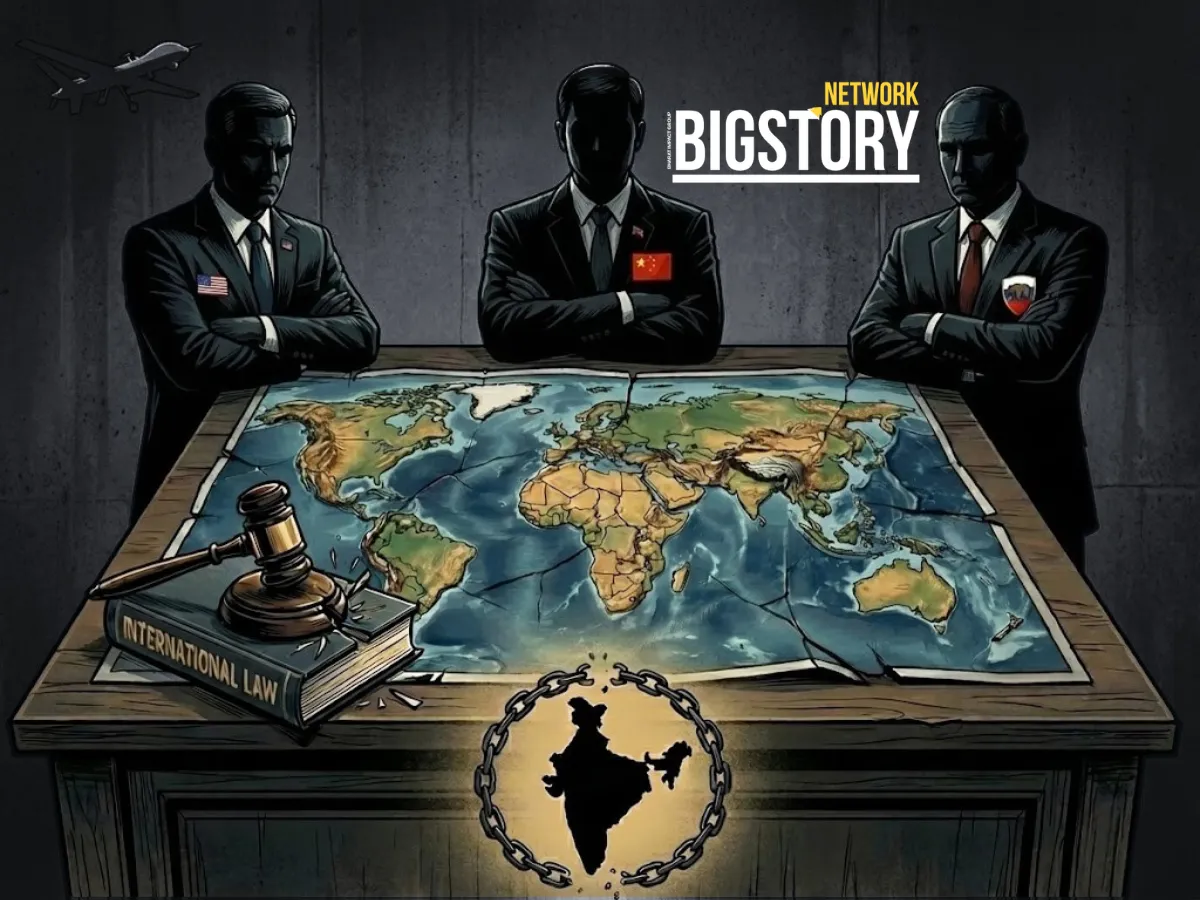
In this new era, international law is no longer a binding constraint; it feels more like a rhetorical tool, available only to those with the power to enforce it. The raid was not an anomaly; it was an announcement. It signaled to friend and foe alike that the "Rules-Based Order" has been formally rescinded, replaced by a system where the definition of "criminal" is determined solely by the capability of the prosecutor's air force.
This report analyzes the seismic shifts triggered by the Venezuela operation. We will explore the weaponization of domestic law to bypass sovereignty, the collapse of regional security in South America, the opportunistic acceleration of Russian and Chinese objectives in Eurasia, and the existential encirclement of India—the silent, paralyzed victim of this new imperial age.
To understand why this moment is different, we have to look backward. We have to stop pretending that the United States views Latin America as a collection of sovereign partners. For over two centuries, Washington has viewed the region through a single lens: as a strategic contiguous zone—a "backyard" defined by the Monroe Doctrine of 1823.
But what happened in Caracas isn't just history repeating itself. It is a mutation.
Originally, the Monroe Doctrine was a "Do Not Enter" sign for European empires. But by the 20th century, it had morphed into an ownership title. We saw the "Gunboat Diplomacy" of the 1920s, where Marines occupied customs houses to collect debts. We saw the Cold War shadows of the 1970s, where the CIA quietly propped up dictators to keep the peace.
The events of 1989 ushered in a new era. What we just saw was prefigured by the Panama invasion to capture Manuel Noriega, though even that was a complicated affair. Involving 27,000 soldiers, city fighting, and civilian casualties, it gave the appearance of a traditional war.
"Operation Absolute Resolve" was quite the contrary. It didn’t look like a war; it looked like a corporate takeover.
There was no massive invasion force, no occupation of the capital. It was a hyper-kinetic, surgical extraction designed to alter the political trajectory of a nation in a single night. This is the arrival of "Selective Aggression." The US is done with "nation-building"—that expensive, failed project of the post-9/11 era. Now, we are in the era of "Asset Stripping."
The most chilling part of this new playbook isn't the helicopters; it's the accounting.
Following the raid, the administration declared a "Provisional Administrative Decree" over Venezuela’s oil sector. The justification? To "reimburse" the United States for the cost of the operation and to settle outstanding debts.
Think about what that means. Washington has effectively resurrected the colonial receivership model of the early 1900s, but updated for the 2020s. The message to the world is stark: Sovereignty is conditional. If you are deemed a "failed state" or a "criminal enterprise," your national resources are no longer yours—they are assets liable to be seized by the hegemon to pay for its own intervention.
And if you look at it, this isn't the policing of the world but the foreclosure of a country. If you think this legal alchemy is limited to the Caribbean, you aren't paying attention to what's happening in Eastern Europe or the Taiwan Strait.
The most significant innovation of "Operation Absolute Resolve" was not the military hardware used to execute it, but the legislative software that justified it.
For the first time in modern history, a superpower did not declare war on a rival state; it simply "indicted" it.
The operation’s legal foundation was constructed months in advance through the "Banning Operations and Leases with the Illegitimate Venezuelan Authoritarian Regime Act" (BOLIVAR Act, H.R. 825).
While publicly sold to the American voter as a sanctions package, the Act fundamentally redefined the legal status of the Venezuelan state. By codifying the Maduro administration not as a government but as a "criminal enterprise," the US Congress stripped the regime of its Westphalian sovereign immunity.
This "lawfare" created a permission structure for the use of force. By formally designating the Venezuelan leadership as "Narco-Terrorists" and the state apparatus as the "Cartel of the Suns" (a Foreign Terrorist Organization), the US Department of Justice effectively expanded its jurisdiction extraterritorially.
The raid was not an invasion; in the eyes of US law, it was the service of a federal arrest warrant.
The "Impunity Doctrine" This invokes a new and dangerous precedent in international law. The Impunity Doctrine suggests that if a Great Power designates a foreign government as criminal, the protections of sovereignty are null and void. This creates a terrifying loophole: Any nation can now theoretically justify an invasion by first criminalizing its adversary’s leadership in its own domestic courts. It replaces the "Right to Protect" (R2P) with the "Right to Arrest."
Following the extraction, the US established a "Petro-Protectorate" over PDVSA, Venezuela's state oil company. The "Trump Corollary"—the assertion that the US will manage these assets to "reimburse" itself for the operation—is a revival of the colonial receivership model.
This move explicitly decouples China and Russia from Venezuelan energy reserves, canceling billions in loans and contracts signed by the previous regime. It sends a message that is both economic and military: In the new order, to the victor go the barrels.
While the West celebrates the removal of a dictator in Caracas, the true cost of the operation is being paid in Eastern Europe and the Taiwan Strait. The raid didn't just remove a piece from the board; it rewrote the rulebook for America’s primary adversaries.
Vladimir Putin’s silence in the days following the raid was not hesitation. It was validation.
For years, Moscow has sought a tacit "Realist Trade": You secure your sphere of influence in the Americas, and I secure mine in Eurasia. By executing a regime change in its own backyard, the US inadvertently signaled to the Kremlin that the "Green Light" was on.
Just 48 hours after the Venezuela operation, the Russian Air Force shifted its strategy in Ukraine from general attrition to kinetic strangulation. Abandoning the terror bombing of energy grids, they initiated the "Gauge War."
Utilizing hypersonic Kinzhal missiles, Russian forces struck the Sknyliv Station near Lviv with surgical precision. Sknyliv is not just a train station; it is the "dry port" where the European standard-gauge railway (1,435 mm) meets Ukraine’s Soviet-era broad-gauge (1,520 mm). By destroying the transshipment yards at this specific junction, Russia severed the logistical umbilical cord that connects Ukraine to Poland.
The result is a logistical cardiac arrest. Western heavy armor and grain exports are now bottled up at the border, unable to cross the "gauge gap." This is the "Caracas Dividend": a Russia emboldened to execute a strategy of total economic choking, knowing the Global Policeman has lost the moral authority to stop it.
The People’s Republic of China views the events of 2026 through a lens of deep paradox. Beijing knows that the American war machine is dangerously tethered to its own supply chains.
In November 2025, the US slashed the "Fentanyl Tariff" on Chinese goods from 20% to 10%. Why? To secure the flow of critical minerals. This reveals the "Economic Paradox": The F-35 Lightning II fighters that flew air cover over Caracas rely on AN/APG-85 radars, the "eyes" of the jet. These radars are built using Gallium Nitride (GaN)—a material whose global supply chain is 90% controlled by China.
The US military machine cannot function without the acquiescence of its primary rival. China retains the "kill switch" with the ability to revoke export licenses for Gallium at any moment, grounding US production lines.
More dangerously, the PLA is adapting the "Venezuela Precedent" for Taiwan. If the US can justify a military intervention as a "law enforcement action" against "Narco-Terrorists," China has found its blueprint.
Beijing is now positioned to reframe a future blockade of Taiwan not as a war, but as a "Customs Enforcement Quarantine." By labeling Taiwanese leadership as "separatist criminals" engaged in "arms smuggling," the China Coast Guard can implement a blockade under the guise of policing domestic crime. The US has provided the legal script; China simply needs to change the actors.
Amidst these global convulsions, the Republic of India finds itself in the most precarious position of any major power. The collapse of international norms has coincided with a physical tightening of the noose around India’s borders.
While the world’s eyes were fixed on the Caribbean, a quieter but far more dangerous crisis was unfolding on India's Eastern Flank.
The most immediate threat lies in the revitalization of the Lalmonirhat Airbase in Bangladesh. Once a derelict World War II airstrip, it has been rapidly modernized by the interim government in Dhaka, backed by Chinese infrastructure investment and—crucially—Pakistani logistical support.
The geography is terrifying. Located less than 15 kilometers from the Indian border, this base effectively eliminates the concept of "strategic warning."
The vulnerability of the Siliguri Corridor: the narrow 22-kilometer strip connecting Northeast India to the mainland, is no longer theoretical. War-gaming scenarios conducted in the wake of the base’s operationalization paint a grim picture of what a "Customs Quarantine" or limited conflict would look like.
In less than a week, the "Seven Sisters" would be effectively de-mechanized with civilian transport grounded, power grids failing, and the military isolated from its supply lines, all before a single tank crosses the border.
Given this existential threat, why has New Delhi remained so conspicuously silent on the US intervention in Venezuela? Why offer only a muted expression of "deep concern" while BRICS partners like Brazil and South Africa scream about sovereignty?
The answer lies in the "Diplomatic Bind." India’s silence is the currency of its survival.
To counter the Chinese threat in the Himalayas and the Indian Ocean, India has become technically dependent on American power. The Indian Air Force needs the GE F414 jet engine to power its future Tejas Mk2 fleet. The Indian Navy is waiting for the delivery of MQ-9B SeaGuardian drones to track Chinese submarines entering the Bay of Bengal.
With these critical technology transfers pending final signature in March 2026, New Delhi cannot afford to alienate Washington. India is trapped in a realist nightmare: it must tacitly accept US imperialism in the Caribbean to secure the weapons necessary to fight Chinese imperialism on its own borders.
The events of early 2026 serve as a grim epitaph for the illusion of a rules-based order. The "Imperial Boomerang" has returned; the methods of intervention refined in the periphery have become the central organizing principles of the global system.
We have entered an age of Naked Interest, where the only law is what you can enforce.
In this new world, there are no allies—only temporary alignments of convenience. The lesson of the Venezuela raid is brutal but clear: Sovereignty is not a right granted by the UN Charter; it is a privilege maintained by strength. And for those who lack it, the "Unthink" is now the only reality that matters.
 Exclusive Content






Sign up for the Daily newsletter to get your biggest stories, handpicked for you each day.



 Trending Now! in last 24hrs