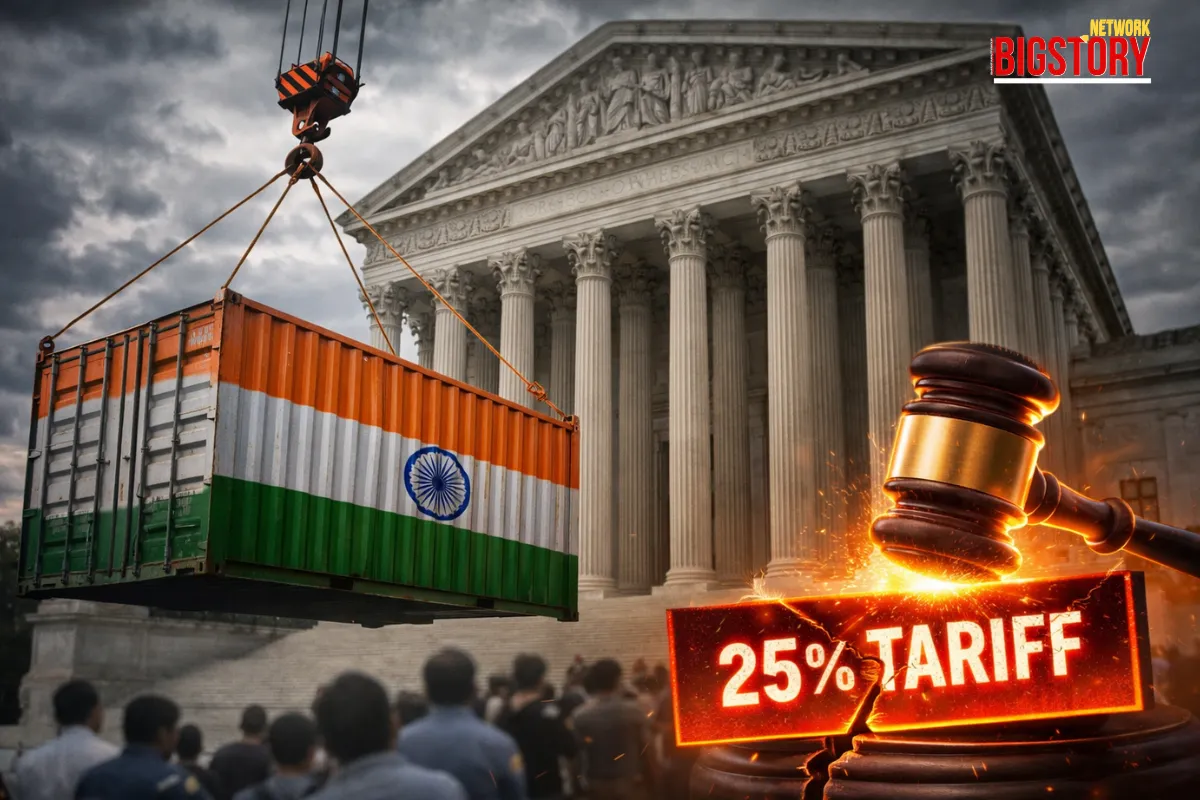
It took less than a month for the "historic" India-U.S. interim trade deal to hit a constitutional brick wall. On February 20, the U.S. Supreme Court delivered a seismic 6–3 ruling in Learning Resources, Inc. v. Trump, stripping the President of his ability to unilaterally bypass Congress to slap massive, punitive tariffs on global allies.
This matters because the ruling effectively vaporized the 50% total tariffs (including the 25% Russian oil penalty) that the U.S. had been using as a hammer against New Delhi. While Indian exporters briefly celebrated, the White House didn't surrender. President Trump instantly invoked Section 122 of the Trade Act, replacing the illegal duties with a blanket 15% global surcharge. The 18% negotiated rate from earlier this month is out; 15% is the new reality—but the clock is ticking.
The "BigStory" Angle (The "Refund War" Lobby)
Mainstream media is obsessing over Trump's legal pivot. They are entirely missing the $175 Billion Paper Trail.
With the Supreme Court officially declaring the previous IEEPA-based tariffs "illegal," U.S. Customs and Border Protection (CBP) halted collections at 12:01 AM today. But what happens to the billions already paid?
Indian export councils (especially in the gems, jewelry, and textile sectors of Surat and Jaipur) are already mobilizing. They are heavily lobbying the Commerce Ministry in New Delhi to make "Refund Facilitation" a non-negotiable demand when India's Chief Negotiator, Darpan Jain, arrives in Washington D.C. this week. This is no longer just a trade negotiation; it is a high-stakes corporate reclamation project.
The Context (Rapid Fire)
- The Trigger: The SCOTUS ruling stated that Congress never granted the President sweeping taxation powers under the International Emergency Economic Powers Act (IEEPA), dismantling Trump's primary weapon for his "Reciprocal Trade" agenda.
- The Backstory: Just weeks ago, on February 6, India had agreed to purchase $500 billion in U.S. goods to lower these exact tariffs from 25% to 18%.
- The Escalation: The new 15% rate under Section 122 is a statutory band-aid. It comes with a strict 150-day expiration date, meaning by July 2026, Trump will need an act of a deeply divided Congress to keep the tariffs alive.
Key Players (The Chessboard)
- John Roberts (The Constitutionalist): The Chief Justice authored the majority opinion, firmly drawing a line in the sand to protect Congressional authority over taxes and global trade revenues.
- Donald Trump (The Disrupter): Undeterred by the judicial smackdown, he insists the underlying India-U.S. trade deal is "fantastic" and "still on," using Section 122 to keep his protectionist wall standing for another five months.
- Gulzar Didwania (The Analyst): The Deloitte India Partner is advising panicked exporters on the ground, confirming that the old reciprocal tariffs will no longer apply, providing an immediate (if chaotic) cash-flow relief to Indian MSMEs.
The Implications (Your Wallet & World)
- Short Term (Exporters): Indian businesses must contact their U.S. customs brokers today to ensure all maritime and air shipments are processed under the new Section 122 codes. Using the old, invalidated IEEPA codes will result in severe port delays.
- Long Term (The July Cliff): The 150-day limit sets up a massive geopolitical cliff for July 2026. If the U.S. Congress refuses to extend the 15% global tariff, Indian goods could theoretically revert to standard, near-zero Most Favored Nation (MFN) rates—fundamentally altering global supply chains.
The Closing Question
With the Supreme Court ruling the initial tariffs illegal, Indian companies have technically overpaid millions to the U.S. government. Do you think the Indian government should halt the $500 billion trade pact until those refunds are fully paid out? Tell us in the comments.
FAQs
- Q: Did the US Supreme Court cancel Trump's tariffs on India?
- A: Yes, the Supreme Court ruled the emergency tariffs under IEEPA were illegal, erasing the 25% Russian oil penalty. However, President Trump immediately replaced them with a temporary 15% global tariff under Section 122.
- Q: How can Indian exporters get a refund for US tariffs paid in 2025?
- A: Because the Supreme Court struck down the IEEPA tariffs as unconstitutional, legal experts believe the estimated $175 billion collected globally is subject to refunds. Exporters must file protests and petitions through their U.S. customs brokers.
- Q: What is the current US tariff rate for Indian goods after the Feb 2026 ruling?
- A: As of February 24, 2026, Indian goods face a 15% global surcharge under Section 122, alongside standard MFN duties. This replaces the 18% rate temporarily agreed upon earlier in the month.
- Q: Is the India-US trade deal still valid after the Supreme Court decision?
- A: The political framework remains, but the legal text must be entirely renegotiated. Indian delegates are heading to Washington D.C. this week to adapt the deal to the new 15% rate and the 150-day expiration timeline.
Sources:

 Sseema Giill
 Exclusive Content