Discover how CEO Brian Niccol uses digital innovation and operational efficiency to turn around legacy brands. Explore the "Back to Starbucks" plan and his success at Chipotle.
 Rashmeet Kaur Chawla
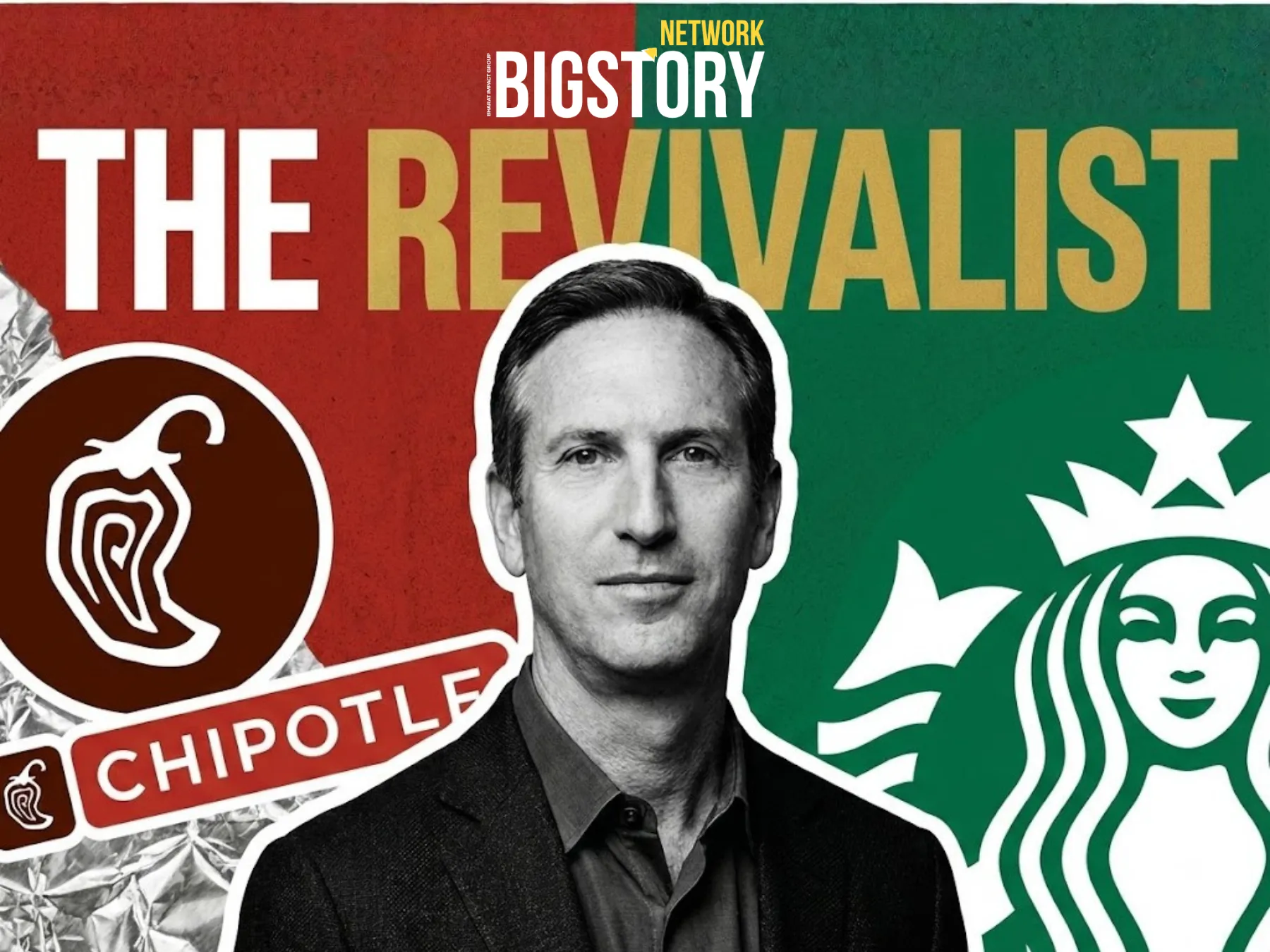
The Challenger Who Rewrote the Fast-Food Playbook—And Now Takes on Starbucks
How does digital innovation transform traditional fast food?
In 2018, Brian Niccol walked into a crisis. As the newly appointed CEO of Chipotle Mexican Grill, he inherited a brand haemorrhaging customers, trust, and market value. The once-beloved fast-casual chain had plummeted from grace following devastating food safety scandals that sickened hundreds of customers across multiple states. Stock prices had cratered, customer traffic was in free fall, and the company’s reputation lay in tatters.
The conflict Niccol faced wasn’t just about recovering from a PR nightmare. It represented a fundamental clash between old-guard restaurant thinking and the demands of a digital-first consumer base.
Traditional fast-food executives believed that recovery meant apologizing, implementing safety protocols, and waiting for customers to forget. Niccol saw something entirely different: an industry on the verge of transformation that was stubbornly clinging to analog operations in a digital world.
The restaurant industry was experiencing a seismic shift. Mobile ordering, delivery platforms, and digital payments were no longer nice-to-haves but essential infrastructure. Yet most legacy brands treated digital as an afterthought, a secondary channel bolted onto traditional operations. Drive-throughs dominated strategic thinking, while apps were neglected. This wasn’t just Chipotle’s problem; it was an industry-wide blindness to the future that was already arriving.
"Physical Locations or Digital Platforms: What Should Restaurants Become?"
Niccol recognized that the real conflict wasn’t between Chipotle and its food safety past. It was between two visions of what restaurants could become: physical locations optimized for in-person transactions versus digital platforms that happened to make food. Every established player was optimizing for yesterday’s customer while tomorrow’s customer was already ordering from their phone, expecting seamless digital experiences, and demanding that brands meet them where they were.
Operational Excellence Enables Human Connection – THE CORE BELIEF
Brian Niccol’s core belief, forged during his transformative tenure at Taco Bell, was radical in its simplicity: the restaurant business is no longer primarily about restaurants. It’s about creating seamless digital experiences that deliver food while strengthening not weakening the human connection. This belief flew in the face of conventional restaurant wisdom. Industry veterans had spent decades perfecting in-store experiences, optimizing kitchen layouts for counter service, and training employees for face-to-face interactions. The thought of fundamentally reconceiving restaurants as logistics and technology companies wrapped in food preparation seemed heretical. But more provocatively, Niccol argued that streamlining operations actually creates space for authentic human interaction rather than diminishing it.
The Paradox?
At the heart of Niccol’s philosophy: operational efficiency vs human connection is a false choice. By removing operational friction - confusing processes, inefficient workflows, inconsistent standards — employees are freed to focus on what truly matters: customer care.
Niccol had seen this principle work at Taco Bell, where he pioneered mobile ordering and built a digital infrastructure that drove billions in sales. He understood that consumer behaviour had fundamentally shifted. People weren’t just occasionally ordering online; they were living digital-first lives. Their expectations for restaurants were now shaped by Amazon, Uber, and Netflix—companies that made everything frictionless, personalized, and instant.
His conviction went deeper than just adding an app. Niccol believed that digital transformation required reimagining every aspect of operations: kitchen workflows, employee roles, facility design, and even menu engineering. A truly digital-first restaurant wouldn’t look like a traditional restaurant with technology added. It would be built from the ground up around digital ordering, with every process optimized for speed, accuracy, and scalability—freeing human talent for genuine hospitality.
The Breakthrough: When Crisis Forced Digital Innovation
The breakthrough came in 2020, though Niccol had been laying the groundwork since his first day. When COVID-19 forced dining rooms to close nationwide, restaurants that had ignored digital transformation faced existential threats overnight. Those waiting for “things to return to normal” watched their businesses collapse.
Chipotle was different. By March 2020, Niccol had already built a robust digital infrastructure. The company had launched a second production line dedicated exclusively to digital orders—a revolutionary concept called the “digital kitchen.” Mobile ordering represented a significant portion of sales. A network of Chipotlanes (digital-only drive-throughs) was expanding rapidly. When the pandemic hit, Chipotle didn’t scramble to adapt; it accelerated.
Digital sales exploded, growing from under 20% of revenue to over 50% in months. While competitors desperately tried to partner with third-party delivery apps and cobble together ordering systems, Chipotle’s purpose-built digital ecosystem handled the surge seamlessly.
The turning point wasn’t just surviving the pandemic. It was proving that Niccol’s thesis was correct: the restaurant that treats digital as its core business, not an ancillary channel, doesn’t just survive disruption—it thrives because of it. Chipotle’s stock price, which had languished below $300 when Niccol arrived, soared past $1,500. The company’s market capitalization exploded, making it one of the most valuable restaurant chains in America.
From Chipotle to Starbucks: A Turnaround Specialist Makes His Most Critical Move
Brian Niccol established his career as a turnaround specialist long before Starbucks came calling. In his role as CEO of Chipotle Mexican Grill from 2018 to 2024, he successfully navigated a recovery period for the company after it encountered both reputational and operational difficulties.
He led Chipotle to focus on digital innovation, menu simplification, and maintaining operational discipline—principles that would define his leadership philosophy.
Prior to Chipotle, Niccol held major leadership roles at Taco Bell (as CEO from 2015-2018) and Yum! Brands, where he built his reputation for combining brand creativity with operational rigor. He serves as a board member at Walmart and is involved with the Business Roundtable, indicating his prominent position in corporate America and his influence beyond individual company leadership.
When Starbucks announced through a press release in August 2024 that Niccol would become their new CEO, the move was widely interpreted as a strategic masterstroke. The company faced growth deceleration, operational inefficiencies, and growing concerns about the decline of the in-store experience that had once defined the brand. The market responded immediately: Starbucks stock soared on the announcement alone, signaling investor confidence in Niccol’s ability to execute another turnaround.
The New Conflict: Can One Operational Playbook Bring Back the Magic?
What happens when a brand known worldwide for its warmth and personal touch begins to lose its human connection and becomes more transactional? This was the central crisis Niccol inherited at Starbucks—a company that had built a global empire on the promise of being the “third place” between home and work, but had gradually lost that emotional resonance in pursuit of efficiency and scale.
The question confronting Niccol and Starbucks wasn’t just operational. It was existential: Can “back to basics” reignite a global coffee giant? And more provocatively: Can streamlining operations actually strengthen human connection rather than weaken it?
Starbucks was grappling with multiple simultaneous pressures. Store-level complexity had mushroomed over decades of innovation, with ever-expanding menus, seasonal offerings, promotional complexity, and the addition of digital channels without fundamentally rethinking operations. Baristas were overwhelmed. Consistency had eroded. The experience that once felt special now often felt transactional.
This is what made Starbucks reach out to Brian Niccol at that precise moment. The company needed someone who had proven they could simultaneously drive operational excellence and brand revitalization, someone who understood that these goals weren’t in conflict but interdependent.
The Starbucks Turnaround Plan 2025: “Back to Starbucks
Brian Niccol’s leadership at Starbucks is built around the “Back to Starbucks” strategy — a deliberately crafted framework designed to restore the coffeehouse experience at every level. This isn’t nostalgia marketing. It’s a strategic reset grounded in the recognition that Starbucks had drifted from the core elements that made it iconic.
The Starbucks turnaround plan 2025 centers on several interconnected objectives:
Resolving the False Dichotomy: Efficiency and Humanity as Partners
The biggest debate in Starbucks' turnaround is whether driving efficiency will damage the human touch customers love. But Niccol's philosophy challenges this assumption—efficiency and hospitality aren't enemies, they're partners. Think about it: a barista drowning in confusing systems, unclear priorities, and chaotic workflows has no energy left for genuine customer connections. But give that same barista clear processes, intuitive tools, and achievable standards, and suddenly they have the mental space to remember regulars, craft drinks with care, and create meaningful moments.
Research from Berkeley confirms this—organizational clarity doesn't constrain employees; it empowers them by reducing stress and providing psychological safety. Niccol's early results at Starbucks support this approach: store teams appreciate the clearer direction, investors remain confident, and media coverage has been positive. As he told Masters of Scale, operational excellence and brand identity must advance together—you can't maintain a premium brand without premium execution, and you can't deliver premium execution without operational discipline.
While Starbucks' global scale makes this turnaround more complex than Chipotle's domestic operation, the leadership principles remain the same: simplify, measure, empower, and stay focused on what made the brand valuable in the first place.
Is This Brian Niccol's Most Critical Leadership Challenge?
Starbucks represents a fundamentally different challenge than Chipotle or Taco Bell. It's not just a retail chain—it's a cultural institution with deep emotional connections across diverse global markets. The stakes extend beyond financial recovery to emotional reconnection with millions of customers who remember when Starbucks felt special.
Brian Niccol's challenge at Starbucks isn't primarily about financial engineering or digital optimization—though both matter. It's about proving that large-scale operational excellence can coexist with intimate customer experience. It's about demonstrating that standardization doesn't mean sterility, and that measurement doesn't preclude magic.
The debate around operational efficiency versus human connection will largely determine whether his Starbucks leadership is judged successful. If customers experience improvements in service speed and consistency but feel the brand has become more corporate and less personal, the turnaround will ring hollow. If employees appreciate clearer systems but feel reduced to executing protocols, the culture will suffer.
But if Niccol succeeds in his core thesis—that great systems enable great service—the implications extend far beyond Starbucks. He'll have proven that even the most human-centered businesses benefit from operational rigor, and that the path to authentic connection often runs through disciplined excellence.
The Challenger's Manifesto
Brian Niccol's approach to transforming legacy brands rests on a counterintuitive foundation: operational excellence and human connection aren't opposing forces—they're partners. He believes restaurants must be reimagined as digital platforms first, with every process optimized around mobile ordering and seamless experiences. This isn't about adding technology to traditional operations; it's about rebuilding from the ground up. Simplify relentlessly—strip away menu complexity, confusing protocols, and chaotic workflows—because clarity enables consistency, and consistency builds trust.
The path to transformation runs through disciplined measurement and strategic return. Clear performance frameworks empower teams with both autonomy and accountability, while transparent priorities free employees from survival mode to focus on genuine customer care. But perhaps most importantly, Niccol's philosophy challenges the obsession with innovation: sometimes the breakthrough isn't building something new, it's rediscovering what made you great in the first place and executing it better than anyone thought possible. Great systems don't diminish hospitality—they enable it.
Conclusion: The Power of Return
The story of Brian Niccol—from Taco Bell to Chipotle to Starbucks—is still being written. But the narrative arc is becoming clear: in a business world that prizes innovation and disruption, Niccol's approach stands out for its disciplined restraint. He doesn't try to create something entirely new. He identifies what has worked, strips away what obscures it, and executes with precision.
At Chipotle, this meant focusing relentlessly on digital infrastructure and operational simplification while staying true to the brand's "food with integrity" positioning. At Starbucks, it means returning to coffeehouse fundamentals while building the operational capacity to deliver them consistently at global scale.
Brian Niccol proved at Chipotle that challenger thinking doesn't require being a startup or external disruptor. Sometimes the most powerful challengers emerge from within established industries, armed with unconventional beliefs and the courage to rebuild legacy organizations around clearer principles.
His journey from crisis manager to industry visionary demonstrates that great leadership means seeing what others overlook: that the future isn't always about what's new, but often about what's been forgotten.
FAQs
Q: What was Brian Niccol's background before joining Chipotle?
Niccol served as CEO of Taco Bell (2015-2018), pioneering mobile ordering and digital transformation. He previously held leadership roles at Pizza Hut and began his career at Procter & Gamble. He also serves on Walmart's board, bringing strategic perspectives beyond individual companies.
Q: What is the Brian Niccol operations playbook?
A leadership framework built on simplification, measurement, and disciplined execution: reduce complexity, track 5-7 key metrics, build digital-first infrastructure, create separate production streams for digital vs. physical channels, own customer relationships through proprietary platforms, and empower teams through clarity.
Q: How did Niccol turn around Chipotle after the food safety scandals?
Three interconnected strategies: restored trust through transparent food safety protocols, pivoted to digital-first operations with mobile ordering and "digital kitchens," and reconnected with brand values around quality ingredients. Result: digital sales grew from $100M to $3B+ annually, stock price increased 500%+.
Q: What are Chipotlanes and how do they differ from regular drive-throughs?
Chipotlanes are pure pickup lanes for pre-ordered food, not ordering stations. Customers place orders via app, food is prepared while they're en route, and pickup takes 30-45 seconds vs. 3-5 minutes at traditional drive-throughs. No menu boards, no payment processing—just seamless pickup.
Q: Why did Starbucks hire Brian Niccol as CEO in 2024?
Starbucks faced operational complexity, growth stagnation, digital infrastructure gaps, and eroding brand connection. Niccol's track record at Chipotle proved he could simultaneously simplify operations, drive digital innovation, and rebuild emotional brand connection—exactly what Starbucks needed.
Q: What is the "Back to Starbucks" strategy?
A framework to restore the coffeehouse experience: simplify menus and protocols, implement a five-metric measurement system for operational clarity, reconnect with sensory elements (coffee aroma, espresso sounds, community space), empower stores with clear standards and autonomy, and integrate digital seamlessly into operations.
Q: Can operational efficiency and human connection coexist in restaurants?
Yes—they're mutually reinforcing. Research shows that unclear systems consume mental energy, leaving no bandwidth for customer connection. Well-designed systems free employees to focus on hospitality. Chipotle's digital transformation improved both operational metrics and customer satisfaction scores simultaneously.
Q: What makes Brian Niccol's leadership approach different?
Disciplined restraint over constant innovation, digital-first conviction (not digital as one channel), measurement rigor (5-7 key metrics), viewing systems as servant leadership, treating brand and operations as inseparable, and confidence in "back to basics" over innovation for innovation's sake.
Q: How does the Starbucks turnaround compare to Chipotle?
Starbucks is more complex: 36,000+ locations in 80+ countries vs. Chipotle's 3,200 primarily US stores. Starbucks faces chronic drift vs. Chipotle's acute crisis. Starbucks needs digital optimization vs. Chipotle's greenfield opportunity. But core principles remain: simplify, measure, empower, return to brand roots.
Q: What lessons can other restaurant companies learn?
Digital requires operational transformation, not just an app. Own your customer relationships. Create separate workflows for digital and physical channels. Measure 5-7 key metrics transparently. Simplification is strategy, not retreat. Great systems enable people, not constrain them. Exceptional execution of basics beats mediocre innovation.
SOURCES
https://en.wikipedia.org/wiki/Brian_Niccol
https://www.businessroundtable.org/members/brian-niccol
https://corporate.walmart.com/about/board-of-directors/brian-niccol
https://phideltatheta.org/news-stories/famous-phis/brian-niccol/
https://businesschief.com/news/starbucks-turnaround-ceo-brian-niccol-sees-gains
https://mastersofscale.com/episode/starbucks-ceo-brian-niccol-is-here-to-put-the-brand-back-on-top/
 Exclusive Content
Sign up for the Daily newsletter to get your biggest stories, handpicked for you each day.


 Trending Now! in last 24hrs