You already know the pressure. What you may not know is where it actually came from. Tiger parenting is not ancient Confucian wisdom or a deliberate cultural philosophy. It is a survival algorithm written in the aftermath of partition, famine, and war — passed down through families that never got the message that the emergency ended. The tragedy is not that anyone failed. It is that the war ended and nobody sent word to the families still fighting it.
 Brajesh Mishra
You know there is a particular kind of person you have probably met — or maybe you are this person.
They excel in any setting. Organised, driven, consistently delivering. When asked about their wellbeing, their default answer is fine — but that is the norm today, right? Ask them about pride in their accomplishments, though, and they fall silent and take a step back. Not because of a lack of achievements, but because somewhere, the concept of pride — which implies a definitive endpoint — is alien to them. For them, the finish line is constantly shifting.
Feel familiar?
This is neither ambition nor a personality type. It is an installation. And the interesting fact is, it was put there long before they were old enough to question it.
A very similar way of thinking and acting appears in young adults across India, China, Vietnam, and South Korea — regardless of different languages, religions, and wealth levels.
The inability to feel proud of what they have achieved. A paralysis when facing choices their parents do not approve of. Guilt for wanting something different from what was expected. And a collapse when they fail — not exactly disappointment, but something closer to identity death. As if the failure does not mean they fell short, but that they never had the right to exist in the first place.
These are not isolated personality struggles. The data is unambiguous.
Indian youth rank 60th out of 84 countries in mental health, with an average score placing them in the Distressed or Struggling category. More than 6 in 10 young adults across Asia are currently at high clinical risk for mental health challenges — a rate nearly five times that of their parents' generation. In South Korea, suicide is the leading cause of death for people in their teens, twenties, and thirties. In Vietnam, 1 in 5 adolescents faces a documented mental health issue, yet only 8.4% ever access any support.
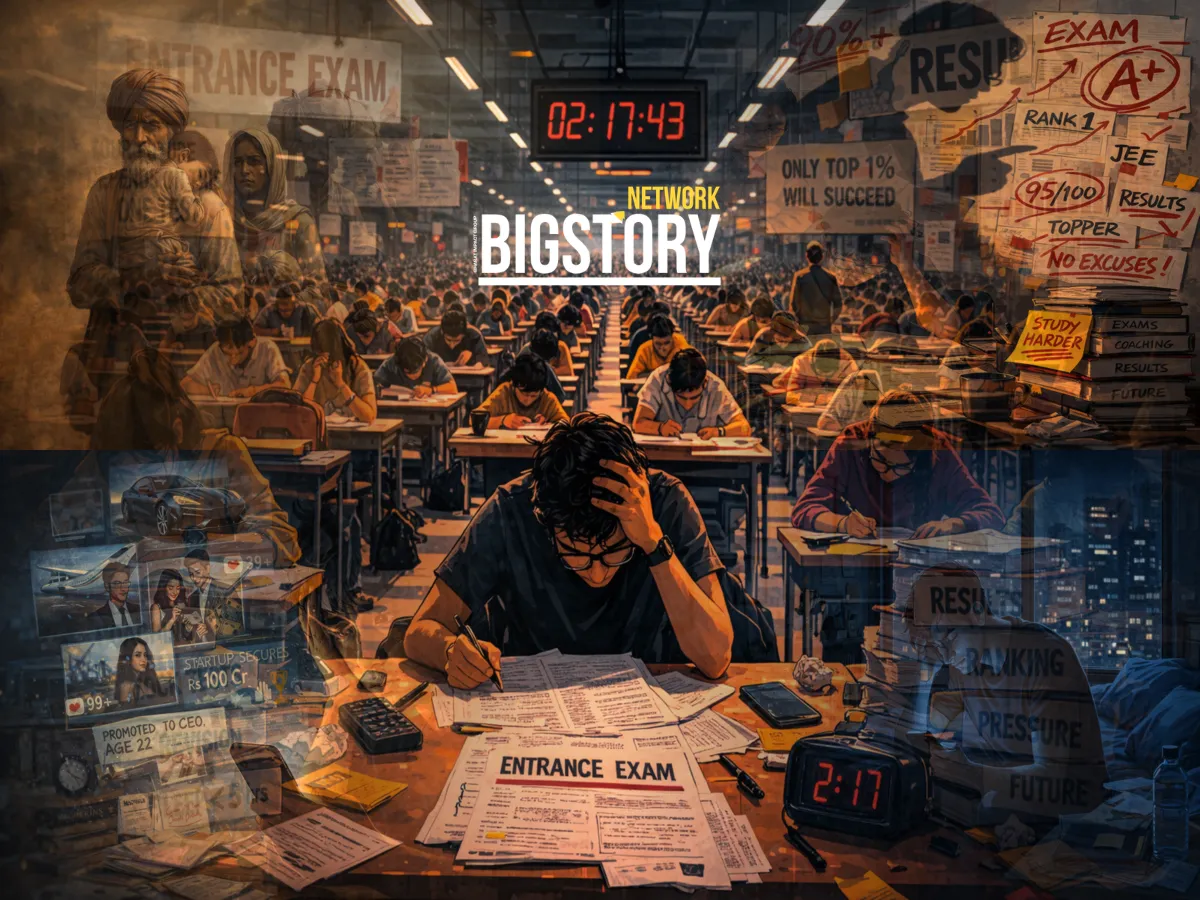
In Kota — India's largest coaching hub with over 300,000 students migrating annually to prepare for national entrance exams — 87% of students report high parental pressure, 86% report high academic stress, and in 2023 alone, 32 students died by suicide. The highest number ever recorded in the city.
The common assumption is that these are the costs of ambition. That pressure produces excellence and excellence has a price. That assumption is wrong. And understanding why requires going back much further than the last exam season.
What we call Asian parenting — the high demands, the emotional distance, the comparison shaming, the single-minded push toward medicine, engineering, law, or civil service — is frequently described as culture. As tradition. As something ancient and deliberate.
It is none of those things.
Classical Confucian philosophy, contrary to how it is used today, did not support the competitive search for outside approval — it actually viewed this as a moral mistake. The extreme academic pressure often justified by invoking Confucian tradition was never what that philosophy aimed for. What people now call Tiger Parenting is not rooted in ancient wisdom. It is rooted in people who survived catastrophe.
In 1947, the Partition of British India triggered the largest mass migration in recorded human history. An estimated 12 to 20 million people were displaced overnight. Families lost ancestral land, property, and social standing in days. Up to one million people died in sectarian violence. The psychological response among survivors was a mechanism researchers now call the cycle of selective silence: do not process what happened, do not name it, just focus entirely on rebuilding. Secure the child's future at any cost. Emotion is a luxury. Safety is not.
In China, between 1958 and 1962, the Great Leap Forward famine killed an estimated 15 to 55 million people — the deadliest famine in recorded human history. Parents who survived built an entire psychology around resource preservation, risk elimination, and hyper-vigilance. When the One Child Policy arrived in 1979, it concentrated every gram of that accumulated ancestral anxiety onto a single heir. One child. One chance. No margin for failure.
In Vietnam, the Bao Cap period following reunification in 1975 left up to one-third of citizens malnourished. Families survived on strict government rations. Parents from this generation watched their children grow up in the relative abundance of the Doi Moi era and felt a terror their children had no framework to understand. How do you explain the fear of poverty to someone who has never been hungry?
Three countries. Three different catastrophes. One identical output.
A parenting system built on a single operating principle: the world is dangerous, failure is catastrophic, and love must be rationed to produce the performance required to survive.
This was not cruelty. It was logical. In the environments these parents and grandparents inhabited, conditional pressure was a rational survival algorithm. Push hard enough and the child gets the limited seat, the stable job, the secure future. The system worked for the world it was designed for. The problem is that world no longer exists — and nobody updated the code.
Developmental psychologists call this Conditional Regard: the understanding, often absorbed implicitly in early childhood, that a child's worth and acceptance are not guaranteed but are instead performance outputs.
Achieve the marks and warmth is available. Miss them and something is withdrawn. Not dramatically, not always consciously — but the child learns to read the room. They learn what produces safety and what produces silence.
Over time, something fundamental shifts. The child stops asking what do I want and starts asking what keeps me safe. The internal compass — the one that is supposed to develop through exploration, failure, and recovery — never fully forms. Instead, the child develops what researchers call Introjected Self-Regulation: external rules absorbed so deeply they feel internal. Behaviour driven not by genuine values but by the fear of losing approval.
The output is a person who is highly functional on the outside and deeply uncertain on the inside. They can perform but cannot feel. They can achieve but cannot rest in that achievement — because the part of them that was supposed to learn I am enough regardless of outcome was never given the conditions to develop.
This is not a character flaw. It is the predictable output of a specific system running exactly as designed.
For previous generations, the pressure had edges. The comparison was local — your cousin, your neighbour's son, the topper in class. Manageable, if not comfortable.
Generation Z inherited the same conditional architecture and then received a device that made the comparison infinite and relentless.
A 15-year-old driving a Lamborghini on Instagram. A peer your age closing a startup funding round on LinkedIn. A 19-year-old in your city who apparently built a business, maintained grades, travels internationally, and still has time to document all of it. The algorithm does not show you the full picture. It shows you the highlight reel — the statistically improbable peaks, on a loop, specifically engineered to keep you scrolling by making you feel like you are falling behind.
Researchers call it Digitally Mediated Identity Strain: a person with no stable internal compass receiving infinite competing signals from systems designed to exploit psychological insecurity.
The traditional path says: study hard, get the degree, get the job. The phone says: someone your age is already a millionaire and you are wasting time. The parent says: focus, stop dreaming, do what works. The algorithm says: you should be doing everything at once.
There is no stable ground to stand on — and the person standing on it was never given the internal resources to build their own.
China calls this phenomenon neijuan, or involution: a cycle of escalating effort that yields progressively smaller results until the strenuous activity becomes the sole purpose. The pushback in India against Narayana Murthy's suggested 70-hour work week was not born of laziness. It was a message from a generation that the long-standing agreement to sacrifice all personal life now for a promised security later is no longer a viable or trustworthy contract.
There is something the data does not fully capture but that shows up in every conversation about this.
The good son. The obedient daughter. The one who followed the path, got the degree, took the job, and is now sitting in a stable life that feels completely hollow.
The bad son. The one who resisted, who tried something different, who is still carrying the weight of having disappointed the family — regardless of what he actually built.
Neither of them chose their position. Both were assigned by a system that needed compliance to function. The good child performed the code successfully. The bad child glitched. Both are running the same program. Both are, in different ways, lost inside it.
What the research makes clear — and what almost no public conversation acknowledges — is that the parents are not running this consciously either. The legacy of grandparents who endured partition and famine was one of unspoken trauma. They never articulated their experiences forward. The silence itself became the inheritance. Anxiety was passed down not through verbal accounts but through the household's emotional climate — manifested in what was praised, what was disciplined, and what was perpetually left unaddressed.
Epigenetic research now shows that severe historical trauma modifies genetic expression related to stress regulation, passing biological predispositions for anxiety and hypervigilance down family lines. The fear is literally in the body. Passed down without a single word being spoken about where it came from.
The scarcity that wrote this code is largely gone. Not entirely — inequality remains real, competition remains fierce, and the exam bottlenecks of the JEE, Gaokao, and Vietnam's university entrance system are genuinely brutal. The economic stakes are not imaginary.
But the specific catastrophe that made unconditional love a luxury — the famine, the partition, the rationed rice — that world is gone. The code, however, remains. Running in families that no longer need it for survival, now producing anxiety, identity collapse, and a generation that cannot locate itself outside of external validation.
What broke across generations was not love. It was the language love was expressed in.
This is not an indictment of Asian parents. The sacrifices are documented and immense. The intention was never damage — it was survival, love expressed in the only language the circumstances allowed. A parent who pushes hard because they watched their own parents lose everything is not a villain. They are the last chapter of a very long story of fear.
And the child carrying that weight is not a victim. They are the inheritor of a survival system that worked — that genuinely worked — for the world it was built for. The anxiety, the perfectionism, the inability to rest in achievement — these are not character flaws. They are the predictable output of a program running in the wrong era.
The tragedy is not that anyone failed. The tragedy is that the war ended and nobody sent word to the families still fighting it.
Somewhere in Asia right now, a parent is checking their child's marks. Not because they do not love them — but because love, for as long as they can remember, was never separate from survival. And somewhere, that child is staring at a screen, watching someone else win, wondering why nothing they have done has ever felt like enough.
Neither of them knows they are running the same program — written in a language neither of them speaks anymore.
 Exclusive Content





Sign up for the Daily newsletter to get your biggest stories, handpicked for you each day.



 Trending Now! in last 24hrs