David Vélez grew up watching cartel violence in Medellín, challenged Brazil's five-bank oligopoly with a purple credit card and a mobile app, and built Nubank into the world's largest neobank. This is the thinking behind financial inclusion at scale.
 Rashmeet Kaur Chawla
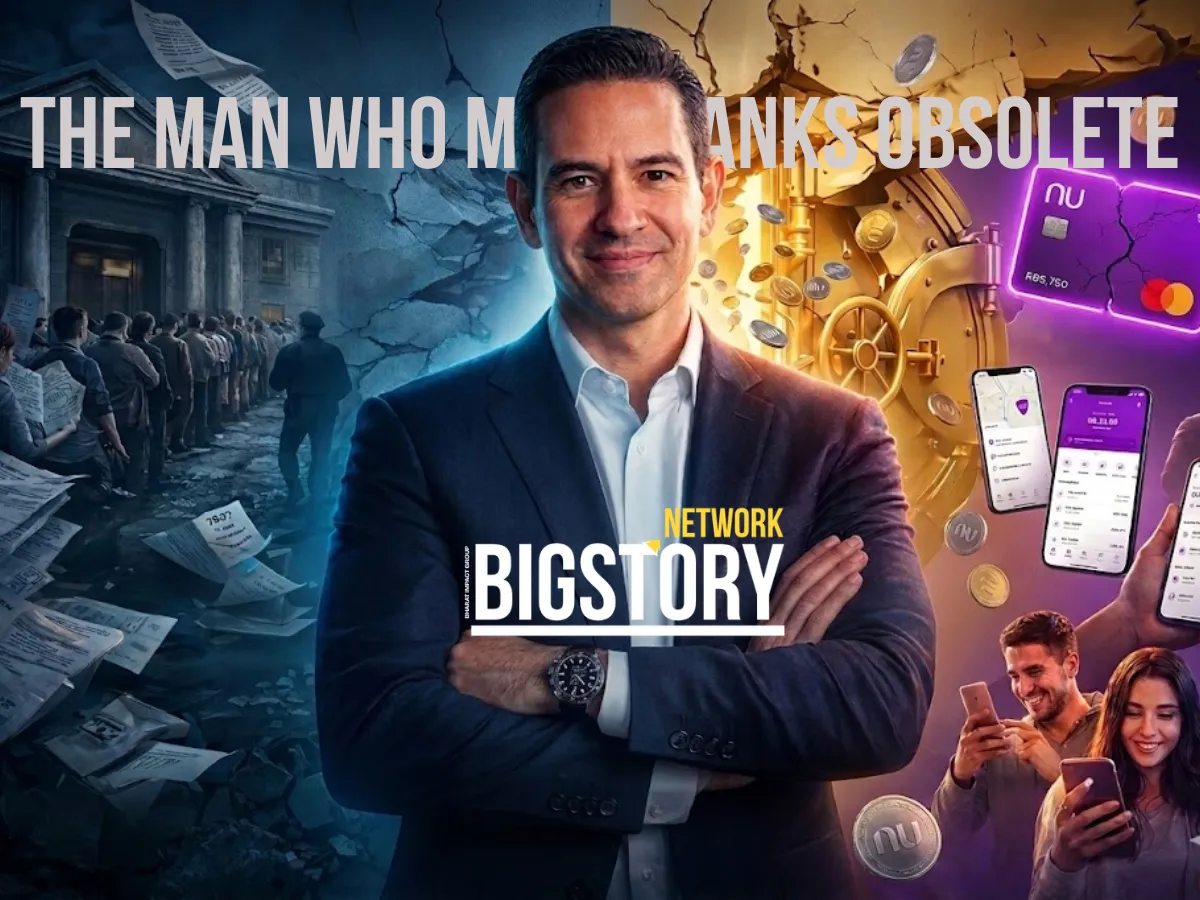
That is what David Vélez told his small team of engineers in a cramped São Paulo apartment in 2013 not with guns or lobbyists but with a purple credit card, a mobile app, and a burning conviction that 200 million people deserved better.
The five largest banks in Brazil controlled over 80% of all financial assets. They charged some of the highest fees in the world. They made customers queue for hours. They treated banking as a privilege, not a right. For decades, no one dared challenge them.
Then came David Vélez.
Born in Medellín, Colombia a city once synonymous with cartel violence, Vélez grew up watching people survive impossible circumstances. He never forgot that.
Years later, sitting in one of the world's most protected banking oligopolies, he saw the same pattern: a powerful few controlling what should belong to everyone.
A first-generation immigrant challenger who built the world's largest digital bank outside Asia, giving financial dignity to over 100 million people who had been ignored for generations.
A System Designed to Keep You Out
Brazil's banking sector in the early 2010s was a fortress. Five institutions Itaú, Bradesco, Banco do Brasil, Santander, and Caixa controlled the overwhelming majority of deposits, credit, and insurance in a country of over 200 million people. Annual credit card interest rates regularly exceeded 300%. Opening a bank account required a stack of documents, hours of time, and often a personal referral. Customer service was notoriously indifferent.
For millions of Brazilians particularly those in lower income brackets, younger adults, and the self-employed traditional banking was a closed door.
When Vélez arrived in São Paulo in 2012, fresh from Stanford and stints at Goldman Sachs, Morgan Stanley, and Sequoia Capital, he experienced that wall personally. Despite his impressive credentials, opening a bank account was a maze of paperwork and waiting. He watched ordinary Brazilians navigate a system that seemed designed to frustrate them. And he thought: this is solvable.
That observation became the seed of Nubank. Not a fintech product. A competitive pressure. A challenger designed to make the incumbents uncomfortable and to make 200 million customers feel seen.
David Vélez Osorno is the co-founder and CEO of Nubank, the Brazilian digital banking company that has grown into the world's largest neobank outside Asia. As of 2025, Nubank operating under its parent company Nu Holdings serves over 100 million customers across Brazil, Mexico, and Colombia, and carries a market capitalisation that has at various points exceeded $50 billion.
He was born in 1981 in Medellín, Colombia. He studied engineering and business at Stanford University, then earned his MBA at Stanford Graduate School of Business. He worked at Goldman Sachs, Morgan Stanley, and Sequoia Capital before founding Nubank in 2013 alongside co-founders Cristina Junqueira and Edward Wible.
In 2021, Nubank listed on the New York Stock Exchange in one of the largest fintech IPOs in history. Vélez was named to TIME magazine's list of the 100 Most Influential People. Forbes recognised him as one of the wealthiest self-made entrepreneurs in Latin America.
But none of those facts fully capture who he is. For that, you have to go back to Medellín.
David Vélez was born into a Colombia that was, by many measures, at its darkest. The 1980s in Medellín were defined by the narco-violence of the Escobar era. Bombings, assassinations, and fear were part of daily life. Ordinary families including the Vélez family lived under the constant weight of instability.
His family were entrepreneurs. Watching them navigate Colombia's volatile economy gave Vélez an early and visceral education in what it means to build something from nothing under conditions of uncertainty. When the security situation deteriorated beyond what the family could accept, they relocated to Costa Rica a country that offered something Colombia at the time could not: stability and safety. It was in Costa Rica that Vélez completed his early schooling and began to absorb a different way of thinking about institutions, governments, and systems.
He then moved to the United States to pursue higher education first undergraduate studies, then Stanford. At Stanford, Vélez encountered the Silicon Valley ethos up close: the belief that technology, applied thoughtfully, could solve problems that had resisted solution for generations. He absorbed it. But unlike many of his Stanford peers who turned their ambitions toward consumer apps or software tools for the already-privileged, Vélez kept his eyes on a different kind of problem.
From Sequoia to São Paulo: The Moment the Idea Caught Fire
After Stanford, Vélez's career moved through the commanding heights of global finance. At Morgan Stanley and Goldman Sachs, he developed a sophisticated understanding of how large financial institutions operated how they assessed risk, structured products, and crucially, how they generated their enormous profits.
At Sequoia Capital and General Atlantic, he shifted to the other side of the table, evaluating emerging market businesses for investment. It was in this role that he began travelling extensively across Latin America assessing the commercial landscape, meeting founders, understanding markets.
What he found in Brazil disturbed him. The banking sector's concentration was extraordinary even by emerging market standards. The fees charged to ordinary consumers were not a minor inefficiency they were a structural extraction that transferred wealth from the many to the already-powerful few. And there was almost no digital alternative.
Vélez saw a gap. But more importantly, he felt a pull. He did not just see a business opportunity. He saw a moral imperative.
"I didn't want to build another financial company. I wanted to build the company that every financial company should have been."
In 2012, Vélez relocated to São Paulo as someone who intended to build a life and a business there. He began mapping the problem in granular detail: which customer segments were most underserved, what technology was available, where regulation might allow an opening, and who he wanted beside him.
He found Cristina Junqueira, a seasoned banking executive who understood the industry's mechanics from the inside and shared his diagnosis of its failures. He found Edward Wible, an engineering genius who could build what they were imagining. In 2013, the three of them founded Nubank.
The first product was disarmingly simple: a no-annual-fee credit card, managed entirely through a mobile app. No branches. No paperwork mountains. No hold music. No condescension. Just a clean, functional product that worked the way customers, not the bank, wanted it to work.
Brazilians responded with something the banking industry rarely inspires: enthusiasm. The waitlist grew to hundreds of thousands before Nubank had even officially launched nationally. Something had been waiting to be unlocked. Vélez had found the key.
Every great challenger is built on a belief so strong it can survive ridicule, rejection, and near-failure. For David Vélez, that belief can be stated simply: financial services should empower people, not extract from them.
The traditional banking model in Brazil and in much of the world was constructed around information asymmetry. Banks knew things customers did not. They used that knowledge to charge fees customers did not understand, for services customers did not want, through contracts customers could not fully read. Complexity was not a bug. It was the product.
Vélez decided to invert this. Nubank's design philosophy from day one was radical transparency: simple language, clear pricing, instant notifications, full account visibility. The mobile app was not a feature. It was the entire experience and it was built to serve the user, not obscure the bank's margins.
Vélez also built Nubank around a belief in the latent capability of underserved customers. Where traditional banks looked at Brazil's informal economy workers, first-time earners, and credit-invisible youth as risks to be avoided, Nubank looked at them as customers who had been wrongly excluded and who, given the right product, would prove to be creditworthy, loyal, and enormously valuable.
This was not naïve idealism. It was backed by data analysis and risk modelling. And it turned out to be correct. Nubank's loan default rates consistently compared favourably with traditional banks not because Nubank avoided risk, but because it built a smarter relationship with customers who finally had a reason to reciprocate trust.
Regulatory Resistance
Brazil's banking regulator, the Banco Central do Brasil, had never licensed a company quite like Nubank. The regulatory framework was designed for traditional banks with branches, physical assets, and long track records. Getting a full banking licence as a digital-first startup required Nubank to educate regulators as much as apply to them. The process took years and demanded extraordinary legal, compliance, and lobbying resources from a company simultaneously trying to build products and acquire customers.
Investor Skepticism
Early fundraising was brutal. Vélez approached dozens of investors in Silicon Valley and São Paulo who told him, politely or otherwise, that challenging Brazil's banking oligopoly was not a realistic ambition. The incumbents had political connections, regulatory moats, and near-unlimited capital. A startup with a purple card was not going to move them. Vélez heard the word "no" more times in Nubank's first two years than most founders hear in a lifetime.
The Scaling Problem
Nubank's growth, when it came, arrived faster than anyone including Vélez had anticipated. Managing customer service quality, technology infrastructure, fraud prevention, and financial product risk at scale while expanding into new product lines required a level of organisational sophistication that Nubank had to build in real time. There were internal crises. There were product failures. There were moments when the culture that had made Nubank special felt at risk of being diluted by rapid hiring.
"Every time we hit a wall, we went back to the mission. Not the metrics. The mission. That kept us honest."
The Pandemic Test
In 2020, the COVID-19 pandemic struck Brazil with particular ferocity. Economic contraction, soaring unemployment, and financial stress among Nubank's customer base created a potential credit catastrophe. Many observers expected devastating default rates.
Instead, Nubank's proactive approach to customer communication, flexible payment options, and real-time credit monitoring allowed it to navigate the crisis better than many traditional lenders. The pandemic, paradoxically, demonstrated that Nubank's model was more resilient under stress than its detractors had predicted.
December 9, 2021. The New York Stock Exchange. Nu Holdings listed at a valuation that briefly exceeded $45 billion, making it the most valuable financial institution in Latin America by market capitalisation. For context: this was a company that had not existed eight years earlier. A company whose first office was a borrowed desk. A company that had been told, repeatedly, that it was attempting the impossible.
The IPO was not just a financial event. It was a validation of the thesis, of the team, of the customers, and of the belief that banking could be rebuilt from the ground up for the people it had always been supposed to serve.
But Vélez was characteristically unsentimental about it. In interviews following the listing, he returned again and again to the idea that the IPO was not the destination — it was a resource. The mission had not changed. Over 100 million customers in Latin America still needed better financial services. The work was not done.
In an industry where quarterly earnings drive almost every decision, Vélez has consistently oriented Nubank around multi-year bets. The decision to forgo revenue from annual fees in the early years when every additional dollar of revenue was precious was a statement of long-term intent. This willingness to sacrifice short-term margin for long-term trust has become one of Nubank's most durable competitive advantages.
Customer Obsession as Culture, Not Slogan
Most companies claim to be customer-obsessed. At Nubank, it is embedded in hiring, performance review, and product development processes. Vélez famously spent time personally reading customer feedback in the company's early years. Product teams must articulate the customer problem they are solving before any engineering work begins. Customer service employees are given unusual autonomy to resolve problems creatively without needing managerial approval for every decision.
Intellectual Honesty at the Top
Vélez is notably candid about what Nubank does not do well and what risks remain underappreciated. In earnings calls and public interviews, he discusses competitive threats, regulatory uncertainties, and execution risks with a directness unusual for a CEO of a company his size. This intellectual honesty appears to filter into the culture: Nubank employees consistently describe an environment where problems are named early rather than papered over.
Building for Inclusion Without Condescension
Perhaps most distinctively, Vélez has built Nubank's products with the underlying belief that underserved customers are not a charity case they are a market that has been misevaluated. By treating financially excluded Brazilians as intelligent adults capable of managing money well if given the right tools, Nubank has unlocked a customer loyalty that its competitors, still locked in their condescending assumptions, cannot replicate.
The Challenger's Manifesto:
At BIGSTORY Network, we call people like David Vélez Challengers. Not because they are contrarians. Not because they rejected the system out of bitterness. But because they looked at a system that was failing millions of people, believed it could be rebuilt better, and then spent years of their lives proving it.
Proof that a founder from a country that most of the global financial system ignores can build one of the most important financial institutions of his generation. Proof that the customers the banks abandoned are not liabilities they are opportunities, waiting for someone with the courage and competence to serve them properly. Proof that mission and market can coexist that building for people who need help and building a durable, profitable business are not competing objectives.
In an era where many startups claim to be changing the world but are mostly optimising engagement metrics, David Vélez built something that actually changes what happens when 100 million people open their wallets.
1. Find the problem that makes you angry. Not interested. Angry. Anger is sustainable in ways that interest is not. The wall that Brazil's banking system put in front of ordinary people made Vélez angry. That anger carried him through years of rejection. Your best work will come from problems you cannot emotionally detach from.
2. Choose your market before your product. Vélez did not build a product and then look for a market. He identified 200 million underserved banking customers and then figured out what product they needed most. The market came first. This sequencing matters enormously.
3. Trust is the only moat that compounds. Technology can be copied. Processes can be reverse-engineered. But trust — earned through thousands of small moments of doing right by customers — takes years to accumulate and cannot be replicated quickly.
4. The incumbents' scale is also their weakness. Every advantage the big banks had also made them slower and less capable of reimagining their products. If you are fighting an incumbent, find the places where their size makes them brittle. That is where you enter.
5. Emerging markets are not lesser markets. The assumption that financial innovation belongs first in New York or London and then trickles down to São Paulo or Lagos is wrong. The complexity and urgency of emerging market problems often produce more radical and more durable innovations. Do not discount your geography.
"The biggest risk was not that we would fail. The biggest risk was that we would succeed at something that didn't actually matter."
Few know that Vélez's family fled Medellín during the height of cartel violence — relocating to Costa Rica when he was still a child. The instability he grew up watching shaped everything about how he thinks about building institutions that people can actually trust.
Hardships and challenges are not exceptions to life — they are part of it. What separates those who build something meaningful is simply this: they stayed. Through every closed door, every "no," every moment of doubt, they chose to believe — in what they were building, and in the people, they were building it for.
David Vélez heard "no" more times than most of us can imagine. He stayed anyway. And because he did, 100 million people now have a seat at a table that was never built for them.
That is the BIGSTORY.
 Exclusive Content


Sign up for the Daily newsletter to get your biggest stories, handpicked for you each day.


 Trending Now! in last 24hrs