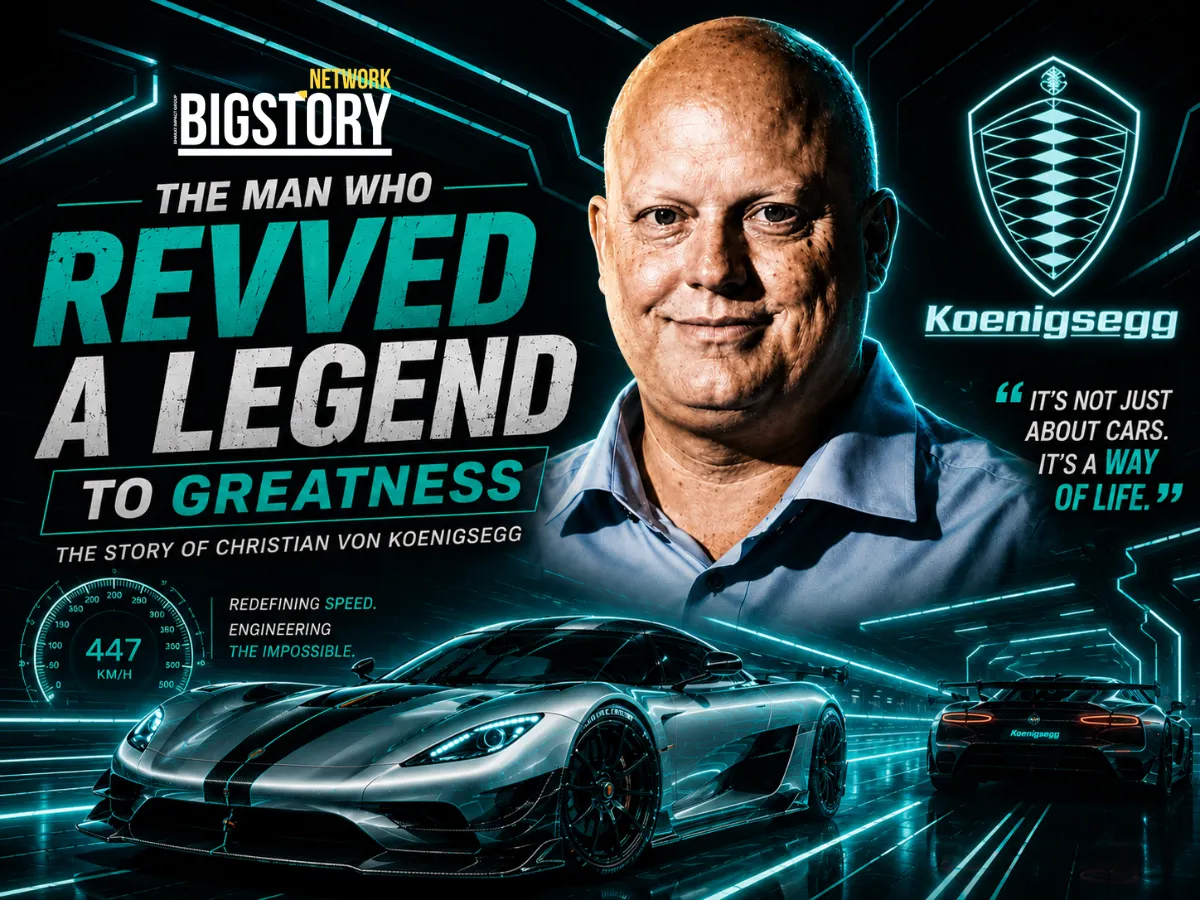
From a cartoon-inspired childhood dream to a globally recognized hyper car empire, Christian von Koenigsegg turned radical engineering and relentless conviction into one of the most remarkable founder stories in automotive history.
 Rashmeet Kaur Chawla
In 1977, a five-year-old boy in Stockholm sat cross-legged on the floor, eyes wide, watching a stop-motion animated film on television. The movie a beloved Norwegian classic called The Pinchcliffe Grand Prix tells the story of a bicycle repairman who dares to build his own race car and beats the world's greatest drivers with it. For most children, it was just a film. For Christian von Koenigsegg, it was a blueprint.
That small boy would grow up to do exactly what the cartoon hero did. Not in a fairy tale. Not on a screen. In a real workshop, with real metal and carbon fibre and sweat. He would go on to found Koenigsegg Automotive AB at the age of 22, without a formal engineering degree, without industry experience, and with not much more than a vivid vision and an almost stubborn refusal to be told no.
The company has broken production car speed records, invented engine technologies that major automotive giants are now scrambling to licence, and sold-out entire model lineups within days of announcement. In 2024, Christian was named EY World Entrepreneur of the Year for Sweden, a recognition that placed him among the most consequential business founders of his generation.
But the story between that Norwegian cartoon and a Swedish air hangar full of the world's fastest cars is not a smooth one. It is the story of fire, failure, reinvention, and a peculiar kind of conviction the kind that builds companies where none should reasonably exist.
Christian Von Koenigsegg was born on 2 July 1972 in Stockholm, Sweden. He descends from a noble Germanic lineage with roots tracing to the 11th century the Koenigsegg family coat of arms, earned in the 15th century, eventually became the company's logo. His father, Jesko Von Koenigsegg, was the CEO of JK Energiteknik; his mother, Brita Aasa, a fashionista with a distinctly stylish eye.
Christian is largely self-taught as an engineer a fact that, depending on who you ask, is either his greatest limitation or his greatest asset. He attended Lundsbergs boarding school in Sweden and later studied economics at the Scandinavian School of Brussels, but formal technical education was never his path.
Instead, his formation was curiosity: dismantling cassette players as a child to understand how they worked, tuning mopeds as a teenager until he became the best-known moped modifier in his area, and by eighteen, filing patent searches for a music device that used memory chips instead of CDs — an idea that, years later, became the standard the world calls digital audio.
Christian's wife, Halldóra Von Koenigsegg, whom he married in 2000, serves as COO of the company. Their elder son, Sebastian, now works at Koenigsegg Automotive as Brand and Content Manager.
Before the records, before the accolades, before the sleek showroom in Angelholm with jets parked outside, there was just a problem: Christian Von Koenigsegg had no business starting a car company.
The hypercar world in the early 1990s was a fortress. Ferrari had decades of Formula One pedigree. Bugatti had the weight of a century's legacy. Lamborghini had the drama. McLaren had the science. Every brand in that elite universe existed because of history, heritage, or both. A 22-year-old Swede with no engineering qualifications, no manufacturing background, and no wealthy patron had no rational business even trying.
And yet, in 1994, that is precisely what he did.
Funding was the first wall. Christian had seeded his venture partly through earlier entrepreneurial dabbling import-export trading, including frozen chicken and flooring products, of all things that gave him modest starting capital. His father, Jesko Von Koenigsegg, later became an early investor and financed operations for over three years. The Swedish Technical Development Board contributed roughly 200,000 US dollars. It was enough to begin, but barely.
The technical challenges were, if anything, even steeper. Early prototypes used Audi V8 engines, until the supply contract fell through. The team then sourced Flat-12 engines from Motori Moderni, sending the firm into bankruptcy. Every step forward seemed to arrive with a new wall behind it.
The Pinchcliffe Grand Prix ignited something, but what fed that flame was a mind that simply could not leave things alone. Where other children played, Christian took apart whatever he could find and tried to put it back together better. He was not particularly interested in following instructions. He was interested in understanding principles.
As a teenager, his moped tuning earned him a reputation in his neighbourhood. He worked briefly at a Suzuki dealership washing cars hardly a glamorous beginning, but one that kept him close to machines. By eighteen, the ideas were coming faster than he could act on them. The chip-based music player was one. A flooring joint system he called 'Click’ a way to lock floorboards together without nails or adhesive, easy to disassemble without damage was another. Click was rejected everywhere he pitched it. An almost identical concept was later independently patented in Belgium and Sweden by companies entirely unrelated to him.
The company was formally founded on 12 August 1994, in Angelholm, Sweden, when Christian was 22 years old. He gathered approximately 60 million Swedish kronor from investors a figure that sounds substantial until measured against what a hypercar actually costs to develop. The first prototype, built on Christian's original sketches and brought to a 1:5 scale model by industrial designer David Crafoord, was completed in 1996. It then went through years of testing and iteration.
Koenigsegg's first street-legal production car, the CC8S, was introduced only in 2002 eight years after the company's founding. In the mainstream business world, eight years to first product is unthinkable. In the world of bespoke hypercars, built from scratch by a tiny team, it is simply the time the work requires.
Christian Von Koenigsegg operates from a philosophical position that is unusual in any industry, let alone in one as capital-intensive and tradition-bound as automotive manufacturing.
Talking about his belief, he has spoken extensively about refusing to inherit other people's constraints. When the conventional automotive wisdom says that a powerful car must be heavy, his answer is the hollow-core carbon composite production system. When it says that high performance means poor efficiency, his answer is the Freevalve technology — a fully camless engine valve system driven by electro-hydraulic-pneumatic actuators, which increases torque, reduces fuel consumption by up to 20 percent, and opens possibilities for combustion control that the traditional camshaft cannot even approach.
His belief in in-house development is near-absolute. Unlike most boutique manufacturers who source engines and major components externally, Koenigsegg designs and builds almost everything within its own walls: engines, transmissions, chassis, aerodynamics. This is slower and more expensive. It is also the reason that Koenigsegg innovations are genuine innovations rather than assembled partnerships.
He applies the same logic to leadership: he remains personally involved in every design and engineering decision. Not as a figurehead, but as a working participant. In a company of his size, that proximity is what keeps the culture of invention alive.
On 22 February 2003, a fire tore through Koenigsegg's original production facility. The damage was severe. Years of accumulated work, prototypes, tooling much of it gone. For a small company without the buffer of a major automotive group behind it, a catastrophe of this scale is normally the end.
Christian Von Koenigsegg did not treat it as the end.
He relocated the company to a decommissioned military airfield near Angelholm the former base of the Swedish Air Force's Ghost squadron. The fighter jet hangar became the car factory. The spirit of the Ghosts became informally woven into the company's identity. What had been a disaster became, in retrospect, a reinvention: a better facility, a larger space, and a symbolism that suited a company built on doing the seemingly impossible.
The struggles, however, were not only physical. Early models faced technical reliability criticism, including documented issues with complex systems on the Regera. Christian's response was instructive: rather than deflecting or minimising, he engaged directly with affected customers, explained the engineering decisions that led to the problems, and committed to resolution. For a brand that trades on perfection, acknowledging imperfection publicly is a significant act. It also demonstrated what his engineering philosophy actually is — not the pretence of flawlessness, but the relentless pursuit of it.
There was also the episode of the almost-acquisition of Saab. In 2009, Koenigsegg Group signed a letter of intent to purchase Saab Automobile from General Motors, a deal valued at approximately 600 million US dollars. The deal ultimately collapsed in September 2009. Some saw this as a failure. Christian appears to have seen it as clarification — confirmation that Koenigsegg's real work was in the extreme upper edge of automotive performance, not mass-market rescue operations.
In November 2017, on a closed stretch of Nevada highway, a Koenigsegg Agera RS ran to a two-way average speed of 277.9 mph — 447.2 km/h setting the official production car top speed record. It was not a record borrowed from a rival or incrementally improved; it was a record that moved the entire benchmark of what a production automobile could do. The car that set it was made by a company with fewer than 100 employees at the time.
That moment reframed everything. Christian Von Koenigsegg was no longer the curious Swede who watched a cartoon and took it too seriously. He was the engineer who had quietly built something that Ferrari, Bugatti, and Lamborghini — with their combined centuries of heritage and billions of euros in resources could not match on the day that counted.
The Light Speed Transmission (LST), debuted in the Jesko, further cemented the point. A nine-speed multi-clutch system that eliminates traditional synchronisers, the LST achieves gear changes at near-instantaneous speed. Rival manufacturers have since studied it closely. Several are now in conversations about licensing Koenigsegg's underlying technologies.
By 2024 the year Christian received the EY Entrepreneur of the Year award for Sweden Koenigsegg had completed all 100 units of the Jesko, sold out its entire lineup, employed close to 800 people, and opened a new factory doubling previous production capacity. The Gemera, a four-seat hypercar with a camless engine producing over 600 horsepower from a three-cylinder unit supplemented by electric motors, had entered production. The Sadair's Spear, a track-focused Jesko variant producing 1,625 horsepower on E85 fuel, was unveiled in mid-2025 and set a production car lap record at Laguna Seca in November of that year.
What distinguishes Christian Von Koenigsegg as a leader is not charisma in the conventional boardroom sense. It is presence specifically, his continued, substantive, technical presence inside a company he founded over three decades ago.
He is a named inventor on multiple patents. He does not outsource the hard problems to specialists and review their PowerPoints. He sits in on engineering meetings, challenges assumptions, and contributes ideas that make it into production cars. The Triplex rear suspension a third horizontal damper between the rear wheels that counteracts the squat caused by extreme acceleration was a direct product of his own conceptual thinking about a problem other manufacturer had simply accepted as unavoidable.
His leadership style is, as described by those who work with him, a combination of artist and scientist. He cares about aesthetics as much as aerodynamics. He cares about weight as much as horsepower. He also builds with family. His wife Halldóra serves as COO. His son Sebastian works in brand and content. This is not a company managed at arm's length from a distant executive floor. It is, in many respects, still the project that a 22-year-old started in a Swedish workshop now simply running at a scale that 22-year-old could not have imagined.
Christian Von Koenigsegg has, across multiple interviews and public appearances, offered a perspective on entrepreneurship that cuts through the motivational noise with unusual directness. Three themes emerge consistently.
The first is that not having a conventional background is not a disadvantage it is, in technical industries especially, a potential advantage. Those who have not been trained to accept the existing constraints of a field do not feel bound by them. They ask questions that experts have long stopped asking. Christian built engines without being told by an engineering institution that certain approaches were impractical.
The second is that resilience is not a feeling. It is a practice. The fire in 2003. The failed Saab acquisition. The prototype engine suppliers going bankrupt. The years before a single production car existed. Each of these was, by any external measure, a reason to stop. The only reason not to stop is the clarity and strength of the original vision.
The third is that real innovation requires building what others will not. The Freevalve engine, the Light Speed Transmission, the Triplex suspension none of these existed before Koenigsegg created them. The company's competitive advantage is not in assembling available components more cleverly than rivals. It is in creating components that do not exist until Koenigsegg needs them to.
"I believe that the moment you stop trying to do something impossible, you stop growing."
For any young founder reading this: the blueprint is not the guarantee. But the blueprint, and the belief in it, are the only things that give the guarantee a chance.
Christian Von Koenigsegg did not wait for Ferrari to retire. He did not wait for Bugatti to step aside. He did not ask the automotive establishment whether there was room for a company from Sweden with no pedigree and no precedent. He built the room himself.
A Challenger knows that resources are not the same thing as resourcefulness. The companies with the most capital in the hypercar world did not set the production car speed record in 2017. A team of fewer than a hundred people did, because they were solving a problem other had stopped taking seriously.
The fire of 2003 produced a better factory. The failed engine supply contracts produced in-house engineering that is now being licensed to the industry. Every setback in this story was transmuted into capability. Christian Von Koenigsegg built technologies that did not exist not because existing technologies were unavailable, but because existing technologies were insufficient for what he was trying to achieve.
This is what it means to be a Challenger.
The story of Christian Von Koenigsegg is not, at its core, a story about fast cars. It is a story about what happens when a person refuses to allow the world's definition of possible to limit what they actually build.
It is a story about a boy who watched a cartoon, took it seriously for thirty years, and emerged on the other side with a globally recognised company, a portfolio of groundbreaking patents, and a record that the best-resourced automotive companies in the world have not been able to surpass.
The most important business stories are the ones where someone, against measurable and documented odds, chose to keep going. Christian Von Koenigsegg kept going through failed prototypes, collapsed supply contracts, a factory fire, a billion-dollar acquisition that fell apart, and years of scepticism from an industry that had no category for what he was building.
He did not just build a car. He built an argument — that the dream you are told is too ambitious is almost always exactly the right size.
The future is written by people who refuse to accept the first draft the world offers them. Christian Von Koenigsegg is one of those people. The journey of Christian Von Koenigsegg ultimately reminds us that real-world success is rarely about perfect timing, ideal resources, or formal credentials it is about the stubborn courage to keep building when nothing around you validates your vision.
His story translates into a simple but powerful life lesson: you don’t need to start with certainty; you need to start with conviction. Whether it’s a business, a career shift, or a personal dream, progress comes from repeatedly choosing action over doubt, learning through failure instead of fearing it, and creating your own path instead of waiting for permission. In everyday life, this means trusting your ideas a little longer than others do, staying consistent when results are invisible, and understanding that what feels “impossible” is often just something no one around you has attempted yet and that alone is never a valid reason to stop.
 Exclusive Content





Sign up for the Daily newsletter to get your biggest stories, handpicked for you each day.



 Trending Now! in last 24hrs