Poverty told him to settle. Failure told him to stop. P.C. Musthafa chose to listen to neither. Instead, he built iD Fresh Food, a brand trusted by millions for its commitment to quality and transparency. Discover how a labourer's son transformed a simple idea into iD Fresh Food, one of India's most trusted food brands.
 Rashmeet Kaur Chawla
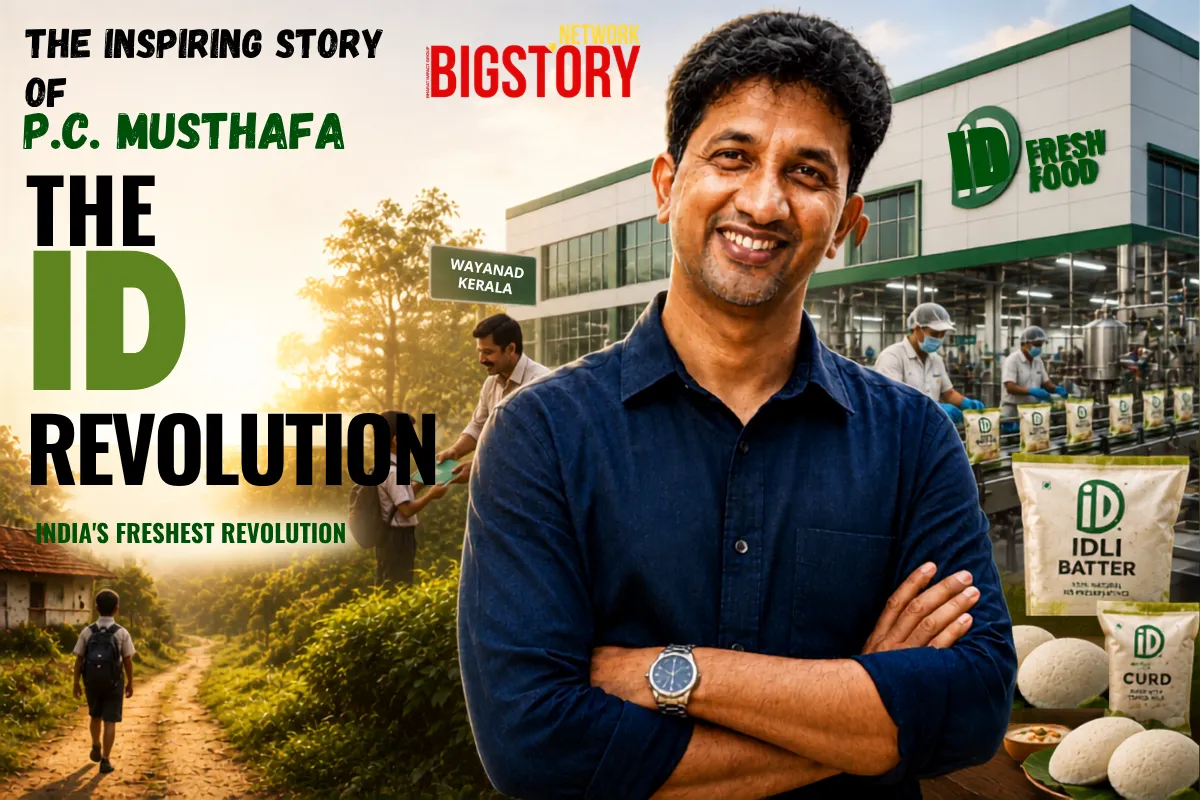
In a country where background is often destiny, Musthafa's story is a quiet, powerful rebellion. It does not read like a fairy tale. This is the story of a man who did not just build a business. He built a movement around the idea that real food, made honestly, for people, is a purpose worth dedicating a life to.
Musthafa's father, a daily wage labourer in Wayanad, Kerala, earned barely enough for the family to survive. The notion of investing further in a child who had already stumbled seemed impractical, even irresponsible. School felt like a luxury the family could not afford, both financially and emotionally.
The kind of expectation that is not born out of cruelty, but out of circumstance. And for a boy growing up in poverty, the most dangerous thing in the world is not failure.
“It is accepting that failure is final.”
One of India's most recognized fresh food brands, known for its preservative-free idli and dosa batter, parotas, curd, and more. Built from a modest kitchen in Bengaluru in 2005, iD Fresh Food today operates across multiple Indian cities and has an international presence, with revenues exceeding ₹500 crore and a brand valuation frequently cited in the ₹3,000 crore range.
But numbers, while impressive, do not fully capture who Musthafa is. He is a first-generation entrepreneur from a laboring family, an IIM Bangalore alumnus who once walked barefoot to school, a CEO who responds personally to customer complaints, and a man who has consistently chosen transparency over convenience in business, and in life.
Born in Perinthalmanna in the Malappuram district of Kerala, Musthafa grew up in Wayanad, a hilly, forested region where life moves slowly and opportunity even more so. His father worked as a coolie, carrying loads for daily wages that rarely crossed ₹10. The family lived with the kind of scarcity where every meal mattered, every rupee was counted, and aspirations were kept carefully in check.
School was not a joyful place for young Musthafa. He struggled with academics, and when he failed in Class 6, the universe seemed to confirm what poverty had always whispered: that children like him were not meant for great things.
Once Musthafa made the decision to take school seriously, he did not look back. With renewed focus and a hunger that went far beyond academics, he not only recovered from his early failures but excelled. He completed his engineering degree and then achieved what must have seemed almost mythological from the vantage point of his Wayanad childhood — he secured admission to IIM Bangalore, one of India's most prestigious management institutions.
Post IIM, the world opened its doors. Musthafa landed a well-paying corporate job in the Middle East. By the measure of almost anyone who grew up the way he did, this was success. This was the dream fulfilled. He was comfortable, respected, earning well everything that poverty-stricken childhoods chase as their finish line.
In 2005, he made a decision that many would call reckless: he quit his job, returned to India, and co-founded iD Fresh Food in Bengaluru along with his cousins. With limited capital, no established market, and a product fresh idli-dosa batter that most urban consumers had never considered buying packaged, he started from scratch.
The early days were unglamorous. Batter was ground manually. Distribution was done locally. The team was tiny. The margins were thin. But the product was honest. No preservatives. No artificial colours. No compromise on quality. And slowly, steadily, the market began to notice.
At a time when packaged food in India was synonymous with preservatives, stabilisers, and ambiguous ingredient lists, Musthafa went the opposite direction.
✓ He printed ingredient lists clearly on packaging.
✓ He refused to add preservatives even when it would have extended shelf life and increased margins.
✓ He priced products honestly.
And when rumors spread on social media falsely claiming that iD products contained animal derivatives, he did not go silent or issue a legal notice. He responded openly, directly, and with evidence turning scepticism into loyalty.
Musthafa has often spoken about his customer-first philosophy a belief that if you genuinely take care of your customer, the business takes care of itself. This is not a marketing slogan. It is an operational principle that has shaped everything from product development to how the company handles complaints.
Musthafa does not speak of his past as a wound. He speaks of it as direction. The poverty of Wayanad, the ₹10-a-day wages, the classroom failures — these are not memories he has moved on from. They are the very things that keep him honest about where he is going.
Building a fresh food company in India is not for the faint-hearted. Let’s discover!
✓ The cold chain is unpredictable.
✓ Consumer habits around packaged food are deeply entrenched.
✓ Retailers are sceptical of products with short shelf lives.
✓ And then there is the internet a space where unverified rumours can undo years of trust-building in hours.
✓ iD Fresh Food faced its most public challenge when WhatsApp forwards began circulating claims that the company's products contained cow bones and non-halal ingredients allegations that were completely false, but which spread rapidly across India's messaging networks.
For a brand built on transparency, this was not just a business crisis. It was an existential one.
He publicly refuted the claims with facts, welcomed scrutiny, and doubled down on the brand's commitment to full ingredient transparency. The episode, rather than damaging iD Fresh Food irreparably, ended up reinforcing the brand's credibility among consumers who saw how it handled the crisis.
Beyond the boardroom, Musthafa has also endured deeply personal trials. He has spoken about the grief of losing a family member and the emotional toll of navigating legal processes in the aftermath experiences that tested him not as a CEO but as a human being. He emerged from these, too, with the same quality that defines his professional life: quiet resilience.
The first was failing Class 6. A red mark on a report card, and a world that said: this is where your road ends. His decision to go back nudged by a teacher who refused to give up on him was, in retrospect, the founding act of everything that followed.
The second turning point was walking away from a comfortable career in the Middle East. Most people who grow up poor and then achieve stability do not risk it. The psychological weight of scarcity makes security almost sacred. Musthafa's willingness to give that up to bet on an idea, a product, a principle speaks to a rare quality: the ability to be motivated not just by fear of poverty, but by vision of purpose.
These two moments, separated by decades, share a common thread. In both cases, Musthafa chose discomfort in service of something larger. That, more than any single business decision, is what has made him who he is.
P.C. Musthafa is not the kind of CEO who hides behind a PR team. He engages directly with customers on social media, with employees on the floor, with critics in public forums. He does not speak in corporate jargon. He speaks the way a person does who has had to earn trust the hard way and knows there are no shortcuts.
His leadership is built on three pillars. First, transparency is a near-obsessive commitment to showing customers exactly what is in every product. Second, consistency is a refusal to cut corners even when the market would probably not notice. Third, humility and awareness that nothing he has achieved was inevitable, and everything could disappear if he stops paying attention to what actually matters.
For Musthafa, success is not about being the smartest person in the room. It is about being the most honest. About doing the right thing consistently, even when no one is watching. About building something that genuinely solves a real problem for people and not being in a hurry to cut that process short for the sake of a quicker return.
He is also a reminder that failure is not the opposite of success. It is the curriculum. The boy who failed Class 6 did not become a ₹3,000 crore entrepreneur despite that failure. He became one, in part, because of what that failure taught him about resilience, humility, and the value of a second chance.
• Begin where you are. Your postcode, your marks, your bank balance — none of these are your final word.
• Honesty is not a soft value. It is the hardest competitive advantage to replicate.
• Build trust before you build revenue. Revenue follows trust. Not the other way around.
• When the rumours fly, respond with facts. When the crisis hits, show your face.
• Do not outrun your principles. They are the only things that stay constant when everything else changes.
• Take people with you. The journey means more when the people who believed in you first get to share in what you build.

 Exclusive Content




Sign up for the Daily newsletter to get your biggest stories, handpicked for you each day.


 Trending Now! in last 24hrs