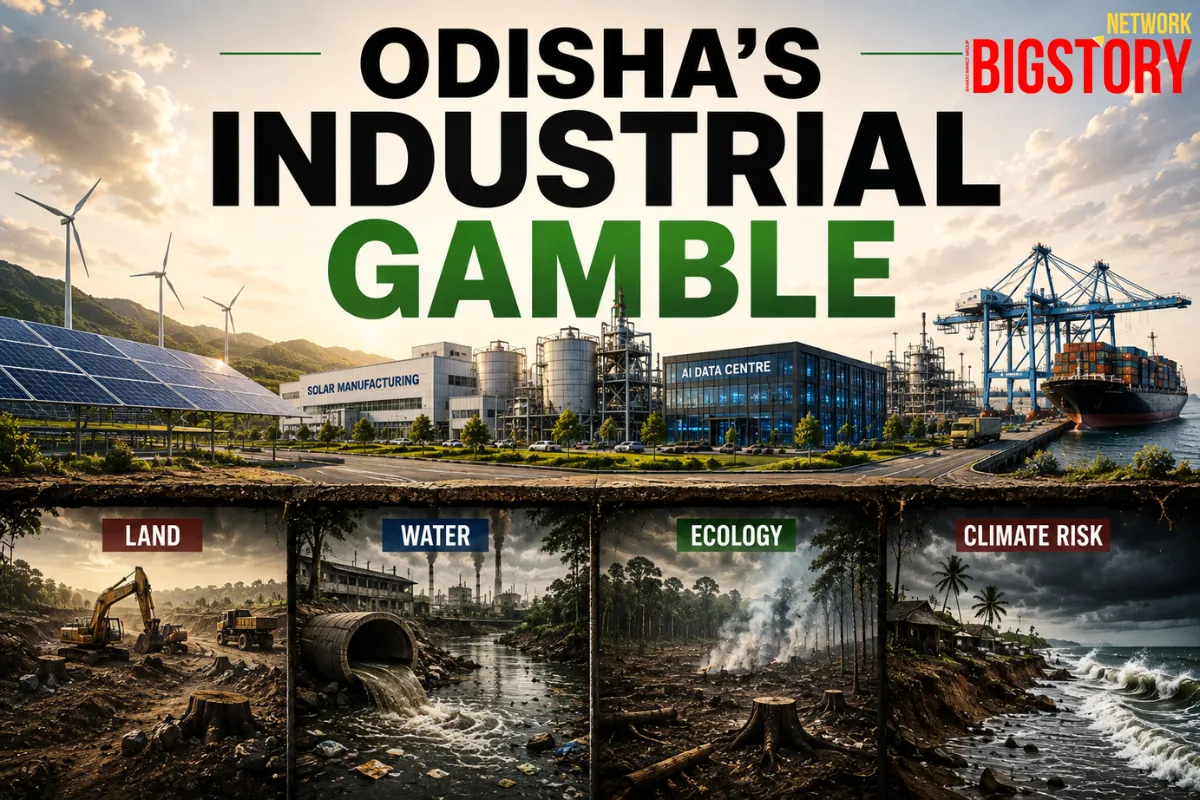
Odisha is attracting massive investments in steel, solar manufacturing, batteries, textiles and AI data centres. But beneath the investment boom lie difficult questions around land, tribal consent, water, forests and coastal ecology. Is Odisha building a sustainable industrial future—or repeating the costs of its past?
 Minaketan Mishra
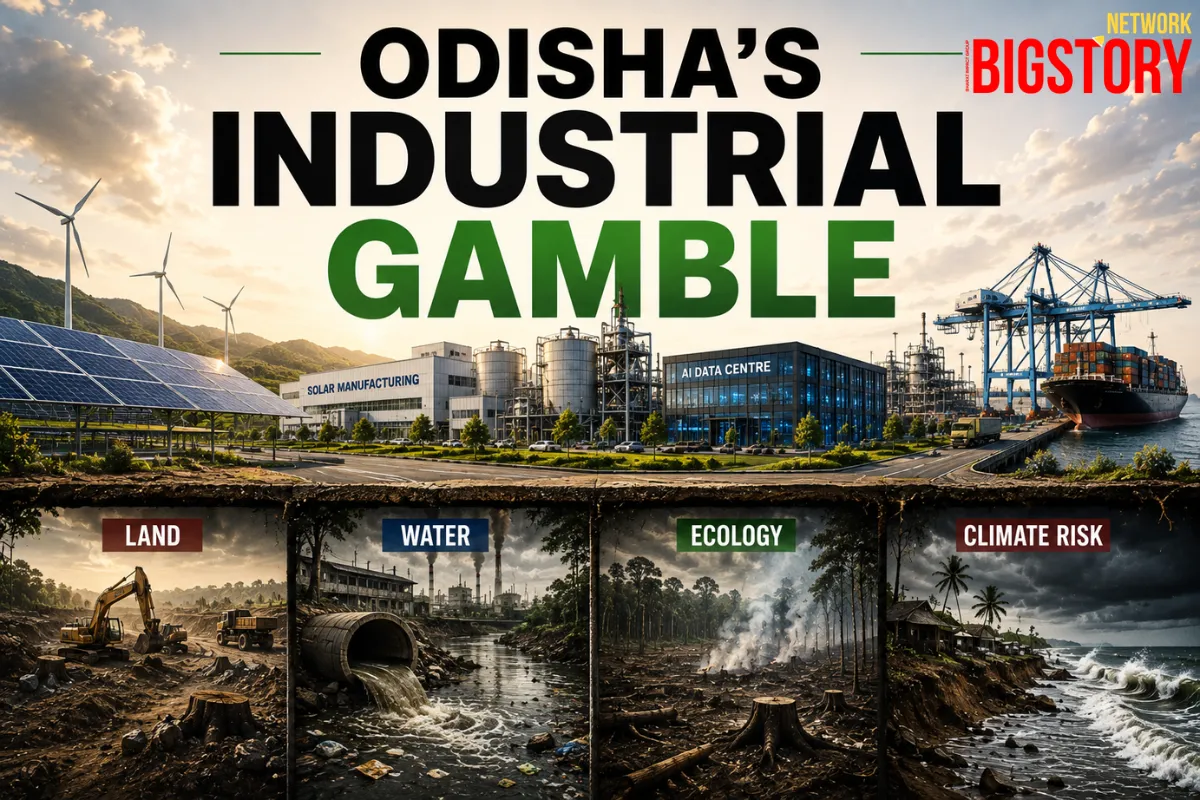
Odisha has spent decades being known for minerals, steel and cyclones. Now it is attracting solar manufacturing, textiles, batteries, AI infrastructure and some of the country's biggest industrial investments. The harder question is whether the state can convert that capital into durable development without exhausting the land, water and ecology that make the growth possible in the first place.
India's conversation about the next great manufacturing hub rarely starts with Odisha. Maharashtra, Gujarat, Tamil Nadu, Karnataka and, increasingly, Andhra Pradesh tend to fill that space. Odisha has historically occupied a different position in India's economic imagination — a mineral-rich state whose significance came from what lay underground rather than from what industries were built above it.
That picture is shifting.
Odisha's economy is now estimated at roughly ₹9.88 lakh crore at current prices in 2025-26, with real growth running at 7.9% — above the national GDP growth rate of 7.4% for the same year. Per-capita income stands at ₹1,86,761, according to the state's own Economic Survey. (Finance Department Odisha)
But the size of the economy today is not the more interesting story. What companies are beginning to build there is.
From solar equipment and textiles to batteries, steel and artificial intelligence infrastructure, investments are arriving across sectors that could give Odisha an industrial base far wider than the mining-and-metals economy it has long been associated with.
Which raises a harder question than whether the investment is real.
Why is this happening now — and what happens if the state attracts the capital but gets the development model wrong?
Odisha's industrial potential was never hidden. The state holds large reserves of iron ore, coal, bauxite and chromite. Its coastline runs for roughly 480 kilometres, and its major ports — Paradip, Dhamra and Gopalpur — give manufacturers direct access to maritime trade routes.
That combination matters because manufacturing is ultimately a logistics problem. A factory needs raw materials delivered cheaply, reliable electricity, land to build on, workers who can operate it and a way to move the finished product to buyers. Odisha already had several of those pieces in place.
What has changed is the state's capacity to package them coherently.
That becomes visible when you look at the industries now choosing the state. In textiles, Odisha's TEX 2025 investment push produced agreements with companies including Japan's Toray and Sri Lanka's MAS Holdings. The pitch is not simply cheap land — it is an attempt to build a sectoral ecosystem capable of generating significantly more employment than highly automated heavy industry.
Then there are industries that would have sounded implausible in a description of Odisha a decade ago. Companies including Kira Diam, Anjali Labtech and Grow Magnificent have proposed lab-grown diamond manufacturing investments in Khordha. Battery storage and EV-component projects are also emerging, including facilities associated with CESC Green Power and Lithros Batteries.
Individually, some of these projects may not transform the state. Collectively, they point toward something more significant.
Odisha is trying to move up the industrial value chain. It no longer wants to be simply the place where India extracts raw material. It increasingly wants to be where that material is processed, manufactured and exported.
Solar manufacturing is among the clearest illustrations of that shift.
Tata Power Renewable Energy selected Odisha for a proposed 10 GW ingot-and-wafer manufacturing facility, after considering Andhra Pradesh. The project is planned across two phases, with operations expected to begin in 2028. (The Economic Times)
The significance is not simply the scale — the ₹10,000 crore associated with the project. It is the fact that Odisha was competing directly against another coastal state aggressively positioning itself as a manufacturing destination. And Odisha won.
The state has been deploying a combination of capital subsidies, electricity-duty concessions, power-related incentives and GST-linked support to make that proposition work. When a company is deciding where to place a capital-intensive manufacturing facility, those incentives can make an enormous difference.
This is where the industrial story becomes more complicated. Governments do not attract factories simply because they have minerals or ports. They compete for them — using incentives, infrastructure, land and speed of approvals.
Odisha appears to have understood that competition. In July 2026, the state approved 23 industrial projects worth ₹45.74 billion across 11 districts, covering IT, textiles, pharmaceuticals and chemicals. (Reuters)
That does not mean every announced investment will become an operational factory. This distinction is crucial.
An MoU is not a factory. An approved proposal is not production. A proposed investment is not money already spent.
But the volume and breadth of proposals remains a meaningful signal of investor interest. And that interest is moving beyond conventional manufacturing.
The most surprising dimension of this transformation may not be steel or textiles. It is data centres.
In July 2026, HCLTech announced a ₹14,257-crore investment for an AI data centre in Bhubaneswar, in partnership with Sarvam AI. HCLTech simultaneously announced plans for a 5,000-seat technology centre in the city, with operations expected to begin by 2028. (Reuters)
A data centre is fundamentally different from a conventional factory. A steel plant needs ore, coal, land, transport and enormous quantities of energy. A data centre also needs land and connectivity — but its most critical requirement is reliable, large-scale electricity.
Which brings us back to one of Odisha's oldest economic advantages: power. The state has historically generated more electricity than it consumes. The same advantage that once helped Odisha attract heavy industry can now serve an entirely different category of infrastructure. AI infrastructure.
There are also proposals on a much larger scale. Research for this article identified an Adani proposal for a 1 GW AI-focused data centre project in Odisha, with an investment figure of around ₹1 lakh crore. At the time of writing, it remained a proposal rather than a formally cleared project.
That distinction matters. But even proposals at this scale indicate where the competition is heading — and Odisha is no longer standing outside it.
Geography:
Odisha's coastline and ports give manufacturers access to maritime supply chains. Proximity to a functioning port materially reduces logistics costs for companies importing raw materials or exporting finished goods.
Power:
Power-intensive industries cannot tolerate unreliable electricity. Odisha's energy position gives it a structural advantage when competing for metals, manufacturing and data centre investment.
Land and industrial infrastructure:
The Odisha Industrial Infrastructure Development Corporation — IDCO — has been central to assembling and developing industrial land. That matters because land acquisition can otherwise take years and become one of the largest sources of uncertainty for major projects.
Speed:
The state has deliberately built its investment pitch around single-window clearances and faster approvals. When a company is choosing between states offering broadly comparable incentives, compressing the approval timeline by months — or years — can itself function as an economic incentive.
Then there is a fifth factor that has little to do with Odisha specifically.
China + 1:
Global manufacturers have spent years trying to diversify supply chains beyond China. India is among the most obvious beneficiaries of that shift. Coastal states with industrial land, ports, reliable power and stable policy environments are naturally positioned to compete for that capital. Odisha possesses several of those characteristics simultaneously.
That is why the current investment momentum should not simply be read as political marketing. There are real structural reasons companies are choosing the state. But every industrial advantage carries a cost — and this one is no different.
Odisha's most important industrial story also carries one of its most uncomfortable memories.
In 2005, South Korean steelmaker POSCO signed an agreement with Odisha for a massive steel project in Jagatsinghpur. What followed became one of India's most prominent examples of the difficulty of combining large-scale industrial development with land acquisition and local consent. Years of resistance from communities — over land, livelihoods and environmental concerns — preceded POSCO's eventual withdrawal in 2017.
The same landscape is now being transformed into another major steel project. JSW Steel has begun work on a large integrated steel complex at Dhinkia, on land originally associated with the POSCO project. The project is expected to reach a capacity of up to 13.2 million tonnes per annum, with investment estimates exceeding ₹1 trillion. (Business Standard)
The lesson here is not that Odisha cannot industrialise. Neither does JSW's arrival prove that the earlier concerns were irrelevant.
What the history actually demonstrates is why land is not simply an economic input. For the state, it is an industrial asset. For a company, it is a project site. For the people living on it, it may be a home, a farm, a source of income or a community built over generations.
Those are three different ways of valuing the same piece of land. That conflict does not disappear because the investment figures get larger.
The United Nations human-rights system has previously raised concerns regarding the JSW Utkal project — including allegations relating to food, water, health, environmental and cultural rights — while noting the current project followed POSCO's withdrawal. These are allegations and concerns, not findings that establish wrongdoing. They illustrate why consent and rehabilitation remain central to the project's social legitimacy. (SP Comm Reports)
The more immediate example is in the Sijimali hills of Kalahandi and Rayagada, where a proposed bauxite mine associated with Vedanta has become the centre of a serious dispute between the project, local communities and the administration.
More than 44 villages are situated around the Sijimali range, according to reporting on the dispute. In April 2026, clashes occurred between residents and police as opposition intensified. (Mongabay India)
The legal and environmental questions surrounding the project remain contested. Challenges have been brought before the National Green Tribunal concerning forest diversion and related approvals — including a 2026 proceeding that challenged a Stage-I forest clearance for 4.911 hectares connected to an access road intended to facilitate transportation from the mine. (Indian Kanoon)
An investigative article needs to be careful here. It is tempting to reduce the story to a simple equation: government plus company equals villain, villagers equal victims. Reality tends to be more complicated.
Mining generates employment, state revenue, infrastructure and industrial activity. Odisha's economy has historically depended heavily on mineral extraction, and abandoning it entirely would carry its own major economic consequences. But the opposite argument is equally incomplete. A project cannot be evaluated solely on how much investment it brings.
The relevant questions are whether consent was properly obtained, whether rehabilitation is adequate, whether environmental safeguards are enforceable, whether local livelihoods are protected and whether the economic benefits reach the communities carrying the greatest costs.
Those questions are not anti-development. They are questions about the quality of development.
There is a contradiction at the centre of Odisha's industrial strategy.
The same geography that makes the state attractive to industry also makes it unusually exposed to environmental disruption. Odisha's roughly 480 kilometres of coastline include the Mahanadi delta, Chilika, Bhitarkanika's mangroves and other wetland systems that provide ecological and economic functions far beyond their visual scale.
Research using satellite data from 1990 to 2019 found that 52.47% of analysed shoreline transects along the Odisha coast showed erosion, while 34.70% showed accretion. (ScienceDirect)
Research on the Mahanadi delta specifically has found extensive erosion and documented significant future risks for coastal communities. One study found roughly 65% of the delta coastline undergoing erosion and projected serious vulnerability for settlements along the shore. (ScienceDirect)
More recent evidence is no more reassuring. Research published in 2026 on the Konark coastal belt found continuing shoreline transformation associated with sea-level rise, changing wave conditions and human pressures. (Springer)
That matters because coastal infrastructure is one of the things Odisha is actively selling to investors as an advantage. Ports are valuable. Coastal industrial corridors are valuable. But the coast is also a natural defence system — mangroves, wetlands and coastal ecosystems absorb some of the impact of storms and flooding. When they are degraded, the economic calculation changes.
The question is not whether Odisha should use its coastline. It is how much ecological risk can be absorbed before the advantage itself begins to deteriorate.
This may become one of the least visible constraints on Odisha's next industrial phase.
Heavy industry needs water. Data centres need water for cooling, depending on the technology used. Agriculture needs water. Cities need drinking water. These demands do not exist in isolation.
A very large data centre can consume millions of gallons of water per day, depending on its cooling architecture, operating conditions and local climate. The exact requirement varies considerably by facility, so treating any single generic figure as universal would be misleading. But the broader issue is real: AI infrastructure is not physically weightless.
The cloud may sound intangible. The infrastructure beneath it is not. A gigawatt-scale data centre requires enormous quantities of electricity and supporting systems. Its environmental footprint depends on how the electricity is generated, how the facility is cooled and what happens to the waste heat and equipment at end of life.
Odisha wants to attract the industries of the future. But those industries will still depend on very physical resources — land, electricity and water. The same resources required by the communities already living there.
This is where the ₹76,000-crore-plus investment figures become dangerous — not because they are necessarily false, but because of what people instinctively assume they mean.
An investment announcement is not economic development. A project can be approved and never reach full capacity. A company can announce ₹10,000 crore and deploy it across several years. A factory can create jobs while displacing existing livelihoods. A data centre can attract enormous capital while employing far fewer people than a similarly sized manufacturing project. And a large industrial project can expand state GDP without improving the welfare of every community near it.
That does not make investment figures meaningless. It means we need to ask what the investment actually produces.
How many permanent jobs? How many local workers? How much value remains inside Odisha? How much tax revenue reaches the state? How much water does the project consume? How much land is converted? What happens to displaced livelihoods? What environmental obligations are imposed?
And perhaps most importantly: who gets the upside, and who carries the downside?
Those are much harder questions than announcing a number in crore.
There is a temptation to look at Odisha's recent industrial momentum as evidence that the state has solved its development problem. It has not. It has solved a different problem: getting companies interested.
That is significant. It is something Odisha has struggled to achieve at the scale of India's leading industrial states. But attracting capital is only the first half of industrialisation. The second half is converting that capital into broad-based development — reliable infrastructure, skilled employment, local supply chains, higher productivity, stronger cities, better public services and a tax base that can sustain the population long after the ribbon-cutting is over.
And there is a larger challenge still. Odisha is one of India's most environmentally exposed states — facing cyclones, coastal erosion, flooding and pressure on sensitive ecosystems. Its industrialisation cannot simply replicate the model of a landlocked industrial corridor where environmental damage remains someone else's future problem. The geography will not allow it.
Odisha's environment is not separate from its economy. It is part of the economy. The ports depend on the coast. Agriculture depends on water. Fisheries depend on wetlands and marine ecosystems. Communities depend on land. Cities depend on the infrastructure connecting all of them. Degrade enough of those systems and the industrial advantage eventually begins to undermine itself.
That may be the biggest misconception in this debate. The choice is not necessarily between remaining poor and becoming industrialised, or between protecting the environment and creating jobs.
Odisha needs development. It needs better-paying jobs, stronger industries, more private investment and a larger economic base. After decades in which the state was discussed primarily through the lens of poverty, natural disasters and mineral extraction, the current economic momentum is genuinely significant.
The question is whether development should be measured only by how much capital arrives.
The more useful measure is what remains after the capital arrives. Did incomes rise? Did local businesses grow? Did workers acquire transferable skills? Did the state build infrastructure that benefits people beyond the project boundary? Were displaced communities genuinely better off? Did environmental safeguards hold in practice rather than simply on paper? And twenty years later, is the land, water and ecosystem still capable of supporting another generation of growth?
Those questions do not weaken Odisha's industrial story. They make it more credible.
There is no reason to treat Odisha's industrial transformation as imaginary. The numbers are moving. The economy is growing. Major manufacturers are choosing the state. Tata Power has selected Odisha for a large solar manufacturing project. HCLTech and Sarvam are building AI infrastructure in Bhubaneswar. JSW is moving ahead with a large integrated steel complex at Jagatsinghpur. (The Economic Times)
This is not a state waiting for development to arrive. It is actively competing for it.
But that is precisely why the questions around land, consent, water and ecology matter more — not less. The challenge for Odisha is no longer simply how to attract investment. It is how to ensure that investment builds a state that is more prosperous without becoming harder to live in.
Because ₹10,000 crore, ₹50,000 crore or ₹1 lakh crore can tell us how much money is entering an economy. They cannot tell us whether the people living there will be better off in twenty years.
That is the real test of Odisha's industrial gamble.
A state can become richer while becoming harder to live in. That is not sustainable development. It is growth with the bill postponed.
Odisha has the minerals, the ports, the power, the land and increasingly the infrastructure and policy machinery to compete for India's next wave of manufacturing and technology investment. The same state also has vulnerable coastlines, forests, agricultural communities and water systems that cannot be treated as a line item in an investment proposal.
Odisha does not have to choose between development and sustainability. But it does have to prove it can deliver both.
Because a ₹1 lakh crore investment is impressive.
A ₹1 lakh crore investment that still leaves behind a state people can afford to live in, work in and pass on to the next generation —
that's development.
 Exclusive Content





Sign up for the Daily newsletter to get your biggest stories, handpicked for you each day.

 Trending Now! in last 24hrs