Analyze the disconnect between India's 7.8% GDP growth in Q1 2026-27 and the reality of rising food inflation, net FDI outflows, and high youth unemployment.
 Brajesh Mishra
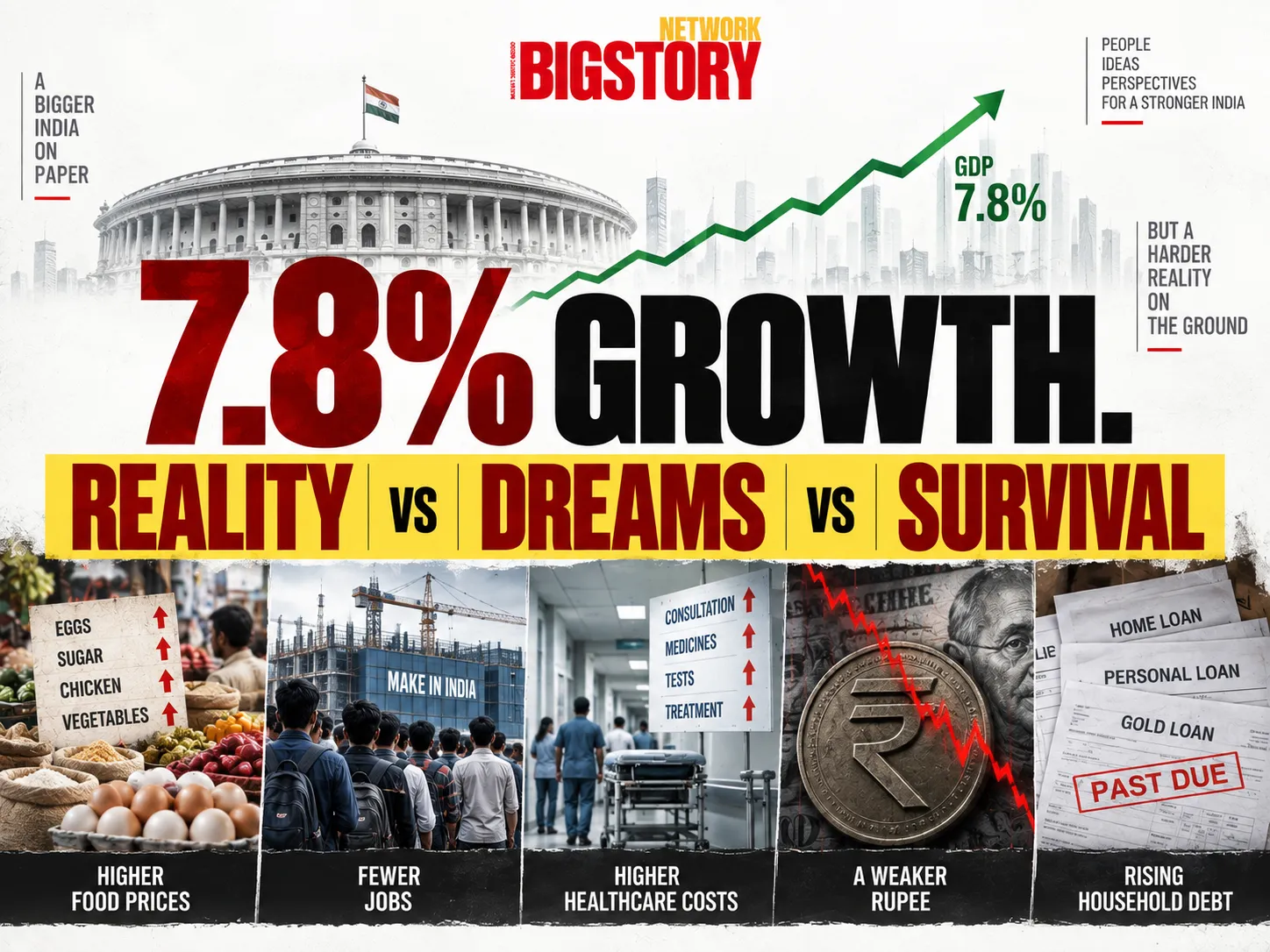
Seven point eight percent, that is the official measure of India's economic expansion in the first quarter of the 2026-27 fiscal year. By every macroeconomic textbook definition, it is a spectacular number. It signals a roaring engine in a sluggish global economy, easily outpacing China, the United States, and the European Union, but step away from the financial dashboards, walk into any local market, look at the price of a tray of eggs or a kilo of sugar, and ask yourself a deeply uncomfortable question: *If the economy is winning at this scale, why does almost nobody feel like they are?*
The answer is not the numbers rather the problem far more systemic and infinitely more dangerous that India has successfully engineered with an economy where macro-level growth completely detaches from household-level security.
Here is the autopsy of where the growth actually happens and exactly where it stops before it ever reaches your wallet.
The cornerstone of the modern Indian economic dream is manufacturing. On a micro level, the government’s flagship industrial masterplan the Production Linked Incentive (PLI) scheme is an undeniable triumph. It has generated ₹2.4 lakh crore in verified investments, driven over ₹15 lakh crore in exports, and synthesized roughly 14 lakh direct and indirect jobs across 14 sectors. That is real capital moving into real factories, but look at the macro reality, despite these massive capital injections, manufacturing's share of India's total GDP is still sitting stagnant at around 13 to 14 percent. It has barely moved in decades.
Worse, the momentum is quietly stalling. India's manufacturing Purchasing Managers' Index (PMI) came in at 52.8 in August 2026—technically an expansion, but a noticeable drop from 53.5 in July. We have built a policy that objectively works for a handful of targeted sectors, but it has completely failed to scale into the broader, national industrial revolution required to lift the middle class.
Foreign Direct Investment (FDI) is supposed to be the ultimate validator of the India story. Foreign capital enters, infrastructure scales, and employment follows.
If you look exclusively at the headline numbers, the narrative holds. In the 2025-26 fiscal year, gross FDI inflows into India rose to a massive $94.6 billion. But gross FDI is the vanity metric; net FDI is the reality.
Because while tens of billions flowed in, an almost identical amount flowed right back out through aggressive repatriations, dividend payouts, and disinvestments by foreign private equity firms. Net FDI ultimately landed at just $7.6 billion (a recovery from a devastating crash to under $1 billion in 2024-25).
Capital is entering and exiting at nearly the exact same velocity. This reveals a harsh structural truth: India is currently acting as a highly lucrative, temporary parking lot for global financial returns, rather than a permanent destination for long-term industrial capital.
Nowhere does this macroeconomic disconnect hit harder than on the dining table.
The Indian rupee has slid past the 95 mark against the US dollar. If you do not trade currency, this sounds like a problem exclusively for central bankers. It isn't. A weaker rupee makes imported fuel, imported fertilizer, and imported industrial machinery fundamentally more expensive. Importers do not absorb these costs; they pass them down the supply chain directly to the consumer. By the time currency depreciation reaches your kitchen, it acts as an invisible, unlegislated tax.
Egg prices are up 35 to 40 percent in a single year. Retail sugar hovers around ₹64 a kilo. Maize—the foundational grain of the animal feed economy has skyrocketed from ₹14,000 a tonne to ₹26,500 a tonne in just three years.
There is an obvious culprit for maize inflation: currently, roughly 37 percent of India's entire maize crop is being diverted away from agriculture and into ethanol production for fuel blending. More maize in fuel tanks equals more expensive poultry.
But if ethanol were the sole disease, a commodity like wheat—which has absolutely zero to do with fuel blending should be stable. It isn't. Wheat prices are rising despite India sitting on a staggering 604 lakh metric tonnes of buffer stock nearly three times the required strategic reserve.
The farmer only sees the price of feed. The consumer only sees the price of a meal. But the government manages agriculture, fuel, and trade as completely isolated departments, utterly failing to see that a fuel policy is actively cannibalizing food security.
This pattern tangible progress sitting immediately adjacent to a paralyzing, unresolved gap infects the very infrastructure of survival.
Take medical education. India desperately needs more doctors. Yet, the pipeline is so fundamentally broken by infrastructure deficits and financial unaffordability that roughly 18,000 postgraduate medical seats recently sat entirely vacant, forcing the government to drop the NEET-PG qualifying cutoff to the zero percentile just to fill classrooms. Meanwhile, healthcare inflation is rising at 12 to 14 percent annually. India’s medical care may be affordable by global standards, but a single medical emergency is still enough to force a middle-class family into generational debt.
Look at employment. Urban youth unemployment remains stubbornly high at 18.2 percent, leaving an estimated 8.7 crore young Indians entirely outside of education or employment. The government’s highly touted PM Internship Scheme promised one crore internships. In its initial rounds, it received over 13 lakh desperate applications. Fewer than 2 lakh offers were generated, and a mere 3,700 internships were actually completed early on.
And look at how the public is surviving this gap. Gold loan searches have surged over 50 percent. Small personal loan defaults have climbed from 4 percent to 6.4 percent, while corporate loan write-offs have crossed the ₹10 lakh crore threshold.
A successful PLI scheme does not automatically solve systemic unemployment. A three-times food buffer does not automatically halt inflation. Expanding medical seats does not guarantee affordable healthcare. And an internship scheme does not synthesize a career.
Every single one of these policies can succeed on its own narrow, bureaucratic terms and still completely fail to solve the larger economic reality of the citizen.
Because policy in India is built in silos. But the economy is experienced as a loop. Fuel mandates change food prices. Food prices dictate inflation. Inflation annihilates the purchasing power of your wage. And the sliding rupee changes what it costs to produce anything at all.
India is growing at 7.8 percent. That is a mathematical fact.
But growth is not the same thing as security. Growth is not affordable food. Growth is not a stable job. The real test of an economy was never the headline growth number; it is whether that number actually reaches the people it is supposed to serve.
 Exclusive Content



Sign up for the Daily newsletter to get your biggest stories, handpicked for you each day.



 Trending Now! in last 24hrs