They spent twenty years in two unrelated worlds — chip design and language research before betting that India deserved AI that spoke its own tongue. Sarvam AI is the $1.5 billion answer.
 Rashmeet Kaur Chawla
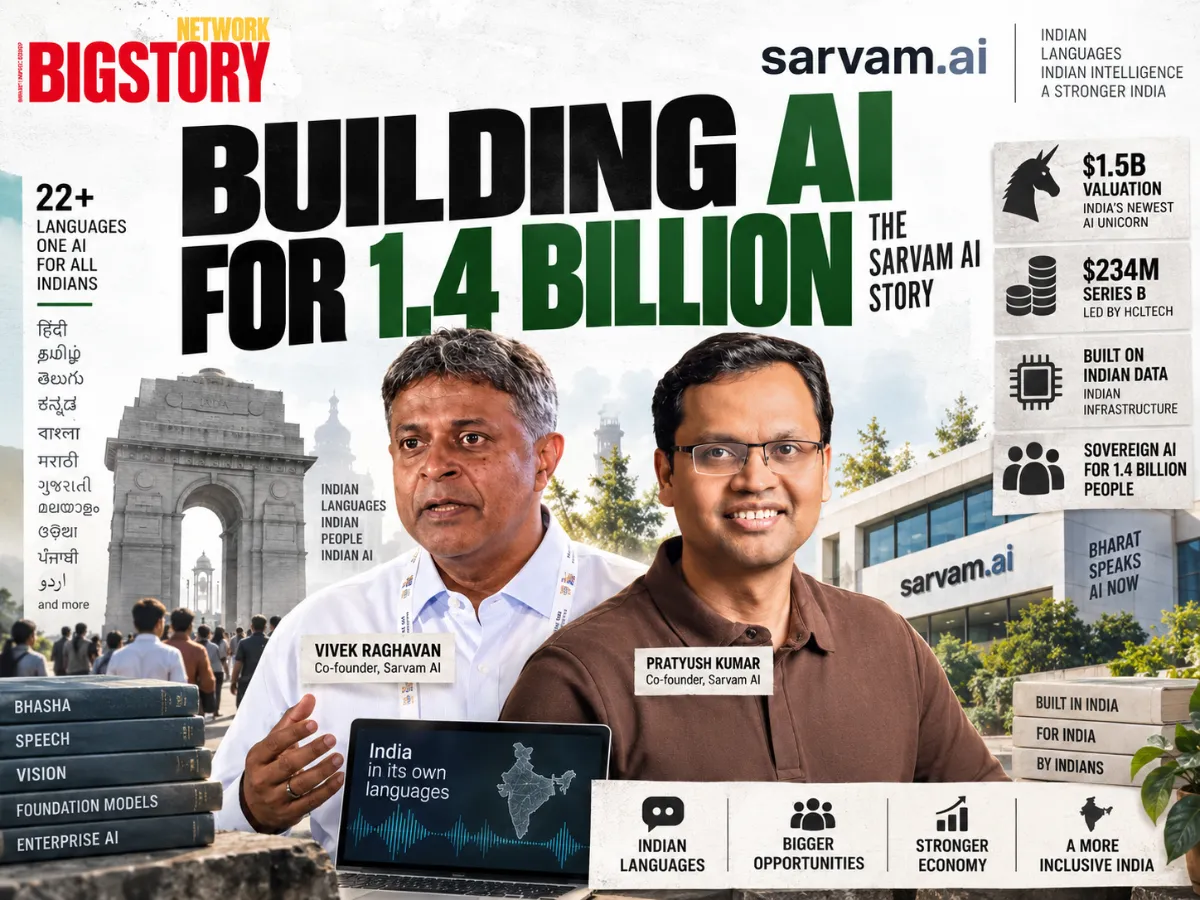
Two Indian engineers pitch an idea that most global investors would have laughed out of the room: that India did not need to rent its intelligence from Silicon Valley, it needed to build its own. No blockbuster demo. No English-first chatbot. Just a stubborn, almost irrational belief that a nation of 1.4 billion people, speaking 22 official languages and hundreds of dialects, deserved an AI that spoke back to it in its own tongue. Three years later, that belief is a $1.5 billion company. This is the story of how Vivek Raghavan and Pratyush Kumar turned a demographic inconvenience into India's biggest AI opportunity.
Every major AI model on earth was built around English, and Indian languages were treated as an afterthought bolted on later. Hindi and Kannada text needed four to eight times as many computational "tokens" as English to say the same thing, making Indian-language AI slower, costlier and clumsier by design. Global capital was pouring into English-centric labs in California, while an Indian startup asking for GPU clusters to train frontier models in Bhojpuri and Bengali sounded, to most VCs, like a rounding error. The conflict was not just technical. It was a question of who gets to be a first-class citizen of the AI age, and who gets translated.
Vivek Raghavan and Pratyush Kumar are the co-founders of Sarvam AI, the Bengaluru-based company that became India's newest unicorn in June 2026 after a $234 million Series B round led by HCLTech, at a valuation of $1.5 billion. Sarvam is building what the founders call a "full-stack sovereign AI platform" — foundation models, speech systems and enterprise tools trained from the ground up on Indian data, for Indian languages, on Indian infrastructure. In 2026, Raghavan was named among TIME magazine's 100 most influential leaders in artificial intelligence for his role in building a homegrown Indian-language AI stack instead of leaning on American technology giants.
Raghavan studied electrical engineering at IIT Delhi, completing his undergraduate degree in 1989, before earning his PhD in Electrical and Computer Engineering from Carnegie Mellon University in 1993. What followed was nearly two decades in an entirely different world: electronic design automation, the specialised software used to design computer chips. He co-founded two EDA companies and held senior roles at Synopsys, Magma Design Automation and Avant!, with Nvidia among his early clients. It was, by any measure, a career built in semiconductors, not language or speech.
Kumar's path ran on a parallel but separate track. An electrical and electronics engineering graduate from IIT Bombay, he completed his PhD in computer engineering at ETH Zurich in 2014. He then spent over fifteen years across research roles at IBM Research and Microsoft Research, before returning to India as adjunct faculty at IIT Madras. There, he co-founded AI4Bharat, an open-source initiative dedicated to building datasets, benchmarks and models for Indian languages, and later co-founded One Fourth Labs, whose PadhAI platform trained more than 100,000 Indian students in deep learning at low cost.
Raghavan's turning point arrived not in a lab but at home. In 2007, following the loss of his mother, he returned to India and stepped away from the semiconductor world entirely. He joined the newly formed Unique Identification Authority of India as Chief Product Manager and Biometric Architect, working alongside Nandan Nilekani to build Aadhaar the world's largest biometric identification system, eventually serving more than a billion Indians. He later worked with the EkStep Foundation on Digital India Bhashini and became Chief Mentor at the Nilekani Centre at AI4Bharat, IIT Madras, advising on AI integration for public systems like GSTN and UPI.
While Raghavan was learning what it took to build infrastructure at population scale, Kumar was documenting, benchmark by benchmark, how badly global AI systems failed Indian users. Through AI4Bharat, he watched first hand how the world's most advanced language models stumbled over Indian scripts, accents and code-switching between languages in the same sentence. In August 2023, their paths converged and Sarvam AI was born in Bengaluru.
The founders describe the core inefficiency they set out to fix as a "token tax": global models needed four to eight tokens to represent a single word in Hindi or Kannada, against roughly 1.4 tokens for English, making Indian-language AI structurally slower and more expensive. Their conviction was that this was not a problem you could patch by fine-tuning an existing Western model. It required native tokenization, vernacular-first training data and models built from first principles for India's linguistic and cultural diversity sovereignty, not translation.
Building a frontier AI lab from India came with obstacles most Silicon Valley founders never face. Competitive large language models demand enormous computing power and capital, both scarce for an Indian startup competing against companies backed by trillion-dollar balance sheets. Raghavan and Kumar had to convince investors that a sovereign AI lab built around Indian languages was a serious bet, not a niche one, at a time when global attention and funding were overwhelmingly chasing English-centric frontier labs. And the technical challenge was brutal in its own right: India's twenty-two official languages are not one problem multiplied by twenty-two, but twenty-two distinct problems, each with its own script, dialects and cultural context.
Then, in February 2026, at the India AI Impact Summit at Bharat Mandapam, Sarvam unveiled its Sarvam-30B and Sarvam-105B models, trained entirely on Indian computing infrastructure, claiming to outperform established global players on Indian-language benchmarks in front of representatives from Google, OpenAI and Anthropic. Four months later, in June 2026, Sarvam closed the first tranche of its Series B at $234 million, led by HCLTech with participation from Bessemer Venture Partners and earlier backers Lightspeed India, Khosla Ventures and Peak XV Partners, pushing its valuation to $1.5 billion and making it India's newest AI unicorn.
Beyond its foundation models, the company has shipped the Bulbul text-to-speech system used by banks and telecom companies, the Saaras speech engine, Sarvam Vision for reading difficult Indian-language handwriting, the Indus consumer app pitched as a homegrown alternative to global chatbots, Chanakya, an air-gapped platform built for defence and government use, and even Sarvam Kaze, a pair of AI-enabled smart glasses. One large fintech client already uses Sarvam's agentic AI platform to support a sales force of more than 350,000 people. That full-stack instinct — owning everything from the base model to the hardware — is what the founders mean when they talk about sovereignty as a product philosophy, not a slogan.
Raghavan and Kumar's story carries a quiet lesson for India's next generation of founders: the twenty years you spend somewhere that looks unrelated to your eventual startup are rarely wasted. Raghavan's decades in chip design taught him how to engineer at scale before he ever touched a language model. Kumar's years documenting AI's blind spots gave him the evidence before he had the company. Neither man built Sarvam as a first-time dreamer chasing a trend. They built it as second-time dreamers who had already spent a career learning what the problem actually was. For young founders, the message is simple: depth in an unrelated field is not a detour from your real work, it may well be the training ground for it.
The most intriguing founders are never first-time dreamers; they're second-time dreamers who carry a lot of experience from the previous twenty years and apply that to something completely new.
Vivek Raghavan and Pratyush Kumar falls under the BIGSTORY's - The Challengers is not because Sarvam AI is now worth $1.5 billion, but because of the gap they refused to accept: a sixth of humanity being asked to make do with AI that was never built with them in mind. They did not wait for a global lab to get around to Indian languages. They built the lab themselves, on Indian soil, with Indian data, for Indian people.
 Exclusive Content

Sign up for the Daily newsletter to get your biggest stories, handpicked for you each day.

 Trending Now! in last 24hrs