How the Chabahar-Gwadar Convergence and the Mecca Joint Defense Agreement Are Changing South-West Asian Geopolitics
 Prof. (Dr.) Nishakant Ojha

The Trade Shift: Iran and Pakistan are moving to economically connect the Indian-backed Chabahar port with the Chinese-backed Gwadar port via the proposed Rimdan-Gabd joint free zone. This blurs the lines and threatens India's exclusive, Pakistan-independent trade route into Central Asia.
The Security Shift: Saudi Arabia, Pakistan, and Turkey have signed the Mecca Joint Defense Agreement. While framed as defensive against Gulf threats, this trilateral mutual-defense pact formalizes a powerful defense-technology pipeline—most notably accelerating the transfer of Turkish drones to Islamabad.
The Strategic Response: India must avoid alarmist "shadow conspiracy" narratives and recalibrate pragmatically. The immediate priorities are leveraging the INSTC to maintain Chabahar's distinct utility, deepening Gulf ties entirely independent of Pakistan, and closely monitoring the Turkish-Pakistani military tech transfers.
A strategic analysis by (Dr.) Nishakant Ojha - an internationally eminent expert in National Security, Counter-Terrorism, and the strategic affairs of West Asia and the Middle East.
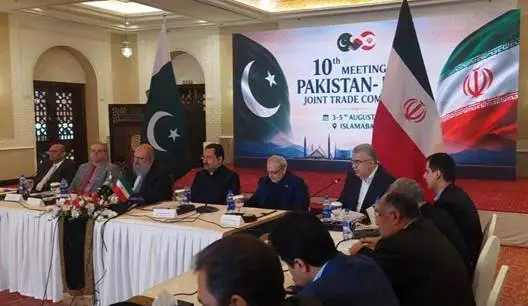
Two announcements, one region -Two things happened within days of each other in early August 2026, and taken together they say a lot regarding where this part of the world is heading. In Islamabad, the 10th Iran-Pakistan Joint Trade Committee sat down to talk about the Chabahar-Gwadar corridor and a proposed Rimdan-Gabd joint free zone-essentially a plan to wire Iran's Chabahar port into Pakistan's Gwadar port using shared border infrastructure, with both governments talking up a target of USD 10 billion in bilateral trade ("Joint Statement of the 10th Iran-Pakistan Joint Trade Committee," Islamabad, August 2026). Meanwhile in Mecca, Saudi Arabia, Pakistan and Turkey signed something with sharper edges: the Mecca Joint Defense Agreement, a mutual-defense pact stating that an attack on any one of the three will be treated as an attack on all three ("Text of the Mecca Joint Defense Agreement," Mecca, August 2026).
These are not the same kind of event, and they were not planned as a matched pair. However, both developments point in a similar direction: the region is quietly reshaping itself, economically around a Chabahar-Gwadar axis and militarily around a Riyadh-Islamabad-Ankara alignment. This simultaneous transformation is especially important for India, as it occurs just as several longstanding assumptions that have underpinned Indian policy-regarding its relationship with the Gulf, Iran, and Pakistan-are all being challenged at once.
The trade side-Chabahar, Gwadar, and what Rimdan-Gabd actually changes India's Chabahar strategy has always rested on one basic idea: give India a route into Afghanistan and Central Asia that doesn't run through Pakistan. For that to work, Chabahar and Gwadar needed to stay in separate lanes-one serving Indian and Central Asian interests, the other serving Chinese and Gulf interests -with the two ports competing rather than cooperating.
That separation is starting to blur. Iranian officials are now openly describing Chabahar and Gwadar as complementary rather than rival ports, and the Rimdan-Gabd crossing - sitting about 120 kilometers from Chabahar and 70 from Gwadar - is meant to link the two using shared customs and logistics arrangements. There's even talk on the Iranian side of tying this crossing into the wider China-Pakistan Economic Corridor, which would hand Beijing a new, indirect channel into Iranian trade.
Why now? Mostly practical reasons, not major strategy. Iran's maritime trade has taken a beating from sanctions and from the disruption caused by the regional war that started in February 2026, so Tehran has real incentive to build an overland alternative through Pakistan. Pakistan, for its part, has spent years trying to get Gwadar's traffic to match the scale of Chinese investment poured into it, and this is a chance to do that finally. None of this is really aimed at India - it's two governments under pressure finding a convenient overlap. That doesn't mean it costs India nothing. It just means the story here is opportunism, not conspiracy.
The security side -The Mecca Joint Defense Agreement -The defense pact is a different animal, and truly the more consequential of the two. It builds on the Saudi-Pakistan Strategic Mutual Defense Agreement from September 2025 and adds Turkey to the mix - a NATO member with the alliance's second-largest army and an increasingly serious defense-export sector, drones especially. What you end up with is a mutual-defense commitment between three of the most militarily capable Sunni-majority states anywhere, and one of them, Pakistan, has nuclear weapons.
Officials from all three countries have repeatedly stated that this agreement is defensive in nature, asserting that it does not constitute a new sectarian bloc and is not linked to any nuclear arrangement ("Text of the Mecca Joint Defense Agreement," Mecca, August 2026; official press statements by the Ministries of Foreign Affairs of Saudi Arabia, Pakistan, and Turkey, August 2026). Those denials merit serious consideration rather than being dismissed outright. The timing of the agreement, coinciding with the ongoing Iran war and recurrent missile and drone attacks on Gulf states, suggests that this is primarily a Gulf-security response to an active conflict, rather than a document specifically drafted with India as its focus.
What's real for India here, and what isn't Still, “not designed to target India” doesn't mean “irrelevant to India.” A few things are worth pulling apart from the noise-
The nuclear dimension is significant for Indian security calculations. Pakistan's longstanding defense partnership with Saudi Arabia, encompassing areas such as training and technical assistance, forms the basis for closer military collaboration. The establishment of a formal mutual-defense pact now raises the possibility that Pakistan’s nuclear deterrent could be perceived as informally extending to Riyadh. While Saudi officials publicly deny any such arrangement, India must assess both the possibility for such an extension and the limitations of official statements. Consequently, a prudent Indian security strategy calls for careful consideration of these developments, acknowledging both the risks and the assurances involved.
Turkey's presence matters for reasons that predate this pact. Ankara has already been supplying Pakistan with drones and other hardware, and has been consistently vocal on Kashmir at international forums. This agreement formalizes ties that were already deepening. What India's defense planners will actually watch is the technology-transfer piece - drones and precision-strike systems in particular, given how relevant that's already proven in South Asian contexts.
Iran does not fit neatly into an “axis” narrative. Tehran was not a signatory to the Mecca pact and has previously indicated that it views the earlier Saudi-Pakistan agreement more as a possible foundation for an inclusive regional security framework than as an exclusive alignment from which it is excluded. From the Iranian perspective, engaging with regional actors, including Saudi Arabia and Pakistan, could provide diplomatic leverage and reduce the risks of strategic isolation. Iran’s willingness to entertain broader security cooperation suggests a practical approach to defending its interests amid shifting alliances. Simultaneously, as Iran increasingly depends on the Pakistan corridor to reduce the effects of economic sanctions and regional unrest, it becomes less able to offer India the kind of exclusive, Pakistan-independent access that originally made Chabahar a uniquely preferable option for New Delhi. This development entails a real, though gradual and indirect, strategic expense to India. However, it reflects Iran's flexible and adaptive calculus in response to economic stresses, instead of evidence of a coordinated strategy directed against India.
The two tracks should not be merged into a single overarching narrative. Sanctions and commercial pressures primarily drive the trade convergence, while the defense pact responds to immediate wartime security needs in the Gulf. While some middle east analysts may contend that these developments represent a coordinated effort against India's regional stakes, the available evidence suggests otherwise. Folding both into a single “shadow conspiracy” narrative attributes a level of coordination to these governments that is not substantiated by current events. Instead, the situation appears to comprise three countries pursuing distinct near-term interests that happen to overlap in ways that disadvantage India. This constitutes a substantive challenge for India, even if it does not reflect the kind of deliberate conspiracy that a more unified narrative might suggest.
Where this leaves Indian strategy -None of this is a case for sitting back. It's a case for being precise about what's actually changing. A few things seem worth prioritizing-
●Keep Chabahar meaningfully useful to India, even as Iran tilts toward the Pakistan route - through the International North-South Transport Corridor and continued Indian investment, so Tehran has reasons to preserve a distinct Indian channel rather than let it fold entirely into a Pakistan-centered network.
● Build out Gulf ties on their own terms. India has spent a decade earning real goodwill with Saudi Arabia and the UAE. That relationship needs to keep developing independently of Pakistan, so the Mecca pact doesn't quietly erode Gulf support on issues that matter to India, like Pakistan-based terrorism.
● Watch the Turkey-Pakistan defense pipeline closely - drones and precision-strike systems specifically, since that's where the operational risk actually shows up.
The bottom line -The Chabahar-Gwadar convergence and the Mecca Joint Defense Agreement mark a real modification in how Iran, Pakistan, Saudi Arabia and Turkey are hedging against sanctions, war, and an uncertain American security guarantee. For India, the right response isn't alarm about a unified plot - the public record doesn't really support that reading - but a clear-headed recalibration: protect what makes Chabahar valuable, deepen Gulf relationships that stand on their own, and keep a close eye on the defense-technology pipeline running through Pakistan.
 Exclusive Content





Sign up for the Daily newsletter to get your biggest stories, handpicked for you each day.



 Trending Now! in last 24hrs