India's diplomats kept LPG flowing through a closed Strait. Then citizens found out the government had 9.5 days of real reserves while announcing 74. What happened next was entirely self-made.
 Brajesh Mishra
India's diplomatic machine performed a near-miracle in February and March 2026.
While the United States and Israel struck Iran and the Islamic Revolutionary Guard Corps closed the Strait of Hormuz, the single passage through which roughly 90% of India's LPG transits, India was managing something no other country could.
For context Israel is one of India's top three defence suppliers, the United States is its most critical strategic partner, and Iran controls the single most important shipping lane for India's energy supply. Three of India's most consequential relationships on opposite sides of an active war, and India had to keep all three intact simultaneously.
While every other country picked a side, India picked up the phone.
Quietly, carefully, and without a single public statement that could antagonise any of the three, India negotiated. And it worked. Indian-flagged LPG carriers crossed the Strait when Western ships could not move at all. The energy kept flowing. The relationships held.
It was, by any measure, a masterclass.
But as India looked at what was happening at home and the masterclass fell apart.
When the cylinders started running short and the rupee hit record lows near ₹95 to the dollar, the government did what governments do; It produced a number.
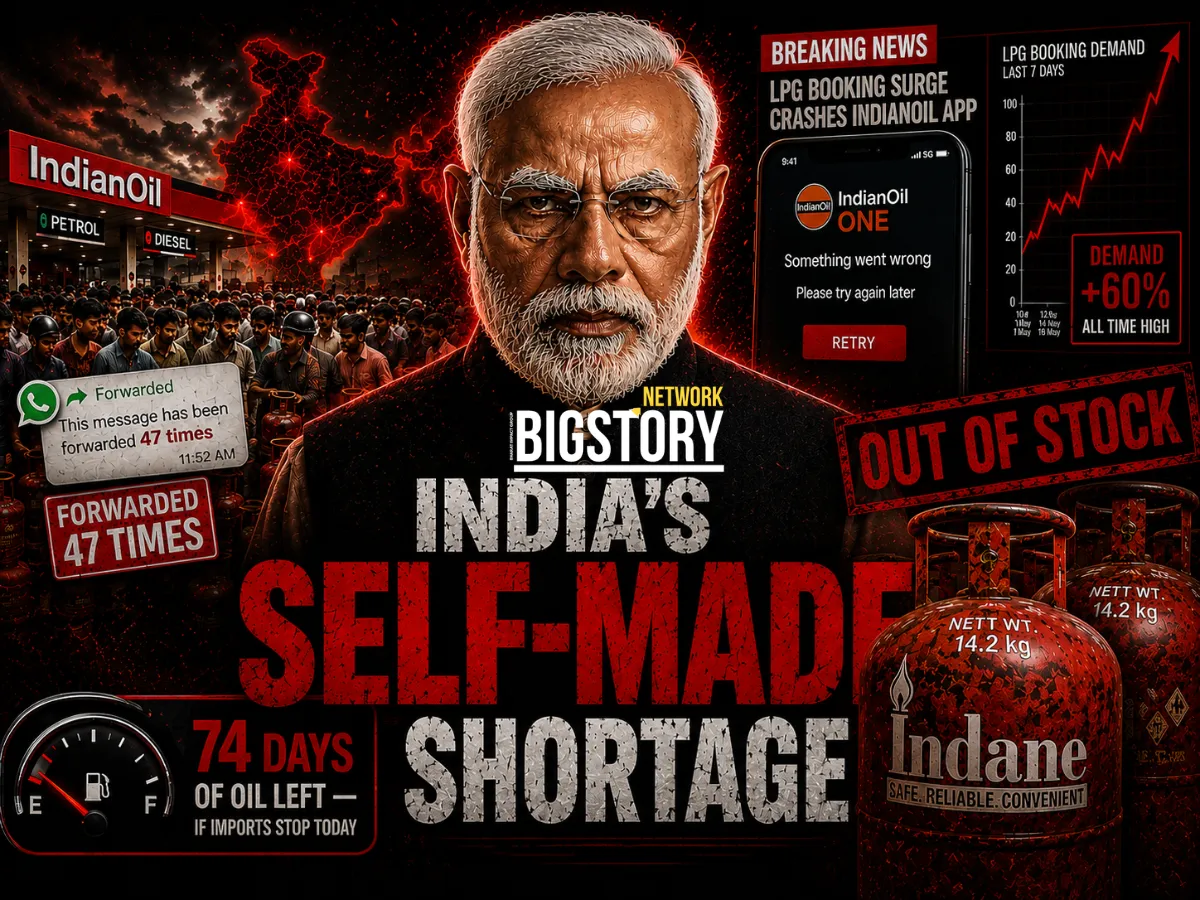
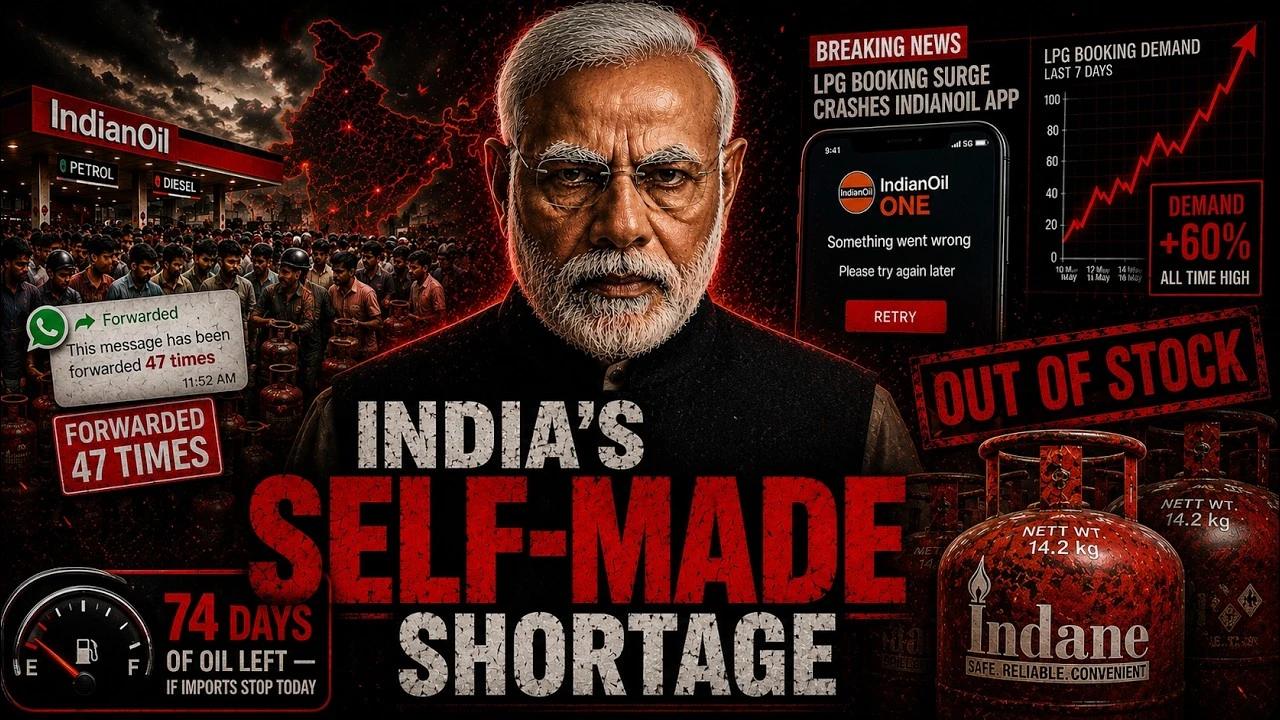
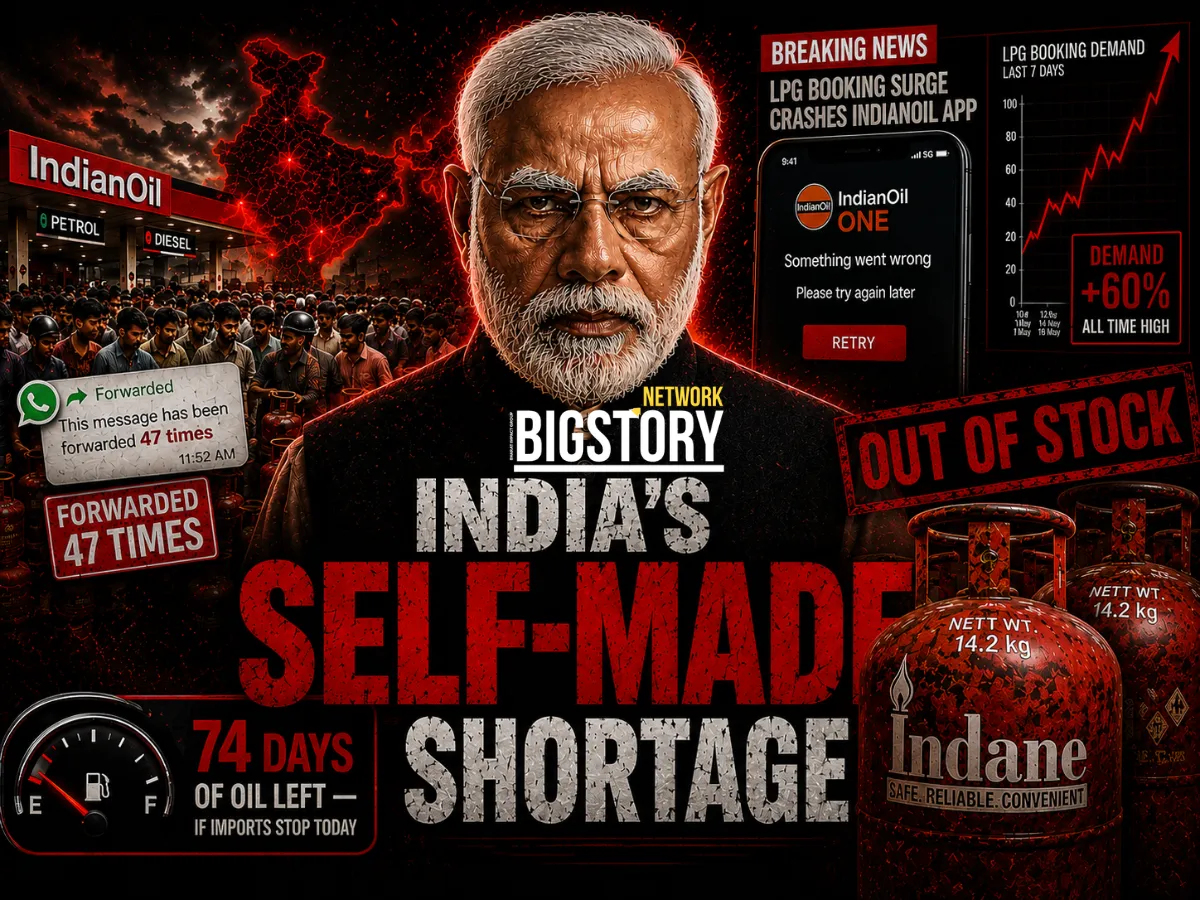
Petroleum Minister Hardeep Puri told Parliament on March 12, 2026, that India had a 74-day petroleum cover. Seventy four days, It sounds substantial, It sounds like someone is in control.
It was not a lie by any means yet It was something more dangerous than a lie.
The 74-day figure included everything currently moving through the commercial supply chain — crude sitting in transit ships, product moving through refinery pipes, fuel in delivery trucks rolling toward petrol pumps across the country. It was a measure of total system inventory. Not a locked emergency buffer, not a vault, a number that included oil that is already spoken for, already in motion, already accounted for in tomorrow's deliveries.
India's actual Strategic Petroleum Reserve covered just 9.5 days. While the International Energy Agency's minimum standard for energy security needed a minimum of 90 days, India was operating on a 10-day fuse while announcing a 74-day cushion.
For cooking gas specifically, the number was even sharper. With 90% of LPG imports transiting through the now-closed Strait, India's strategic buffer for cooking gas was mere two days.
This was the first component of the Trust Deficit. A government that communicated a number accurate in the accounting sense and catastrophically misleading in the practical sense and a public that was shaped by decades of official reassurances that understated problems sensed the gap immediately.
That sensing is not paranoia, It is pattern recognition, Indians have been told things were under control before. They have watched those assurances unravel. The distrust is not irrational, It has been earned and when citizens sense a gap between what they are being told and what is actually true, they do not sit still instead they act.
India was facing a genuine physical LPG supply deficit of approximately 25%. That was real. Pipelines were short, Ships were stranded, The Strait was closed, Nobody disputed that.
But a 25% supply deficit was a manageable problem in the working. The kind that responsible rationing, honest communication, and basic civic cooperation could absorb without systemic collapse. Countries have navigated worse with less.
Then the WhatsApp forwards started.
No source, No date, No author, Just a message warning that cooking gas would be unavailable within 48 hours. Panic was such that people with full cylinders rushed to book another one till the LPG booking system, which handled approximately 55 lakh bookings on a normal day, received 89 lakh requests. The IndianOil ONE app crashed and the crash screenshot "Something went wrong, please try again later" became its own piece of evidence. Millions shared it as proof that the crisis was worse than the government was admitting.
An app error became a conspiracy. The act of trying to book became proof that you should book immediately, before someone else did.
Demand spiked 60% above normal levels not because supply had collapsed further but because fear had multiplied demand. A 25% supply problem had become a 60% demand crisis built entirely from within.
What followed was not irrational, it was perfectly rational inside a broken system.
People filled pressure cookers with petrol at pumps across Gujarat. Milk cans, water tankers, agricultural sprayers, not stupidity, not indiscipline but a very rational response to a rational model of Indian institutional reliability — a model shaped by decades of watching formal channels fail under exactly this kind of pressure.
While citizens were hoarding at the retail end, the supply chain was being hollowed out from the distribution end. Local distributors watched opposition politicians confirm on national television that the energy collapse was real and imminent. They made their calculation. A standard ₹900 cylinder disappeared from the official supply chain and reappeared in locked godowns and private houses for ₹3,000 cash. The government later conducted 128,000 raids and seized 59,000 cylinders. That number is not just a measure of how much hoarding happened. It is a measure of how organised, how widespread, and how fast it happened.
The government was eventually forced to mandate a 25-day waiting period for LPG rebooking just to stop the demand from compounding further and we took a 25% supply problem and turned it into a 60% demand catastrophe.
In a functioning civic system, a supply chain crisis would have been the perfect moment where all political leaders stepped in to ask citizens to conserve, cooperate, and hold steady while the system worked on the problem. That was what happened in Japan however, it was not what happened in India.
Opposition leaders gathered at the gates of Parliament with banners reading "Empty Cylinders, Empty Promises." Kharge, Supriya Sule, Dharmendra Yadav — all present for the cameras. At the state level, politicians stood on stages and predicted gas prices would double the moment elections were over. A logistical supply chain problem was converted, in real time, into an ideological battlefield.
This was not unique to any one party. Every party in India has done this with every crisis. The incentive structure makes it inevitable. A crisis in Indian political culture was not a tragedy to be managed. It was an opportunity — to prove the government incompetent, to energise the base, to dominate the news cycle for another week. No one was behaving irrationally. Everyone was responding rationally to a system that rewarded escalation over resolution.
The local middleman was watching primetime news.
When he saw politicians confirming that the energy collapse was real and imminent, he made his calculation with the same rationality. The cylinder that should have reached a daily wage worker's household ended up in a locked basement at 3.3 times the official price. The government conducted 128,000 raids. Seized 59,000 cylinders. The scale of that enforcement tells you everything about the scale of what it was trying to contain.
The people who suffered most were the people who had no alternative.
The daily wage worker who cooked on LPG could not afford ₹3,000. The small restaurant that ran on commercial cylinders could not get supply at the official rate. The family in a lower-income neighbourhood without storage capacity could not hoard even if it wanted to. The panic that began with institutional distrust ended with its heaviest cost landing on those least equipped to absorb it.
A crisis in India is not a tragedy to be managed but a full blown opportunity.
And the most vulnerable people paid for that opportunity with money they did not have, for cylinders they could not find.
When the Strait of Hormuz closed in February 2026, Japan was importing 95% of its Middle Eastern oil through that exact same blocked route. Same crisis, same shipping lane, same physical supply disruption.
Japan did not crash its booking systems. Japanese citizens did not fill pressure cookers with petrol. There were no raids, no black market cylinders, no 60% demand spikes, no opposition politicians standing at parliament gates with banners about empty promises.
The reason was not discipline, it was not culture, it was not some innate Japanese virtue that Indians lack.
It was a number.
Japan's Strategic Petroleum Reserve stood at approx 254 days. Nearly three times the IEA standard of 90 days. Eight months of fuel locked away in dedicated storage — not in transit ships, not in refinery pipes, not in delivery trucks. Sovereign. Locked. Real.
When the crisis hit, the Japanese government told its citizens exactly how much reserve it had, exactly how long it would last, and exactly what it needed from them. Citizens voluntarily reduced consumption. No app crashes. No hoarding. No black market. The crisis was absorbed because the public trusted the number they were given and the number they were given was true.
Compare that to India's position. A government that announced 74 days and held 9.5. A public that sensed the gap and acted accordingly. A booking system that collapsed under the weight of that distrust. A supply chain hollowed out by distributors who understood that terrified people pay anything.
The difference between Japan in March 2026 and India in March 2026 was not the crisis. It was the institutional infrastructure built over decades reserves that matched promises, communication that told the truth, and a public that had learned it could believe what it was told.
India's diplomats had to be world-class on the global stage precisely because India's domestic buffers were not. The 9.5-day Strategic Petroleum Reserve was not a secret. It was a published number. Every Indian who understood it and many who sensed it without understanding it knew that the 74-day figure was not the whole story.
That knowledge is the Trust Deficit in its purest form not distrust born from cynicism but distrust born from arithmetic.
India neither has an energy problem or just a political problem.
It has created a Trust Deficit.
A gap built over decades of official assurances that understated problems, reserves that did not match promises, and crises that were managed for the cameras rather than for the people living inside them.
That gap, when activated by a real crisis, does not stay neutral. It becomes a force multiplier. It converts manageable problems into catastrophes. It turns a 25% supply deficit into a 60% demand crash. It turns a booking app error into evidence of conspiracy. It turns a cylinder shortage into a black market. And it makes every future crisis harder to manage — because each crisis that goes wrong deepens the distrust that makes the next one worse.
Every actor in the March 2026 chain was behaving rationally.
In the March 2026 crisis, every participant acted with a specific, internal logic. The diplomat who secured Iranian passage for Indian vessels was rational, as was the politician who converted a national emergency into a strategic opening within a system that prizes such maneuvers. Similarly, the distributor who hoarded cylinders to sell them at triple the market rate responded logically to the economic signals he received. Even the family booking three surplus cylinders operated with a form of rationality, given their lived experience of how Indian infrastructure falters under strain.
That is what makes the Trust Deficit so durable. It is not caused by bad people. It is caused by rational people responding to a broken system and in doing so, breaking it further. Every individual decision made sense. The aggregate was a catastrophe.
Building India's Strategic Petroleum Reserve to the IEA minimum of 90 days would cost money India has consistently chosen not to prioritise. Communicating honestly about what reserves actually cover distinguishing between commercial inventory and sovereign storage would require a political culture that does not yet reward transparency. Rebuilding the institutional trust that Japan built over decades is not a policy. It is a generational project.
None of that changes what happened in March 2026.
The Strait of Hormuz will not be the last chokepoint. Climate shocks, trade wars, regional conflicts and supply disruptions are going to come more frequently, not less. Each time one arrives, India will face the same choice. Trust the system or protect yourself. And until the system gives citizens a genuine reason to trust it — the answer will be the same.
The disease is not coming from outside, India is the autoimmune response.
 Exclusive Content



Sign up for the Daily newsletter to get your biggest stories, handpicked for you each day.

 Trending Now! in last 24hrs