
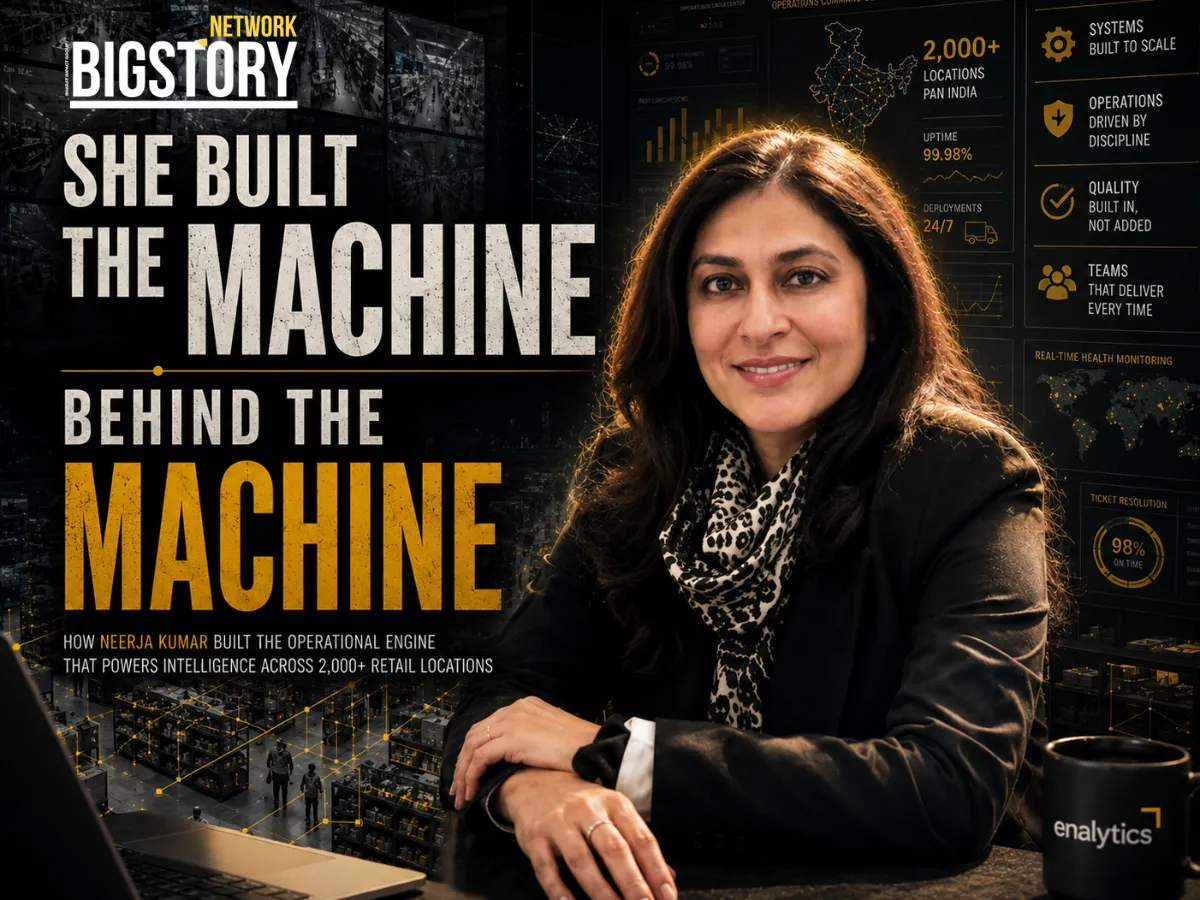
Neerja left Accenture during a pandemic lockdown, joined Enalytix and built the operational system behind 2,000+ enterprise deployments. The execution playbook.
 Brajesh Mishra
There is a deeply entrenched, dangerous mythology within the global startup ecosystem. It is the belief that companies are built purely by visionary ideas, aggressive coding, and the mantra to “move fast and break things.” Business media obsessively covers the disruptive algorithm and the charismatic pitch, treating the actual physical delivery of the product as an afterthought.
When a deployment falters in a remote Tier-3 location or environmental conditions shift within an industrial complex, the most sophisticated algorithm becomes a liability. In these high-stakes moments, the code doesn't preserve the contract but the operational architecture does.
This is the exact operational reality Neerja confronted when she stepped into the role of Co-Founder and Chief Operating Officer at Enalytics (Lex) during the chaotic peak of the 2020 pandemic. She didn't join the company to manage someone else's vision; she joined to architect an unbreakable business machine capable of surviving the brutal realities of the Indian retail ecosystem.
Neerja’s transition from a high-level corporate consultant to a startup operator forced a severe reality check. She was leaving the highly structured, heavily guarded hierarchy of Accenture Consulting. In a multinational corporation, an operator prepares for scale using massive safety nets, specialized departments, and deeply entrenched playbooks. But in a pandemic-era startup operating at a time when global physical retail was shut down and the market was suddenly screaming for "contactless automation", there are no safety nets. You are instantly accountable for everything, and you must build the parachute after you have already jumped.
Her transition from corporate consultant to startup operator forced a severe reality check. During the lockdowns, Big organizations like and security agencies needed immediate, foolproof ways to monitor mask compliance, social distancing, and occupancy without putting human beings at risk. The demand was massive, but the infrastructure was chaotic. Enalytics was dealing with pre-existing CCTV cameras; hardware they did not own, operating in physical environments they did not control.
Neerja saw the massive blind spot of the AI boom: founders were obsessing over the intelligence of their code, but ignoring the physical delivery of their product. Her blueprint for disruption was built on a stark realization that runs counter to standard Silicon Valley advice.
Her core belief: "Business growth does not just come from only a good product; execution defines real success. In B2B SaaS, breaking things isn't a growth strategy; it is a breach of contract." Neerja didn't just manage the backend of Enalytics; she engineered a bulletproof delivery machine. She took the best practices of an MNC, stripped away the bureaucratic bloat, and applied them to the agile framework of a startup. Today, that operational architecture is the invisible backbone supporting millions of data points across 2,000 physical locations.
For a business to scale beyond its first few million dollars, its operations cannot rely on the sheer heroism or late-night hustle of its founders. It must rely on rigid, self-sustaining systems. Neerja engineered the operations of Enalytics by enforcing a set of uncompromising rules designed to preempt failure before it ever reached the client.
Play 1: Protecting the Runway (The Art of Operational Pushback)
Startups rarely die of starvation; they usually die of indigestion. They try to build too many things at once, say yes to every bespoke client request, and burn through their capital building custom features that cannot scale. For a Chief Operating Officer, the most powerful strategic weapon is the word "No."
Neerja operates as the ultimate reality check on resource allocation and product velocity. Her governing philosophy in the boardroom is simple but critical: "Let's land the plane, but let's not set anything on fire while landing." When the product team pitches a rapid expansion idea, or when an enterprise client demands a highly specific software feature, Neerja filters the request through a strict operational capacity check. If the unit economics do not align, if the engineering hours drain vital runway, or if the feature cannot be standardized across the broader platform, she pushes back. For business school students and aspiring managers, this is a masterclass in lateral leadership: ensuring that the thrill of speed-to-market never compromises product stability or bankrupts the company.
Play 2: Standardizing the Unpredictability of the Physical World
While developers focus strictly on the software, an elite operations leader obsesses over the unglamorous machinery that actually keeps the company alive: logistics, procurement, Quality Assurance (QA), and deployment. Enalytics does not manufacture cameras; the company places an AI layer over pre-existing physical hardware. This means their software is entirely at the mercy of chaotic, uncontrollable environments.
To mitigate this immense operational risk, Neerja built a delivery engine designed to preempt physical failure before it breached an SLA (Service Level Agreement). Before a single camera goes live for a client, her team executes a rigorous, standardized QA process to flag environmental challenges. Furthermore, she removed human bottlenecks from crisis management by forcing strict standard templates onto her deployment teams, she ensured that whether they are onboarding a localized shop or a massive national conglomerate, the delivery is flawless and the data completion rate remains impeccably high.
Play 3: Eradicating "Hustle" in Favor of Middle-Management Machinery
A startup can reach its first major revenue milestone through the sheer force of will, networking, and adrenaline. But scaling beyond that requires a middle-management tier that can operate seamlessly without the founders micromanaging every room. Neerja understood early on that "startup hustle" is an inherently unscalable, exhausting business process.
To build true enterprise scale, she systematically trained her middle management to step away from gut-feeling execution and rely entirely on data-based reporting. From logistics and hardware delivery timelines to procurement and client connections, every single phase of the customer lifecycle was documented, templated, and rigorously tracked. By establishing a strict, inflexible cadence for customer reviews and operational touchpoints, she successfully transformed an agile, reactive, chaotic startup environment into a proactive, highly predictable enterprise capable of serving billion-dollar brands.
Play 4: Driving Net Revenue Retention via the "Solving Mode"
Acquiring the first major enterprise client requires aggressive pricing, relentless networking, and a visionary sales pitch. Keeping them for five years—driving the high Net Revenue Retention (NRR) that defines successful SaaS companies—requires a completely different operational mindset.
Neerja enforces a strict behavioral rule for her client-facing Customer Success and Operations teams: Never step out of "solving mode." Instead of pitching new software updates or constantly trying to upsell features to existing clients, her operational cadence is built entirely around active listening and friction analysis. She intentionally embraces the "difficult" customers—the ones who push the system to its absolute breaking point—because their friction is the ultimate stress test. Their complaints are what actually makes the product robust. You do not retain enterprise clients with a slick sales deck; you retain them by asking what their next logistical challenge is, and building the solution into the operational roadmap before they ever have to ask for it.
Play 5: The Deep-Tech Talent Matrix ("Will" Over Pedigree)
Building an AI startup in India usually means engaging in a brutal talent war, competing against massive multinational giants and heavily funded unicorns offering exorbitant pay packages for the top 1% of engineering talent. As a COO, building an elite team without matching those salaries requires a highly contrarian hiring strategy.
Neerja's approach bypasses the pedigree war entirely. While formal education and technical qualifications are necessary prerequisites to orient a candidate in a complex space like AI, she operates on a starkly pragmatic hiring thesis. "Success is a combination of skill and will," she notes. "People without the specific skill, but with the 'will', can be trained. Many things you don't learn in colleges, particularly in the Indian education system, you only learn on the job." In the high-stakes, rapidly shifting operational environment she manages, an enterprising, resourceful, and coachable candidate who can navigate ambiguity and leave their ego at the door is infinitely more valuable than a rigid coder from a top-tier institute who refuses to adapt to client feedback.
The Chief Operating Officer is historically the invisible role in the startup narrative. The media loves the visionary, the pitch, and the disruption. But without the rigid, uncompromising architecture a company might be nothing more than a localized experiment that collapsed the moment it tried to scale.
What started as a frantic, pandemic-era effort to deploy facial recognition attendance systems and monitor mask compliance has evolved into a hyper-efficient, cross-industry delivery system. Neerja's operational vision transformed brilliant code into a reliable enterprise utility that monitors everything from workstation productivity in manufacturing units to queue management in retail stores.
She proved that Indian startups do not have to settle for chaotic execution. They do not have to accept a high churn rate as the cost of doing business. By prioritizing logistics over hype, and retention over acquisition, she proved that an agile startup can scale with the exact same precision, rigor, and standardization as the legacy MNCs they are working to disrupt.
"The tech ecosystem is dangerously obsessed with the magic of the algorithm, but an algorithm cannot survive the physical world on its own. Ideas are cheap. Code can be replicated. If you cannot deploy your product into the chaos of the real world navigating broken hardware, unpredictable environments, and demanding enterprise clients and keep it running flawlessly, you don't have a business; you have a prototype. Stop moving fast and breaking things. Start building systems that refuse to break."
At BIGSTORY Network, we believe that the most important entrepreneurial stories are not the ones told at the peak. They are the ones told from inside the climb—messy, uncertain, and incredibly demanding. Because somewhere between a brilliant AI algorithm and a massive retail ecosystem running smoothly on real-time data, there was an operator who simply refused to accept the baseline. Not the chaos of the startup ecosystem. Not the myth that software solves everything. But in the idea that flawless execution is the ultimate competitive advantage, and that she was the one who had to build the machine to deliver it.
 Exclusive Content



Sign up for the Daily newsletter to get your biggest stories, handpicked for you each day.



 Trending Now! in last 24hrs