
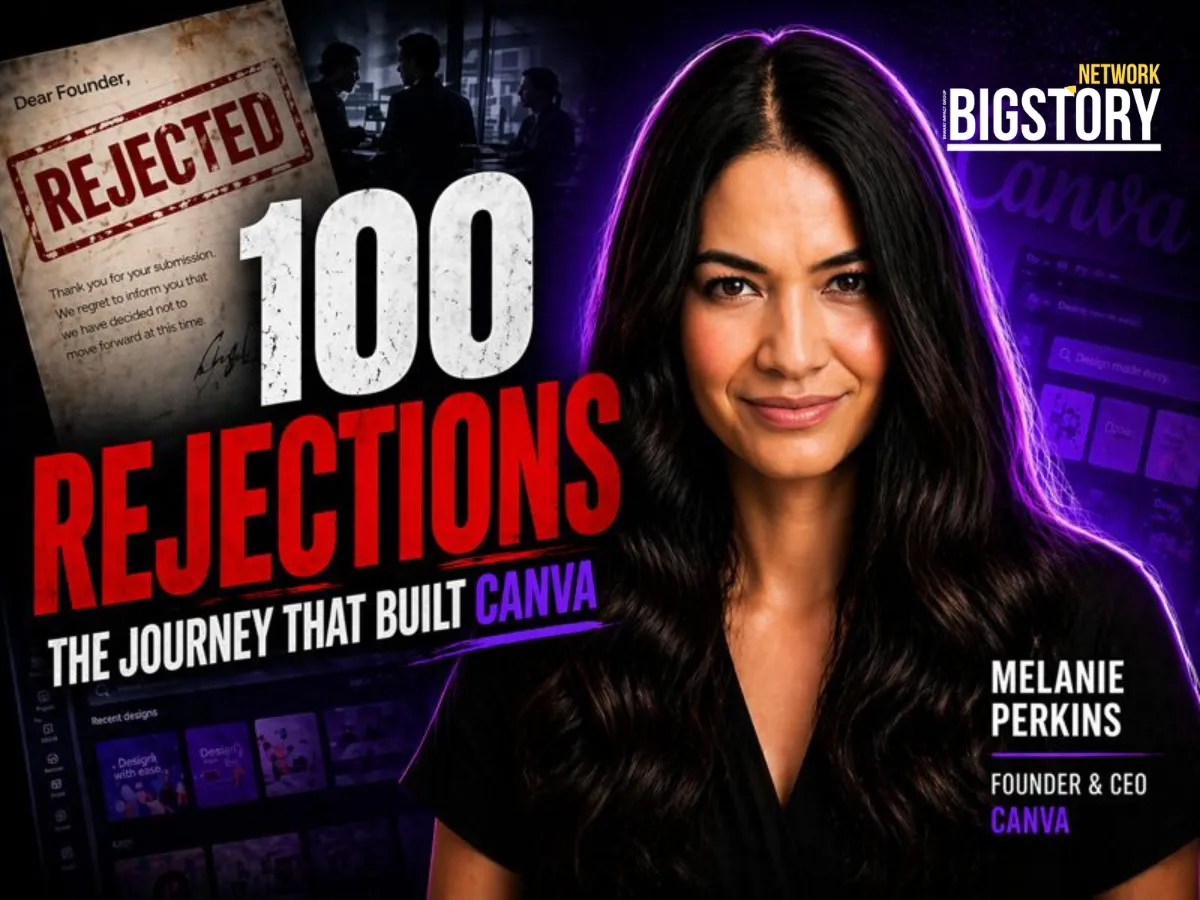
Over 100 rejections. A $40 billion company. Melanie Perkins didn't wait for permission to change the design industry she built the door herself. This is the story of vision, willpower, and what happens when you refuse to let 'not yet' become 'never.'
 Rashmeet Kaur Chawla
Design software, for decades, was the domain of professionals. Programs like Adobe Photoshop and InDesign were built for mastery but mastery came at a cost. Learning curves were steep. Licences were expensive. The average person who wanted to create a flyer, a business card, or a social media post had one option: hire someone who knew what they were doing, or struggle through software that felt like it was designed to intimidate.
This was the system. It was accepted. It was profitable for the incumbents. And to almost everyone in the industry, it was fine.
Today, Canva is used by over 170 million people in 190 countries, is valued at $40 billion, and has democratised graphic design in a way that even Adobe and Microsoft couldn’t have predicted.
“People would have to spend an entire semester learning where the buttons were, and that seemed completely ridiculous.” This was not a complaint she filed away. It became a conviction one that would take over a decade to fully build, and that would ultimately challenge the most powerful names in the software world.
Melanie Perkins born on 13 May 1987 in Perth, Western Australia is the co-founder and CEO of Canva, one of the world’s most valuable private technology companies. Forbes listed her in the World’s 100 Most Powerful Women in 2023, and Fortune placed her 92nd on its Most Powerful Women list the same year. Her net worth stands at approximately $7.56 billion.
Yet behind the valuations is a woman who grew up in Perth, trained in figure skating before dawn, started a scarf business at 14, dropped out of university to chase an idea that over 100 investors said was too ambitious, and built a company that now powers the visual identity of 85% of Fortune 500 companies.
This is her story.
Before Canva: The Making of a Challenger
Perth, Western Australia, sits further from any major global tech hub than almost any city on Earth. But for Melanie, it was home and home was a very good place to learn. Born to an Australian teacher mother and a Malaysian engineer father with Filipino and Sri Lankan heritage, Melanie grew up in a household that valued both creativity and discipline. She attended Sacred Heart College in Sorrento, where she pursued figure skating with serious commitment waking up at 4:30 a.m. every day for training. That regime the willingness to sacrifice comfort for a goal would prove formative.
At 14, she started her first business selling handmade scarves at markets and shops throughout Perth. Small. Simple. But hers.
When she enrolled at the University of Western Australia to study communications, psychology, and commerce, she took on a part-time tutoring role helping students learn graphic design software. Watching bright, capable students spend entire semesters just trying to find the right buttons that’s where the central question of her life’s work first formed.
At 19, Melanie co-founded Fusion Books from her mother’s living room. The idea: allow students to design school yearbooks online using a drag-and-drop interface. No prior design knowledge. No semester-long learning curve.
The sceptics said it was too niche. The market said otherwise. Fusion Books grew into the largest yearbook company in Australia, eventually expanding to France and New Zealand. It was a proof of concept. Melanie dropped out of university. The next chapter was about to begin.
In 2010, Melanie and co-founder Cliff Obrecht her then-boyfriend, now husband moved to Silicon Valley to pitch Canva. They arrived with a clear vision and an 80-page product plan detailing every screen and every button. They had data. They had conviction.
What they didn’t have was a cheque. Not for three years. Over 100 investors said no.
“Although failure was never an option, rejection stings a lot. For better or worse, I don’t give up very readily at all when I set my mind to anything.” Melanie didn’t accept the rejections as verdicts. She accepted them as feedback. Each no sharpened the pitch. Each conversation clarified the product.
But how rare is that kind of persistence? To hear 'no' over and over from investors, from doubters, from an industry that simply wasn't ready and still not flinch. Still not fold. Most people walk away after the third rejection. Melanie Perkins didn't walk away after the sixtieth. And that's not just resilience. That's willpower operating at a level most of us never reach.
The breakthrough came through venture capitalist Bill Tai, who introduced Melanie to Lars Rasmussen co-founder of Google Maps who became their technical adviser and helped them find Cameron Adams, a former Google engineer who joined as co-founder and CPO. With a $3 million seed round secured, Canva launched in 2013.
Simplicity as strategy: Canva’s drag-and-drop interface was the entire product philosophy. Complexity was the competition’s weakness; Melanie made simplicity her moat.
Patience over speed: Canva deliberately delayed shipping for two years to build the right technological foundation.
Purpose over profit: Through Canva’s 1% Pledge, the company donates 1% of its product, time, profits, and equity to causes globally. In December 2021, Melanie and Cliff signed the Giving Pledge.
Diversity as a design principle: Under her leadership, Canva has actively promoted inclusion in its team and the communities it serves.
Building a product that had to be simultaneously simple enough for a first-timer and powerful enough for a senior marketer is a genuinely hard engineering problem. Canva had to keep the experience frictionless at every level of user sophistication requiring relentless iteration and an obsessively user-centric culture.
Then came the competitive pressures: Adobe, Microsoft, and Google responding to Canva’s growth with their own tools and resources. Melanie didn’t react to the competition. She focused on user experience so obsessively that the competition was always catching up rather than setting the agenda.
The single most consequential decision Canva made was to delay shipping for two years. In a startup culture that prizes speed above all else, Melanie chose depth. The result: a collaborative, real-time editing infrastructure that made Canva genuinely different from anything else on the market and a product that worked beautifully from day one.
By 2018, Canva had 10 million users. By 2021, the company was valued at $40 billion one of the few profitable unicorns in global tech. The turning point was never a single moment. It was thousands of consistent choices, all pointing in the same direction.
Melanie Perkins does not lead like a traditional tech CEO. Calm, purposeful, and culture-obsessed, she has built a team of over 3,400 ‘Canvanauts’ with a Glassdoor employer rating of 4.4 out of 5 with 89% of employees recommending the company to a friend.
Her leadership is also defined by a refusal to separate commercial success from social responsibility. The Giving Pledge commitment is consistent with values she has articulated since the beginning: building something great is only meaningful if it contributes to something larger than itself. She has also been a consistent voice for women in technology a figure who matters beyond the design industry.
We often define challengers by the empires they have already built the billions, the valuations, the magazine covers. But that's not where the challenger story begins. It begins in the small room, the rejected pitch, the idea that wouldn't quit even when every door stayed shut. The real challenger isn't the one standing at the top. It's the one still climbing fuelled by nothing but vision and a refusal to give up.
Melanie Perkins is a Challenger in the truest sense. She looked at an industry comfortable charging for complexity, and built her life’s work around the radical idea that simplicity was the real luxury. She sat with 100 rejections and refused to let any of them be final.
· They challenge systems, not just markets.
· They measure success not by valuation but by impact.
· They understand that rejection is data, not destiny.
· They build for people first and profit follows.
· They believe that a simple question, pursued with ferocious honesty, can become a revolution.
Melanie has spoken candidly about the loneliness of the early years the days when investors said no, when the tech team hadn’t come together, when the gap between vision and reality felt impossibly wide. What kept her going wasn’t certainty. It was the clarity of the problem she was solving and the stubbornness of her belief that it was worth solving.
For anyone building something today: the market will eventually reward clarity of purpose combined with patient execution. It will not always reward speed. But it will reward those who understand a real problem deeply enough to keep going when the doors stay closed.
The Canva story is not just an Australian success story, a female founder story, or a design industry story. It is a story about what becomes possible when clarity of purpose meets patient, persistent execution and when a founder refuses to let ‘not yet’ become ‘never.’
The next time you open Canva, you are participating in the outcome of a decade of relentless belief. You are using a product that exists precisely because one person decided that 100 rejections were not a verdict. They were a curriculum.
Every great company begins as someone's unreasonable conviction. For the founders building in the early hours, rewriting their pitch after the hundredth rejection, and choosing, every single day, to keep going this is for them. Melanie Perkins is not an exception to the rules of success. She is the clearest possible argument that the rules deserve to be challenged. Her story is proof enough
 Exclusive Content





Sign up for the Daily newsletter to get your biggest stories, handpicked for you each day.



 Trending Now! in last 24hrs