The IIT Delhi alumnus who built DeHaat into India’s largest full-stack Agri-tech platform. Learn how this disruptive "seeds-to-market" startup overcame investor skepticism to digitize the supply chain for nearly two million smallholder farmers.
 Rashmeet Kaur Chawla
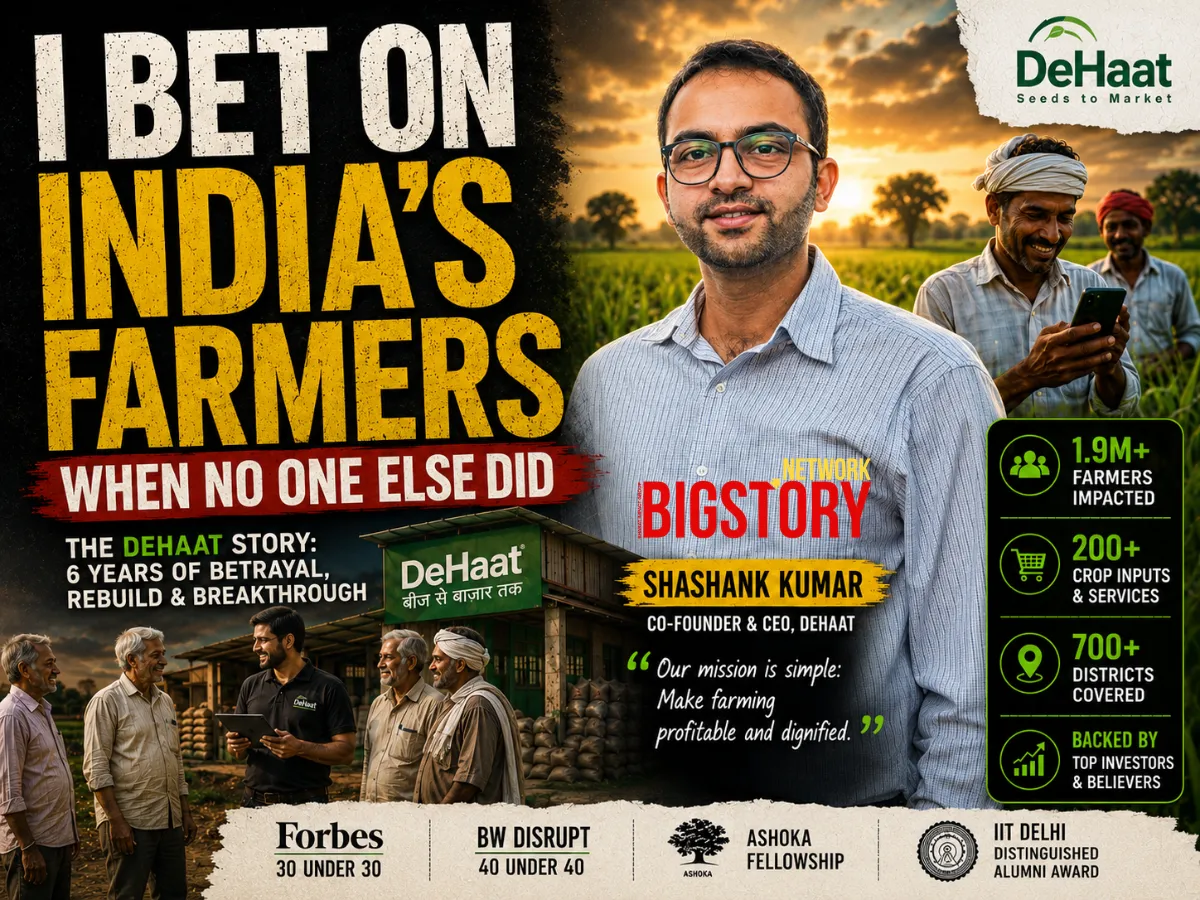
What if the biggest business opportunity in India wasn't sitting in a glass office in Bangalore or Gurgaon, but in a paddy field in rural Bihar?
Shashank Kumar bet his entire career on that idea and it took him six long years, dozens of failed pilots, and a near-total rebuild of his business model before anyone believed him. Today, he runs DeHaat, the full-stack agri-tech platform that has digitized the lives of nearly two million Indian farmers. This is the story of how a small-town IIT Delhi graduate chose the hardest, least glamorous market in the country and turned it into one of India's most closely watched agri-tech success stories.
In 2012, India's investors were chasing e-commerce and food delivery apps. Nobody wanted to fund a platform built for smallholder farmers with patchy internet, low smartphone penetration, and a justified fear of risk. Shashank Kumar and his co-founders were told, in effect, that the market they had chosen was too poor, too fragmented, and too slow to digitize to ever become a real business. They ignored the advice. What followed was nearly a decade of rebuilding trust, technology, and an entire distribution network from scratch — one village at a time.
Shashank Kumar is the Co-founder and CEO of DeHaat, a technology-led business-to-farmer (B2F) agri-tech company that has grown into one of India's largest rural commerce and advisory networks. An alumnus of IIT Delhi, Shashank co-founded DeHaat in 2012 with a simple but ambitious goal: build a "seeds to market" platform that could serve every need of a smallholder farmer under one roof. His work has earned him recognition on the Forbes 30 Under 30 list, the BW Disrupt 40 Under 40 list, an Ashoka Fellowship, and IIT Delhi's Distinguished Alumni Award.

It begins in Bihar's heartland, far from India's usual entrepreneurial hubs. Growing up in a state where agriculture is the backbone of the economy but farmers are among the most under-served in the country, Shashank saw first-hand how disconnected India's smallholder farmers were from modern markets, fair pricing, and quality inputs. That early proximity to rural India would go on to shape the entire premise of his career. He carried this small-town lens with him even after securing a seat at IIT Delhi and, contrary to the popular belief that small-town roots are a disadvantage in the corporate and startup world.
Shashank has often said it gave him an edge: a ground-level understanding of the very problem he would spend his life solving.
After graduating from IIT Delhi in 2008, Shashank did not head straight into agri-tech. He first worked as an associate at Beacon Advisory Services, gaining early exposure to business strategy and financial structuring. But the pull of the agriculture sector was strong, and he soon founded the Farms and Farmers (FnF) Foundation, a non-profit initiative aimed at improving farmer livelihoods. It was through this grassroots, non-profit work that Shashank got his real education not in a classroom, but in the fields of rural Bihar, listening to farmers describe the everyday obstacles that kept them poor despite their hard work.
In 2012, Shashank co-founded DeHaat with a small team that believed a full-stack, crop-agnostic model built specifically for farmers could work at scale.
DeHaat came into existence at a time when nobody had historically tried building a full-stack model for farmers in a crop-agnostic manner.
The vision was to build a single platform covering everything a farmer might need quality seeds and inputs, expert agronomic advisory, access to credit and insurance, and finally, a reliable market to sell their produce.
The early years were slow going, hampered by a broken last mile and low mobile and internet penetration in rural India, and the wider Agri industry was initially unconvinced by this alternative, parallel model of distribution. Rather than force a product onto farmers, Shashank's team went back to basics.
Before DeHaat found its footing, the team assumed farmers would embrace a better cropping pattern the moment better returns were on offer a very urban, spreadsheet-driven assumption. It turned out to be wrong. On the ground, they realized farmers simply didn't have the appetite to take on risk even a proposed change that promised better returns was viewed primarily as a gamble, not an opportunity.
Several early pilots had to be scrapped and rebuilt around this single insight: in rural India, trust has to be earned village by village before any product can scale. That single correction reshaped how DeHaat approached every farmer interaction going forward education and trust first, transactions second.
"These farmers don't have the risk-taking ability a better return still looks like a gamble to them."
At the heart of Shashank's approach is a conviction that technology's real power lies in bringing efficiency and transparency to supply chains that have historically failed the smallest players in them. He has consistently argued that a genuinely farmer-first fintech and advisory model one built around the realities of smallholder risk appetite rather than urban assumptions about scale did not exist in India, and that building it required patience most investors were unwilling to offer.
It took DeHaat six years to reach product-market fit, a long gestation period the founding team had anticipated from the start. Those years were spent understanding multiple crops and regions, building a crop-pest database, and developing the right technology interfaces to support future growth.
Beyond the slow build, Shashank has spoken candidly about a third major challenge: convincing investors that agri-tech, and specifically a farmer-facing model, was worth backing.
Even success brought its own pressures. As DeHaat scaled and raised significant capital, Shashank had to publicly defend the company's financial discipline and address market noise around its spending, a reminder that scaling responsibly in a capital-intensive, low-margin sector like agri-tech comes with continuous scrutiny.
The turning point for DeHaat arrived with the rapid adoption of smartphones and falling internet costs, which accelerated the adoption of new-age agricultural practices among farmers themselves. That shift put Agri-tech "in a new light" for the investor community, and DeHaat already the largest player in the space by revenue and growth became its biggest beneficiary. In the following three years, the company raised USD 207 million and expanded its model to 11 agriculturally rich states.
What sets Shashank apart is his refusal to treat farmers as a monolithic, easily-scaled customer segment. His style is rooted in hyperlocal execution: a vast network of on-ground micro-entrepreneurs who act as the last-mile bridge between DeHaat's technology and the farmer's field. Rather than pushing a single national playbook, DeHaat's model flexes by crop, region, and local risk appetite. He pairs this ground-level patience with a data-first mindset, using DeHaat's crop and pest databases to bring precision agronomy to farmers who have never had access to it before.

2008
Shashank's journey offers a pointed lesson to India's next generation of founders:
The most overlooked markets are often the most defensible ones.
Building for underserved India demands patience that doesn't fit neatly into typical startup timelines — DeHaat needed six years just to find its product-market fit.
His advice, in essence, is to resist the pressure for instant scale, to earn trust the slow way when the customer has been let down before, and to remember that coming from a small town is not a limitation it can be the very insight that competitors from bigger cities simply don't have.
Opportunities don’t come knocking from an office made of glass. Opportunities lie dormant in spaces people have long abandoned a rice field, a country written off as “too poor” or “too slow” – waiting for someone brave enough to venture there. Six years of patience isn’t wasted time; six years is how we build a business that stands the test of time. You cannot scale trust using spreadsheets, only earn it village by village through repairing broken promises.
The next big industry lies in all the overlooked spaces.
Someone who looked at a market everyone else had written off and asked a different question: what if this is exactly where the biggest opportunity is hiding? He challenged the assumption that rural, low-digital-penetration markets couldn't be scaled. He challenged investors who doubted agri-tech's bankability. And he challenged the conventional startup timeline by choosing a six-year runway to product-market fit over a quick exit. That is precisely why his story belongs in BigStory's Challengers series.
3 Things to Remember
• The most overlooked markets can be the most defensible proximity to the problem is an edge, not a disadvantage.
• Patience is a strategy: DeHaat took six years to reach product-market fit, by design.
• Trust scales village by village, not through a single national playbook.
Shashank Kumar’s journey in building DeHaat from absolute zero to India's largest full-stack agri-tech platform is a powerful testament to the value of tackling the deeply fragmented realities that mainstream tech hubs long wrote off as "too slow" or "too poor" to ever scale.
What makes Kumar's his hard work truly essential reading is his profound reframing of the typical entrepreneurial timeline. In an ecosystem often obsessed with instant valuation and overnight scale, he spent six grueling years on the ground simply earning the trust of smallholder farmers and building out a hyper-local distribution network village by village.
This profile serves as a definitive reminder for the next generation of builders that patience is not the antithesis of ambition; rather, when deployed to fix broken systems and serve the most overlooked players, it becomes the very foundation upon which lasting impact is built.
https://agrevolution.in/company
https://www.entrepreneurindia.com/shashank.php
https://startupfeed.in/dehaat-agritech-transforming-bharat/
https://www.prnewswire.com/news-releases/dehaat-indias-homegrown-full-stack-agritech-platform-raises-us115-million-301409100.html
https://agfundernews.com/dehaat-farmer-marketplace-scores-115m-in-indias-biggest-ever-agtech-round
https://tracxn.com/d/companies/dehaat/__MNN5MsKeFhiAAm0Wo-XTzf8ZjQaf2F-wSLRCdDz50UM
https://www.kanavu.org/events/stories/shashank-kumar-and-the-story-of-dehaat/
 Exclusive Content





Sign up for the Daily newsletter to get your biggest stories, handpicked for you each day.


 Trending Now! in last 24hrs