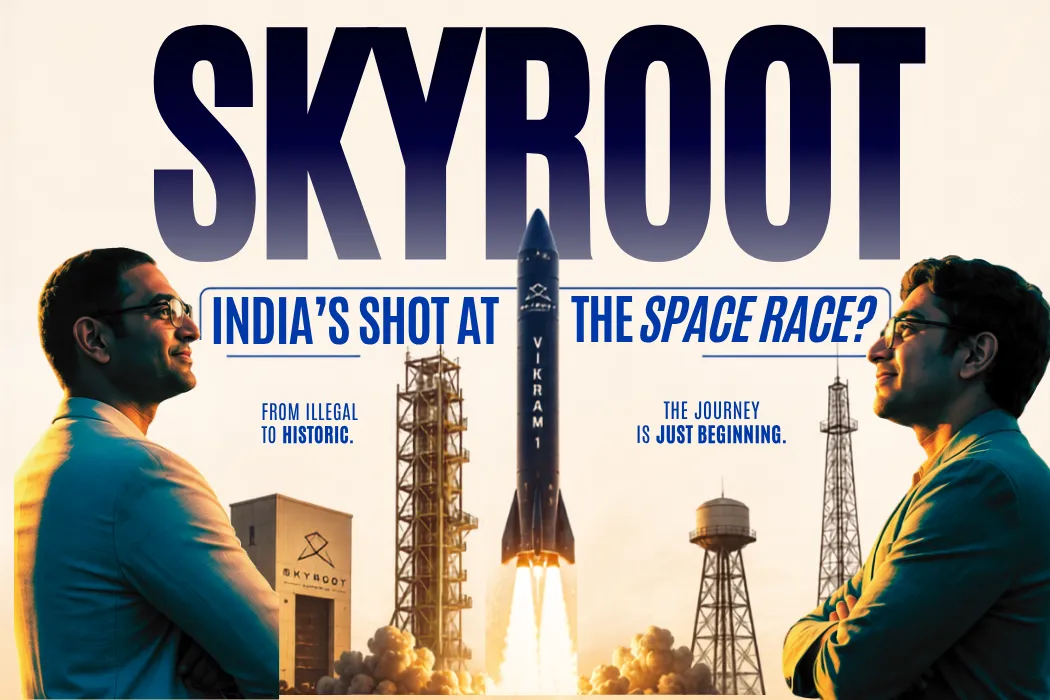
Skyroot's Vikram-1 made India the third nation on earth with private orbital launch capability — a milestone sixty years of legal monopoly had blocked. But its cost per kilogram runs three times higher than SpaceX's, and the two gaps it exploited are already narrowing. Here is the business case behind the headline.
 Minaketan Mishra
Zero — India's private orbital launches before 2020, the cost of a 60-year legal monopoly. 11 — space-tech startups India had in 2019, before IN-SPACe opened the sector. 3x — Skyroot's cost per kilogram to orbit versus SpaceX's rideshare pricing. ₹13,205 crore — Skyroot's projected FY32 revenue, up from ₹101 crore in FY26. 2% — India's current share of the global space economy, against an 8-10% target by 2030. The milestone is real. The business case is still being written.
For sixty years, India's tryst with the space race has been a love-hate relationship. On one side, we boasted the talent and valour of our great Indian minds — minds that have continuously outclassed the western world through innovation and cost-effectiveness. On the other, by the West's own scoreboard, we were continuously underjudged for one simple stat: private orbital launch capability.
That scoreboard changed on July 18, 2026 when Skyroot Aerospace's Vikram-1 reached a 450-kilometre orbit carrying four customer payloads, making India only the third nation on earth where a private company has pulled off an orbital launch after the United States and China. Every wire service ran the same headline. Every column called it history.
Two ex-ISRO engineers spending two years building a rocket company when it was, on paper, illegal to do so. Six years later, that company is worth $1.1 billion, sitting inside a global launch market worth over half a trillion dollars, competing for a piece of a race that India currently owns 2% of and while the government wants that number at 8% by 2030.
But this is not a story about a rocket launch rather it is about what is this feat actually worth?, and how can India hold onto it?
Before 2020, if you were an Indian engineer with an idea for a rocket, the law gave you exactly one path to go ahead; build it inside ISRO, for ISRO's missions, on ISRO's timeline. There was no second door. Founding a private rocket company in India was not discouraged or heavily regulated, It was, on paper, illegal.
This was not a story about incompetence, ISRO's LVM3 rocket has carried a 100% success record since 2017, confirmed directly by ISRO Chairman V Narayanan. Indian engineers sit inside SpaceX's own engineering floor, building rockets for someone else's flag, a company that went public in June 2026 and now trades at a market capitalization near $2 trillion. Talent was never the constraint, the law was.
While ISRO held that legal monopoly at home, the rest of the world had already moved on without India.
Between 2010 and 2019, the global space economy grew from roughly $270 billion to close to $400 billion, driven almost entirely by private companies: SpaceX, Rocket Lab, a wave of new entrants building rockets for paying customers, not just governments. America alone came to control nearly half of that market. Europe, China, Japan, Israel, and Russia took most of the rest.
India's share of private orbital launches in that period: zero. In a country that had already reached Mars on its first attempt, that contradiction is the real cost of the monopoly this article opened with.
That "zero" made two of ISRO's own scientists leave their job to build a private company with hopes that someday the market will be open for private companies in India.
In 2018, Pawan Kumar Chandana and Naga Bharath Daka started building a private rocket company and two years later, on June 24, 2020, the Union Cabinet created IN-SPACe, opening India's space sector to private companies for the first time in the programme's history. Skyroot was not standing at the back of a queue that had just formed. Having already been built in the dark for two years, it was standing at the front and became the first private company to sign an MoU with ISRO under the new framework.
Six years later, on July 18, 2026, Skyroot's Vikram-1 reached a 450-kilometre orbit carrying four customer payloads, making India the third nation on earth where a private company has pulled off an orbital launch. The company is now valued at $1.1 billion.
Here is the uncomfortable number sitting underneath that milestone: Skyroot's cost per kilogram to orbit runs roughly three times higher than SpaceX's rideshare pricing. By the arithmetic that usually decides launch contracts, Skyroot should have no customers at all.
It has them anyway because Skyroot fills up two gaps that their competitors have no answer for yet.
The first gap was reliability, not priority.
For years, the story told about ISRO's commercial backlog was about queues — a government agency naturally puts its own missions first, so a paying customer waits. That's true, but it understates the real problem. In January 2026, ISRO's PSLV rocket failed twice in a row, grounding commercial launches until mid-February and leaving New Space India Limited — ISRO's own commercial arm — sitting on a backlog it could not clear. Insurance premiums for future Indian launches jumped 20-30% almost overnight. For a small satellite operator who has already spent years and millions building a payload, a launch provider whose next slot is uncertain is not a scheduling inconvenience. It is a business risk.
The second gap was precision.
SpaceX's rideshare model works by stacking dozens of satellites onto one rocket and dropping them all at the same altitude and inclination: a bus route. For years that meant one destination: sun-synchronous orbit, at roughly 525 kilometres and 97.5 degrees. A satellite that needed anything more exact; a specific inclination for consistent daily lighting, a non-standard altitude, had to burn its own limited fuel correcting the orbit after being dropped off, shortening its working life before its mission had even begun.
Skyroot built its entire pitch around serving both of these gaps directly dedicated, on-demand small satellite launches, at the customer's exact required orbit, without waiting behind a government queue or a fixed rideshare schedule. Book a rocket the way you'd book a taxi, was the pitch. For a customer burned by an ISRO delay or an imprecise SpaceX drop-off, that pitch was worth paying triple for.
Here is the honest complication. SpaceX has not stood still on gap two. Since 2023 it has added Bandwagon, a mid-inclination rideshare line, and in January 2026 launched Twilight, a dawn-dusk sun-synchronous option both built to close exactly the precision gap Skyroot's pitch depends on. The gap Skyroot found was real. Whether it stays open is a separate question.
Start with the number that should worry any investor before it excites them.
SpaceX has pushed its effective cost to orbit below $3,000 per kilogram on a dedicated Falcon 9 launch, and its rideshare slots start near $6,000 per kilogram. Skyroot has publicly said it is targeting 30-50% cheaper pricing than comparable dedicated small-launch competitors, but that comparison is against companies like Rocket Lab, not against SpaceX's rideshare economics. Set Vikram-1's roughly 300-kilogram payload class against Skyroot's own projected launch revenue — a company targeting $144-216 million a year in launch revenue at a cadence of one Vikram-1 per month, once commercial operations begin in 2027 — and the implied cost per kilogram lands well above SpaceX's rideshare price, not below it.
By the numbers that usually decide a launch contract, Skyroot is not the cheap option. It has never claimed to be against SpaceX specifically. It is the cheaper dedicated option, competing for the customer who has already decided a shared rideshare slot will not work for them.
That distinction is the entire business and here is what makes the arithmetic close at all: Skyroot accesses ISRO's launch and testing infrastructure — facilities that would otherwise cost competitors billions of dollars to build from scratch — under its agreements with IN-SPACe and ISRO. In-house 3D-printed engines and structural components cut manufacturing cost further. Indian engineering talent, priced at a fraction of its Western equivalent, closes the rest of the gap. None of those three levers is a pricing innovation. All three are structural cost advantages specific to building in India, right now.
The financials say exactly how early this bet still is. Skyroot's operating revenue crossed ₹100 crore for the first time in FY26 — its first meaningful revenue since the company was founded in 2018 against a negative EBITDA of ₹130.3 crore the same year. It is projecting revenue of ₹13,205 crore by FY32, an increase of roughly 130 times, once Vikram-1, Vikram-2, and a planned reusable launch vehicle are all in commercial service. As of March 2026, the company holds ₹252 crore in customer advances. That is not a company that has solved its cost problem. It is a company that has convinced its earliest customers the cost problem is worth paying for anyway. Whether that conviction survives contact with a wider market is the next question.
No and SpaceX's own history is the clearest proof of why.
Falcon 1, the rocket SpaceX built before Falcon 9, failed on its first three launch attempts. It did not reach orbit successfully until its fourth try, in 2008. Today's Falcon 9 — the rocket that now defines reliability in commercial spaceflight has flown more than 500 missions with a success rate above 99%. That number was not earned on day one. It was earned launch by launch, failure by failure, over a decade and a half.
Vikram-1's success on July 18, 2026, a 450-kilometre orbit, four customer payloads delivered proves the engineering works once. It does not yet prove what insurers, satellite operators, and government agencies actually pay for: a repeatable record. A single successful flight and a fourth-attempt success look identical on a headline. They mean very different things to an underwriter deciding what premium to charge on the next satellite booked to fly.
Skyroot has stated plans for two more Vikram-1 launches this year, working toward a target cadence of one launch a month once commercial operations begin in 2027. That cadence not yesterday's headline is the number that actually decides whether Vikram-1 becomes a trusted vehicle or stays a celebrated first attempt. Every launch between now and then is effectively an audition, in front of the exact customers whose advance payments are already betting on the answer being yes.
There is a narrow window working in Skyroot's favour. Russia's rockets are largely locked out of the Western commercial market since 2022. Europe's Ariane 6 has faced repeated delays. China's rockets remain politically unacceptable to most Western satellite operators regardless of technical merit. That leaves a real gap for a credible, trusted alternative to SpaceX and very few companies on earth positioned to fill it.
Every story about Skyroot published this week ends at the same place: two founders, an illegal industry, a historic launch. That is a true story, and it is a good one. It is also not the whole story, because it stops exactly where the harder question begins.
Exploiting a gap once is a launch. Defending it against every competitor who has now watched the exact playbook succeed in public is a business. On that question, three things are worth being honest about.
The precision-orbit advantage is already eroding. Skyroot's pitch, a dedicated launch at your exact required orbit, instead of a fixed rideshare drop-off was a real gap when the company was founded. There is a smaller gap today and SpaceX has spent the last three years closing it deliberately: Bandwagon, launched in 2023 for mid-inclination orbits, and Twilight, launched in January 2026 for dawn-dusk sun-synchronous trajectories, both exist specifically to serve the customers Skyroot built its business around. The technology that won Skyroot its first contracts is not proprietary. It is a market position, and the company with the most launch capital on earth has now aimed directly at it.
The cost advantage is a policy relationship, not an engineering moat. Skyroot's economics work because ISRO's infrastructure is available to it at a fraction of what it would cost to build from scratch a facility access decision the government made and can, in principle, revisit. Subsidized access, 3D-printed components, and cheaper Indian engineering labour are all real advantages. None of them is something a competitor is structurally barred from copying, if a future policy review or a well-capitalized rival decides to try.
The only advantage that compounds over time hasn't been built yet. A demonstrated, repeated reliability record is the one asset in this industry that cannot be bought, subsidized, or replicated by announcement. It has to be flown into existence, launch after launch, the way SpaceX earned it after three failed attempts with Falcon 1 and over a decade of flights since. Skyroot has one successful launch. It has stated plans for two more this year. Whichever launch company Indian or otherwise proves that record first locks in the customers who cannot afford to gamble on an unproven provider twice. That race has not been decided by Vikram-1. It has only just started.
Skyroot has the lead. Vikram-1 proved that much beyond argument. Whether it keeps the lead is a question about the next twenty-four months of launch cadence, not about yesterday's history, and not something this article, or any headline this week, can answer for it.
 Exclusive Content






Sign up for the Daily newsletter to get your biggest stories, handpicked for you each day.



 Trending Now! in last 24hrs