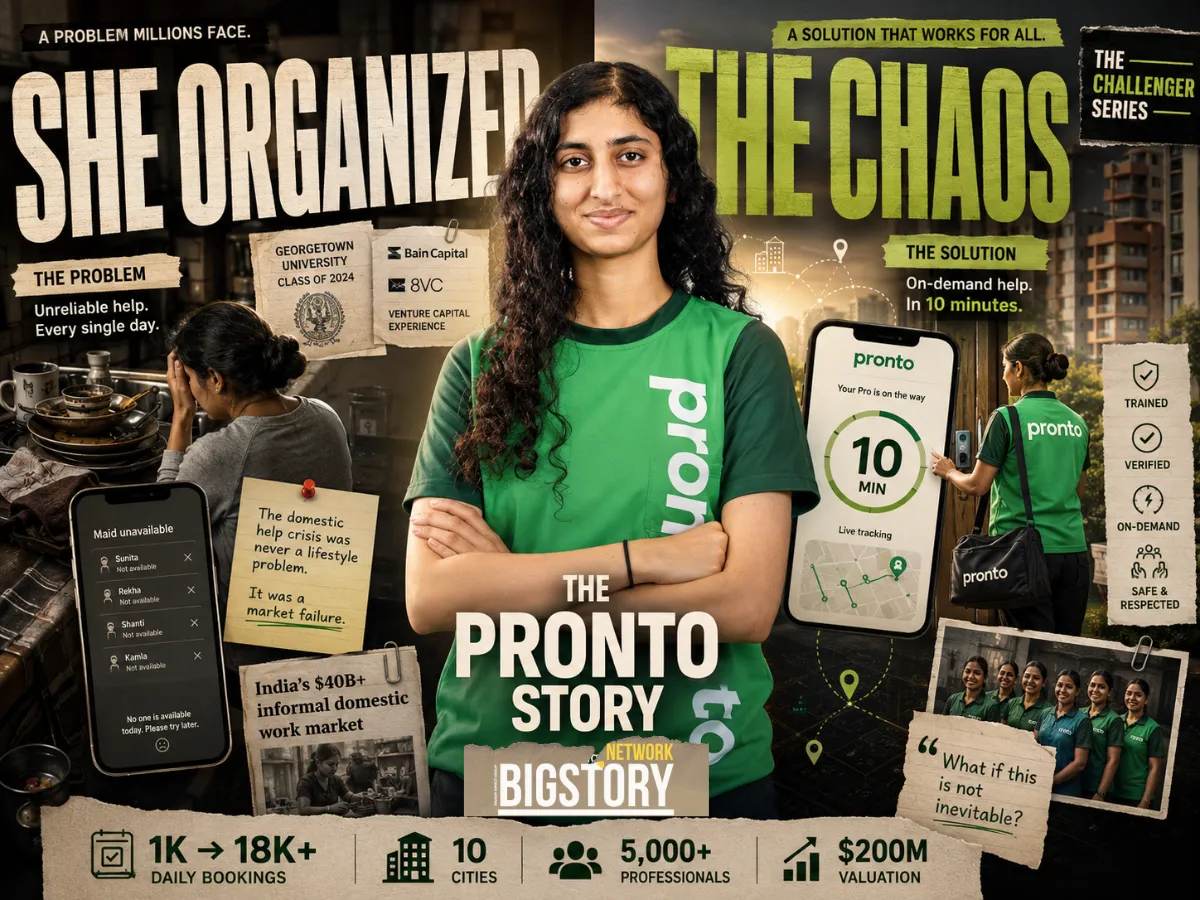
Every Indian household knows the panic of a maid who didn't show up. This is the story of how one founder turned a problem everyone accepted into a market no one saw coming. Meet Anjali Sardana — the 23-year-old who formalized India's most chaotic market and built a $200 million company in under a year.
 Rashmeet Kaur Chawla
This is a particular strain of stress that can be experienced only by Indians. This particular type of stress doesn’t come with a warning sign. It hits you on a Tuesday morning when you wake up with a maid not there, the dishes piling up, and an office call to be made in 40 minutes without a doubt and your only escape being dialing phone numbers that might never pick up. This is stressful quietness something we all understand but accept as part of the process.
For Anjali Sardana, however, it wasn’t just a problem identified from a market research slide. This was the constant buzz she heard as a kid. Dealing with unpredictable workers who quit abruptly was always a worry for her mother during her childhood days. This image of a woman handling her household amidst the constant stress of whether anyone would turn up that day became permanently etched somewhere. This feeling never left
Anjali Sardana is a graduate of Georgetown University where she majored in biology in 2024. Prior to founding Pronto, she served in different investing capacities in companies like Bain Capital and 8VC.
By all standards, she seemed to have landed herself on a professional track that indicated success. The pay grade, the connections, and the prestige- everything seemed to be in place.
However, something was not right. She claims that she could neither eat nor sleep as she would feel as if every moment she spent in VC was a waste as she could spend the time working on Pronto- an obsession which made her move out of America and into India to work on Pronto full time.
That is the crucible. Not an implosion or a collapse or some flash of insight. But something that slowly became clear to her. She had participated in meetings where capital flowed into innovation, but there was always this one thing that she kept returning to, something so obvious and yet not taken advantage of because the market was simply too complex, too technical, too mundane for anyone to build anything on top of it.
As she said herself, “In my final year, I became totally fixated on addressing this issue, the inability of both the consumers and the people within this market segment to get the job done. On behalf of consumers, it’s finding good help that can be trusted, and on behalf of the workers it’s instability, underemployment, insecurity, and building a platform that really works for everyone.”
This is Sardana’s belief, cut down to its barest bones: a market that doesn’t serve either side is not a failed market; it’s an empty one, ready for somebody bold enough to inhabit it. Sardana was that person.
At the time when Pronto rolled out its service in April 2025, India’s industry of domestic help was always informal, dependent on word-of-mouth and neighbourly contacts. All the players present in this market- be it the Urban Company and other newcomers- had operated under the assumption that services were booked and done ahead of schedule.
However, Sardana took a look at this strategy and noticed an inherent discrepancy between their assumptions and reality. The problem being solved was not an issue of inconvenience that arises within a nicely regulated household but rather the emergency – the day when help did not come, unexpected guests came on a weekend, and work became impossible due to a dishevelled kitchen.
But she decided to base her business model around a promise of being able to dispatch the worker in under 10 minutes. This allows Pronto to deliver what can be termed a “quick” service rather than a conventional home services platform. She made sure to deliver on the promise without any hesitations. Prior to launching the mobile application itself, she created the logistics infrastructure – an arrangement of staging points within every city ensuring that a trained and certified professional is never far away from any source of demand. Supply logistics took priority over everything else.
That’s because trust does not develop through a pitch but through fulfillment. And if the 10 minutes do fail once, everything falls apart.
Most platforms in the gig economy refer to their workers as “supply”. Sardana refers to her employees as the "product". All Pros at Pronto have gone through onboarding training and background verification before getting jobs with scheduled shifts that give better earnings stability than the common informal jobs in the sector.
The more fascinating thing about Pronto's approach comes into play when there is trouble while they are doing the work. Pronto trains the employees to quit immediately in case they get unsafe or disrespected at home and report to the company, who promises to have their backs – something that most never had before. Sardana feels that joining such a platform, having an established brand name with them, gives a feeling of honor and significance to their work and that they are an integral part of the team.
This is not some fluffy social responsibility note tucked at the bottom of a pitch deck. This is a strategic message. When those women who sign up for Pronto know that the company will have their back, they stick around. When they stick around, the level of service stays the same. And when service stays the same, the clients keep coming back. The average interval between the client’s first and second use of Pronto is two days, while the platform’s best 10% use Pronto nine times a month.
This rate of retention is not a consequence of a well-designed application. This is the consequence of employees who are committed to showing up because there is a purpose behind that. She did all of this because she understood that you simply cannot create a dependable consumer product using an oppressed workforce.
Her routine consists of being on the move from one hub to another in different cities, where she takes breakfast in Mumbai, lunch in Gurugram, and dinner in Bengaluru in a single day while spending quite some time in unairconditioned hubs, remaining close to the ground realities of workers. She closely follows workers on live bookings and analyses their journeys in seconds to know where there is wastage of time in protecting the ten-minute promise without violating the workers’ conditions.
Instead of issuing a press note when questioned about the basis of Pronto, saying that it was a privileged product and questioning its transformative nature, Sardana responded with stories of workers. The story of Purnima, who supported herself along with her family now. Story of Puja, who after serving as a live-in domestic worker for seven years in which she did not have any liberty, stated her joining Pronto as 'liberty'. And lastly, Chabira’s story about who had started earning enough for the whole family solely on her earnings.
This was done to make sure that a founder does not drift off course by losing touch with reality. It has been established that conviction can only be amplified as long as it remains grounded.
The markets have been kind to Sardana’s faith in her model. While Pronto had about 1,000 bookings per day earlier, today, it has grown to about 18,000 bookings, going from just one city to ten cities, such as Delhi NCR, Bengaluru, and Mumbai. Nine months back, Pronto was a startup where everyone was working hard, sometimes sleeping at office premises. Now, with fresh investment, Pronto’s valuation has gone up to about $200 million, doubling within less than two months, having raised $45 million in total with the participation of firms such as Epiq Capital, Glade Brook Capital, General Catalyst, and Bain Capital Ventures.
There seems to be great faith among investors in the home help services offered by these startups. They are very much like the on-demand quick services of e-commerce. However, while the valuation is impressive, the real impressive number here is the 5,000+ professionals in the company platform- women, who never had any economic identities before
To Sardana, the key disruption is not 10-minute fulfilment. Instead, it is the provision of official status, power, and safety to the domestic workers in the context of a market where they were informal and replaceable helpers.
This is how the original problem was solved. The picture of the mother dealing with erratic helpers in childhood was never just about inconvenience. It was about an extraction-driven process which promised nothing- neither predictability for the house nor safety for the worker and none other. Sardana’s solution goes beyond the development of the app for busy metropolitan Indians. She managed to create an official market within the unspoken economy and quantify the respect.
As it turned out, the market existed all the time. It just required someone persistent and courageous enough to get immersed in it and naive enough not to think it impossible.
The domestic help market in India existed long before Pronto. Millions of households depended on it. Millions of workers survived through it. Yet everyone had accepted the same conclusion: it was too fragmented, too informal, too unpredictable to organize. The chaos became normal. The inefficiency became culture. The problem became invisible.
That is what happens to every industry that has been broken for too long. People stop questioning the dysfunction and start adapting to it.
Challengers do the opposite.
Anjali Sardana did not invent domestic work. She did not invent technology. She did not invent logistics. What she challenged was the assumption that millions of people deserved a system that failed both the customer and the worker at the same time.
The lesson extends far beyond home services.
Every market has its accepted frustrations. Every industry has its version of "that's just how things work." Those words are often the strongest signal that innovation is overdue.
The greatest opportunities rarely hide in glamorous industries. They hide inside everyday inconveniences that people have stopped complaining about.
The next generation of builders will not win by creating entirely new worlds. They will win by repairing the worlds that already exist. Because disruption is not always about invention.
Sometimes disruption is simply refusing to accept what everyone else has agreed to tolerate and the moment you stop treating a long-standing problem as normal, you stop being an observer of the market and become a challenger of it.
Anjali Sardana's narrative is arguably one of the more radical stories that have emerged from India's startup space recently. In an industry full of pivot stories and high-growth business strategies, Anjali has managed to create a business that is simultaneously well-thought through operationally, socially conscious, and fiercely capitalist. What makes the story of Pronto really interesting is what the company believes in. The belief is that dignity beats exploitation when it comes to markets. Can Pronto sustain this belief at the massive scale it operates at, which includes 70,000 bookings a day? That remains to be seen.
 Exclusive Content




Sign up for the Daily newsletter to get your biggest stories, handpicked for you each day.



 Trending Now! in last 24hrs