Founded by Sharvan Kumar Vishwakarma — an entrepreneur who began his career driving tempos and built a diversified industrial empire before entering aviation — Shankh Air is a new-generation regional airline headquartered in Uttar Pradesh. The airline targets India's vast connectivity gap, focusing on routes that major carriers ignore and cities that have never had reliable air access. Shankh Air is not just an airline; it is infrastructure built from the ground up.
 Rashmeet Kaur Chawla
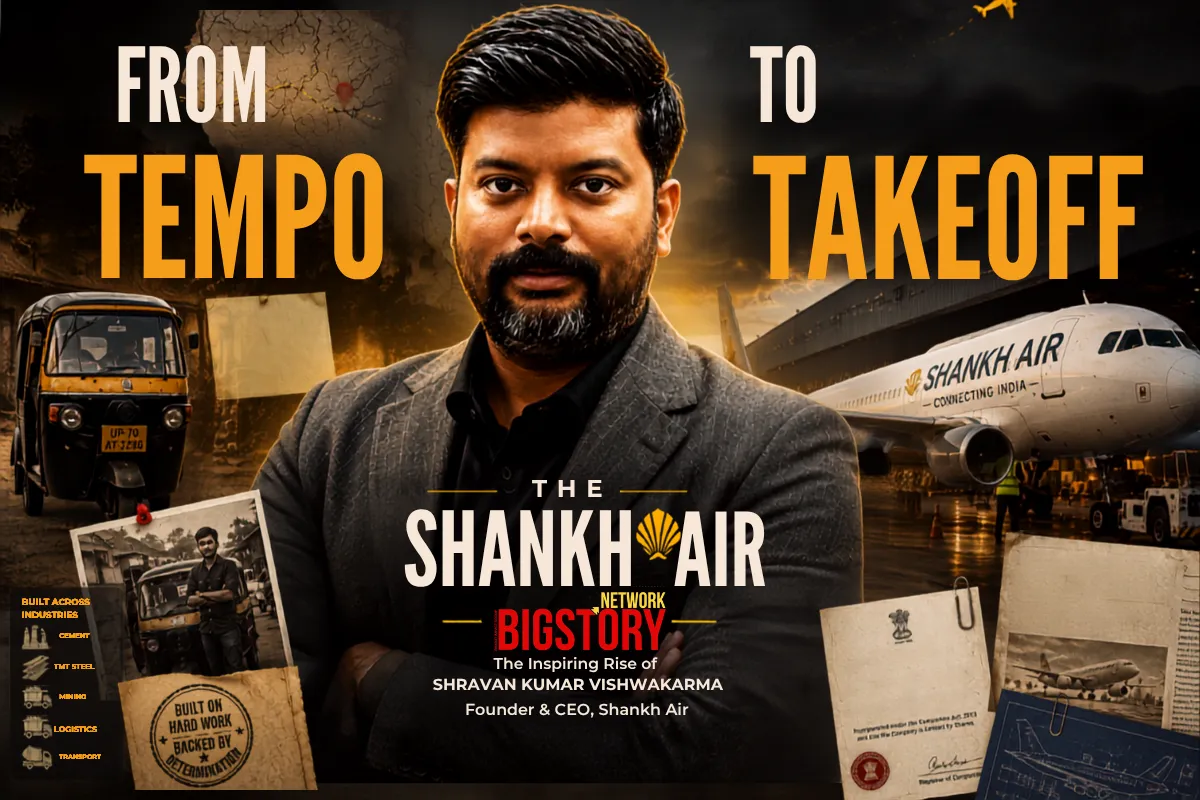
Most people would file that under fantasy. Sharvan Kumar Vishwakarma filed it under business plan.
In a country where aviation has long been the preserve of the well-connected, the highly capitalised, and the generationally wealthy, Vishwakarma's decision to launch Shankh Air — a regional airline built on his own enterprise has become one of the most discussed entrepreneurial stories. Not because it is perfect. Not because it is without controversy. But because it forces every person watching from the sidelines to ask themselves a genuinely uncomfortable question: if he could, what is your excuse?
India loves its rags-to-riches narratives. We celebrate them, share them in WhatsApp forwards, and quietly shelve them as inspiration for another day. But what separates Sharvan Kumar Vishwakarma from the usual feel-good feature is what happened between the tempo and the tarmac and why that distance is both more ordinary and more extraordinary than the headlines suggest.
When his story first broke nationally, it sparked a debate with two clean camps. One camp saw it as a triumphant story — a man born without privilege who willed himself into one of the world's toughest industries. The other camp pointed out, fairly, that by the time he registered Shankh Air, Vishwakarma had already built a diversified business empire spanning cement, TMT steel, mining, transportation, and logistics. He was not, in the strict sense, a struggling man with a wild idea. He was an experienced industrialist making a calculated vertical move
Both camps are right. And that, perhaps, is the most important thing to understand about Vishwakarma's story it is not a miracle. It is a method.
Sharvan Kumar Vishwakarma is the founder and CEO of Shankh Air, a new-generation regional airline with ambitions to connect India's underserved cities through affordable, accessible air travel. Born and raised in Uttar Pradesh, he comes from a middle-class family where, as he has said in interviews, the focus was firmly on earning not dreaming.
He is a self-made industrialist who transitioned from transport work into large-scale business, building interests across the cement, steel, mining, and logistics sectors before pivoting into aviation. His company profile, documented through public business registries, reflects a portfolio of diverse ventures accumulated over more than a decade of entrepreneurial activity. Today, he is widely recognised as a challenger within India's fiercely competitive aviation market a man who looked at an industry known for burning cash and burning founders, and decided it was worth the risk.
Growing up in Uttar Pradesh, Vishwakarma's formative years were shaped by the logic of survival. His family belonged to what he has described as the mindset of earning rather than building — a world where aspiration was a luxury and stability was the highest attainable goal. The roads, the tempo stands, the local market economies these were the textures of his early life.
In reflection, he has said: "A person coming from the bottom up sees everything — bicycles, buses, trains, tempos, everything." It is a statement that reads almost like a transport inventory, but it is really a map of possibility. Where others saw only their station, Vishwakarma seems to have seen an entire system and wondered who was running it, and why it couldn't be him.
There was no aviation exposure, no business-family connections, no privileged network to lean on. What existed instead was proximity to movement the daily choreography of goods and people navigating distance and a mind that filed those observations away.
Vishwakarma has spoken frankly about the early years. He drove tempos with friends, tried his hand at small-scale businesses, and watched most of them fail. These were not glamorous failures they were the grinding, unglamorous kind that quietly exhaust lesser resolve.
"We used to drive autos together and I also ventured into a few small businesses, most of them failed," he has said. What is notable is not the failure itself but his relationship to it. He did not narrate those years as a dark period to overcome. He described them as an education one that sharpened his understanding of risk, logistics, and what it actually takes to keep an operation running.
The inflection point came around 2014. Vishwakarma entered the cement industry, and from that footing began constructing the diversified portfolio that would eventually support his aviation ambitions. Over the following decade, he expanded into TMT steel, mining, transportation, and logistics each vertical building on the last, and each anchoring a clearer understanding of how large-scale operations are managed.
His background in logistics was, by his own account, a particular advantage. Understanding the flow of goods across geographies the inefficiencies, the bottlenecks, the opportunities for optimisation gave him a perspective on transport that extended naturally to aviation. Where most people see a flight as a travel product, Vishwakarma saw it as a logistics solution at altitude.
For a founder in the aviation business, this is not just a mission statement it is a market thesis. India has hundreds of cities that remain disconnected from the national air network. Tier-2 and Tier-3 towns where businesspeople, students, and families continue to spend hours on overcrowded trains and buses for journeys that, by air, would take forty minutes. Vishwakarma's argument is that this gap is not inevitable. It is a commercial opportunity dressed as a social problem.
Reports indicate that Shankh Air intends to focus specifically on regional connectivity linking lesser-served cities, beginning within Uttar Pradesh and expanding outward. The airline's stated positioning is not to compete with IndiGo or Air India on trunk routes, but to create a network where none currently exists. It is, in essence, a last-mile aviation plays and it draws directly from Vishwakarma's understanding of logistics infrastructure.
Entrepreneurship at this scale comes with exposure and Vishwakarma has had his share of it, including the kind that is uncomfortable to navigate publicly.
In 2025, media reports surfaced alleging that he was involved in an altercation with lift installation workers at a Lucknow property. The workers reportedly accused him of illegal confinement and physical assault during a dispute related to elevator installation work. The incident drew significant media attention and triggered an official response from authorities.
It is a chapter that complicates the clean arc of the inspirational narrative. And it would be dishonest to omit it. What the episode illustrates beyond the specific facts, which are subject to ongoing legal process is that public success comes with public scrutiny. The same attention that amplifies a founder's story also amplifies their missteps, with no filter for context and no patience for nuance.
Vishwakarma, like many entrepreneurs’ navigating rapid growth and public visibility, is discovering that the spotlight is not selective. It falls on the ambition and the achievement and it falls equally on the moments that fall short of the story being told.
The decision to enter aviation was not made in a single moment. It was the natural terminus of a decade spent watching how India moves and where it doesn't.
Vishwakarma has spoken about watching ordinary Indians, people like those he grew up with, spend disproportionate time and money on long-distance road and rail travel. As someone who understood transport infrastructure from the inside, the inefficiency was not abstract. It was personal. And the solution regional air connectivity was one he felt he had the operational background to build.
The founding of Shankh Air represented, in his framing, an expansion of the same business logic he had applied to cement, steel, and logistics: find a gap, build the capacity to fill it, and scale with discipline. The airline was not a vanity project. It was the next phase of a diversified infrastructure business one with wings.
What distinguishes Vishwakarma as a founder is not a single dramatic insight but a particular quality of accumulation. He built slowly, diversified deliberately, and moved into aviation only after establishing the financial and operational scaffolding to support it.
He does not fit the archetype of the venture-backed disruptor who raises capital on a pitch and figures out the business later. Nor does he fit the stereotype of the inherited industrialist who converts existing wealth into adjacencies. He is something rarer: a first-generation builder who used each business as a curriculum for the next.
His approach to aviation is, above all, grounded in the literal sense. It is informed by years of watching goods move across highways, of understanding where systems fail, and of building operations that can absorb the friction of reality. That groundedness may be Shankh Air's most underrated competitive asset.
Vishwakarma's story carries no easy shortcuts, which makes it more useful than most. The message embedded in his journey is not "dream big and the universe will respond." It is something more rigorous and more honest.
Let your failures teach you, but do not let them define your ceiling. Find the gap that the world is ignoring because it seems too ordinary and then fill it with extraordinary discipline. The most powerful thing about Vishwakarma's path is not the airline. It is the decade of preparation that made the airline possible.
For young entrepreneurs in India's smaller cities and towns the ones who feel furthest from the rooms where decisions are made his journey is a reminder that the distance between where you are and where you could be is not measured in geography. It is measured in resolve, preparation, and the willingness to start before you are ready.
We do not wait for permission. We do not inherit access. We build the table, pull up the chair, and take the seat because we earned it, mile by mile, year by year, failure by failure.
We are the ones who drove the tempo before we owned the fleet. We are the ones who saw infrastructure where others saw inconvenience. We are the challengers and we are just getting started.
The word 'challenger' is not given. It is earned through the willingness to enter arenas where you are not expected, to persist when the conditions make persistence irrational, and to build something where nothing existed before.
Sharvan Kumar Vishwakarma qualifies on every count.
He entered aviation from a background that gave him no obvious right to be there and brought with him a decade of hard-won operational intelligence that many aviation entrepreneurs lack entirely. He built Shankh Air not on the back of inherited capital or institutional connections, but on the infrastructure of his own making. He has done it imperfectly, as all builders do. He has faced scrutiny, as all public figures must. And he continues to build as all challengers do.
Whether Shankh Air ultimately transforms India's regional aviation landscape remains to be seen. What is already settled is the significance of the attempt.
But stories such as Sharvan Kumar Vishwakarma's are tough to write which is exactly the reason why they should be written. What attracted me to this particular journey was an aspect much more basic than any one individual. This was someone who travelled the road from transport yards to tarmac by way of ten years of conscious building, not luck or bloodline. Such stories are too unique to be ignored, too deep and nuanced to be simply summed up.
Sharvan Kumar Vishwakarma's story belongs in this series because it reflects something essential about the entrepreneurial reality that rarely makes it onto the front page: that great businesses are not born in boardrooms. They are built on roads, in warehouses, in transport yards by people who understood the country's needs long before they had the means to address them.
 Exclusive Content




Sign up for the Daily newsletter to get your biggest stories, handpicked for you each day.


 Trending Now! in last 24hrs