Nikhil Kamath didn't just build India's largest stockbroker. He built it as a philosophical argument — that the financial system's complexity was never accidental, and that refusing to replicate it was the entire strategy. This is the thinking behind Zerodha's 12 million clients and zero external funding.
 Rashmeet Kaur Chawla
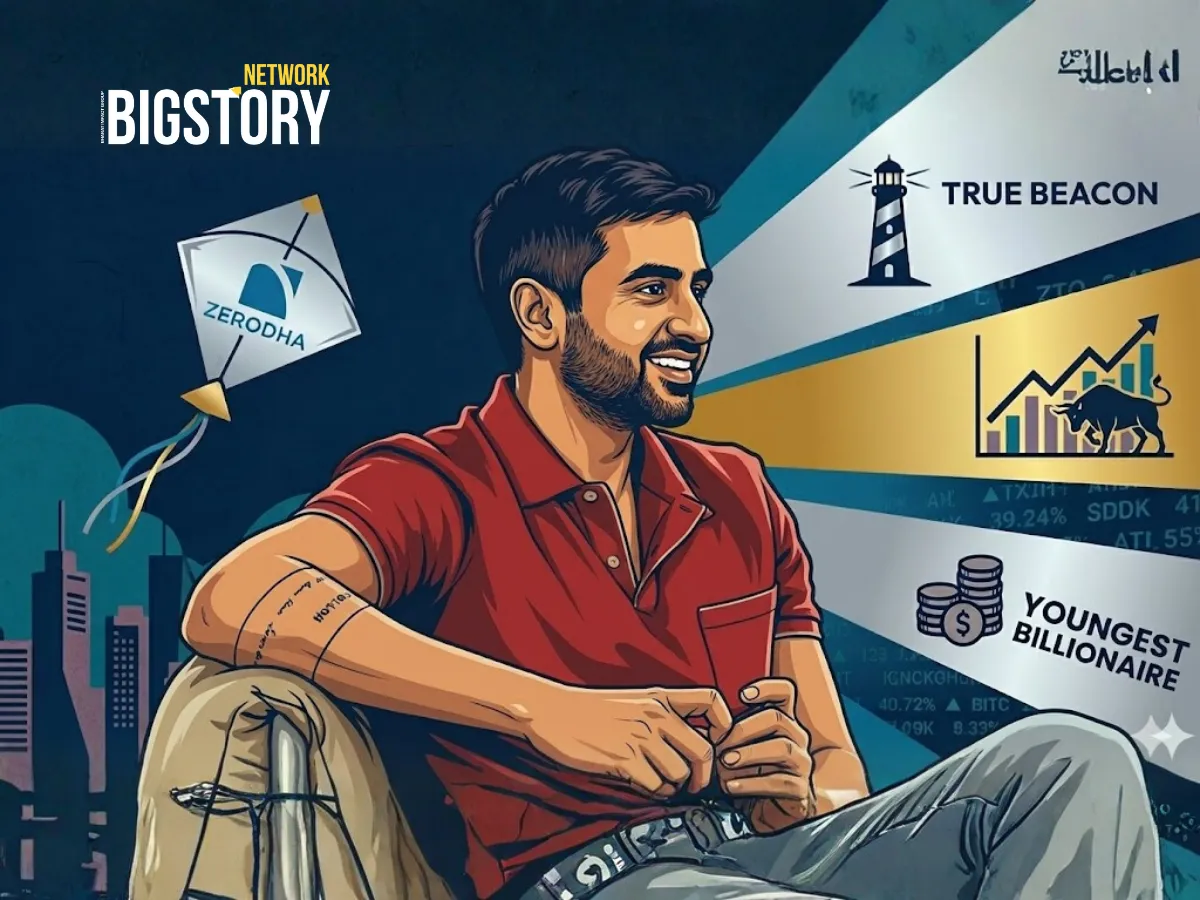
Nikhil Kamath is the co-founder of Zerodha, India's largest stockbroker by active client base. But the real story is not the 12 million clients or the 15% market share. It is the specific thinking that produced them — a conviction, formed before he was 18, that the financial system was not broken by accident. It was broken by design. And that if you refused to benefit from the broken parts, you could build something better.
Raised in a middle-class Konkani family in Karnataka, Nikhil Kamath grew up between his father's banking discipline and his mother's background as a veena artist and event organiser — an early exposure to both structured thinking and creative independence.
School never clicked. Not because he lacked the ability, but because he could not follow rules that did not make sense to him. At 17, he dropped out after Class 10. The decision produced immediate friction — family pressure, social judgment, and the quiet question that followed him for years: what if they are right?
There was no safety net. Kamath took a job at a call centre and traded stocks on the side. He experimented briefly with buying and selling second-hand mobile phones — a small venture that his mother shut down, but one that confirmed something he already understood instinctively: he had a feel for markets, and he wanted to stay in them.
For the next several years, he kept learning from the market itself rather than from any institution. That self-directed education, with its direct feedback loops and real financial consequences, produced something that no classroom had: a precise understanding of how the brokerage industry actually made money — and why that model was extractive.
Three principles shaped everything Nikhil Kamath built. None of them came from a business school:
The Earned Trust Principle
At a time when Indian brokerage firms thrived on high fees, deliberate complexity, and opaque pricing, Kamath identified the real product they were selling: the appearance of expertise. His counter-thesis was not subtle. If you remove the fee extraction, simplify the technology, and charge only what the service is worth, people will find you.
Zerodha's zero-brokerage model on equity delivery and flat ₹20 fee on intraday trades was not a marketing strategy or a loss-leader to acquire customers. It was a philosophical position on what finance should cost. "If you've hired someone, let them do the job," Kamath has said — a principle that applies equally to his management style and his pricing model. Both are built on the premise that trust compounds when you remove the mechanisms that exploit it.
The Structural Independence Rule
Zerodha has never taken external investment. It ran no advertising for years. The company grew entirely through product quality and direct word of mouth. This was not stubbornness dressed up as principle — it was a calculated decision about which obligations to avoid.
External investors bring return expectations that can misalign with long-term product quality. Advertising creates pressure to acquire customers who may not be ready for what you are offering. Kamath's read was that both introduced incentive structures that would eventually compromise what he was actually building. By remaining bootstrapped, Zerodha retained the freedom to price for fairness rather than for growth targets. That freedom is what made the zero-brokerage model structurally sustainable rather than temporary.
The Performance-Only Fee Model
His asset management firm True Beacon operates on zero management fees. It earns only when its investors do. According to Mint, True Beacon delivered approximately 22.3% CAGR in its early years. The model is a direct extension of the Zerodha philosophy — do not charge for proximity to money. Charge only for results. In an industry where management fees are collected regardless of performance, this structural choice is both a values statement and a competitive differentiator. It attracts clients who have been extractied from before and who can recognise the difference.
Nikhil Kamath co-founded Zerodha with his brother Nithin Kamath in 2010. The name itself — combining the Sanskrit word for zero with "rodha," meaning barrier — signalled the intent precisely. They were not entering the brokerage industry to compete within its existing terms. They were entering to remove the barriers the industry had built to protect itself.
The timing was counterintuitive. India's retail investing culture in 2010 was thin, intimidated, and kept that way by high transaction costs and deliberate complexity. Zerodha's flat fee structure made the old percentage-based pricing look extractive by comparison — because it was. Within a few years, the platform's clean technology and transparent pricing had built a client base that the incumbents, with their advertising budgets and established networks, could not replicate quickly.
By 2024, Zerodha served over 12 million active clients and held more than 15% of India's retail trading volume according to NSE data. It remained entirely bootstrapped throughout — a rarity among financial platforms of its scale anywhere in the world, not just in India.
Through Gruhas, Kamath expanded into real estate and startup investing, backing over 50 ventures and contributing to the creation of more than 2,500 jobs by 2024. His podcast WTF is with Nikhil Kamath built a long-form conversation platform that routinely asks the questions mainstream financial media avoids. His Earth Fund and WTFund initiatives have directed over ₹300 crore toward sustainability and social-impact projects.
As the youngest Indian signatory of The Giving Pledge, Kamath committed to directing 50% of his wealth to philanthropy — a commitment made while still in his early thirties, and focused on education, healthcare, and climate action.
What Nikhil Kamath challenged was not just a business model. It was the credentialist architecture that Indian professional life is built on — the assumption that the right degrees, the right firms, and the right social networks are prerequisites for being taken seriously in finance.
Kamath arrived without any of that. What he had was a direct, unmediated understanding of what retail investors actually needed: lower costs, cleaner tools, and a platform that did not profit from their confusion. That understanding came not from a curriculum but from years of direct participation in the market and years of watching, from the inside of a brokerage, how the extraction worked.
The broader significance for India's entrepreneurial landscape is structural. Zerodha demonstrated — at scale and over more than a decade — that a bootstrapped, product-led company could compete with and defeat legacy incumbents without venture capital, without advertising spend, and without the social capital that credentialed founders automatically bring to a room. That proof of concept shaped how a generation of Indian founders thinks about the relationship between capital, growth, and compromise.
Nikhil Kamath is listed among Forbes India's Billionaires 2024 — one of the youngest on the list. The number matters less than the structure that produced it. Zerodha is not a company that raised money and bought its way to scale. It is a company that earned its position by removing what its competitors depended on.
Through Earth Fund and WTFund, Kamath is extending the same logic into philanthropy — measuring outcomes rather than announcements, backing solutions rather than visibility. The teenager told he would amount to nothing without a degree is now building systems for others who feel exactly the same way. That, more than any valuation, is the real output of the playbook.
Zerodha — Official Website The primary source for Zerodha's business model, zero-brokerage structure, and product details. https://zerodha.com
National Stock Exchange of India (NSE) — Market Data Source for Zerodha's 15%+ share of India's retail trading volume and 12 million active client figures. https://www.nseindia.com
Forbes India — Billionaires 2024 Source for Nikhil Kamath's billionaire listing and profile as one of India's youngest self-made billionaires. https://www.forbesindia.com/profile/nikhil-kamath/1909/1
Business Standard — From School Dropout to Billionaire Source for Kamath's Class 10 dropout decision and early career at a call centre. https://www.business-standard.com
The Economic Times — Zerodha Crosses 12 Million Clients Source for Zerodha's client base milestone and market position in Indian retail investing. https://economictimes.indiatimes.com
Mint — How True Beacon Works Source for True Beacon's zero-management-fee model and approximately 22.3% CAGR figure in early years. https://www.livemint.com
Gruhas — Official Website Source for Kamath's venture investment activity, 50+ portfolio companies, and 2,500+ jobs created by 2024. https://gruhas.com
The Giving Pledge — Nikhil Kamath Source for Kamath's pledge commitment, 50% of wealth to philanthropy, and youngest Indian signatory status. https://givingpledge.org
WTF is with Nikhil Kamath — Podcast Source for Kamath's long-form conversation platform and public commentary on finance and entrepreneurship. https://open.spotify.com
Earth Fund and WTFund Source for ₹300 crore directed toward sustainability and social-impact projects. https://gruhas.com
 Exclusive Content




Sign up for the Daily newsletter to get your biggest stories, handpicked for you each day.


 Trending Now! in last 24hrs