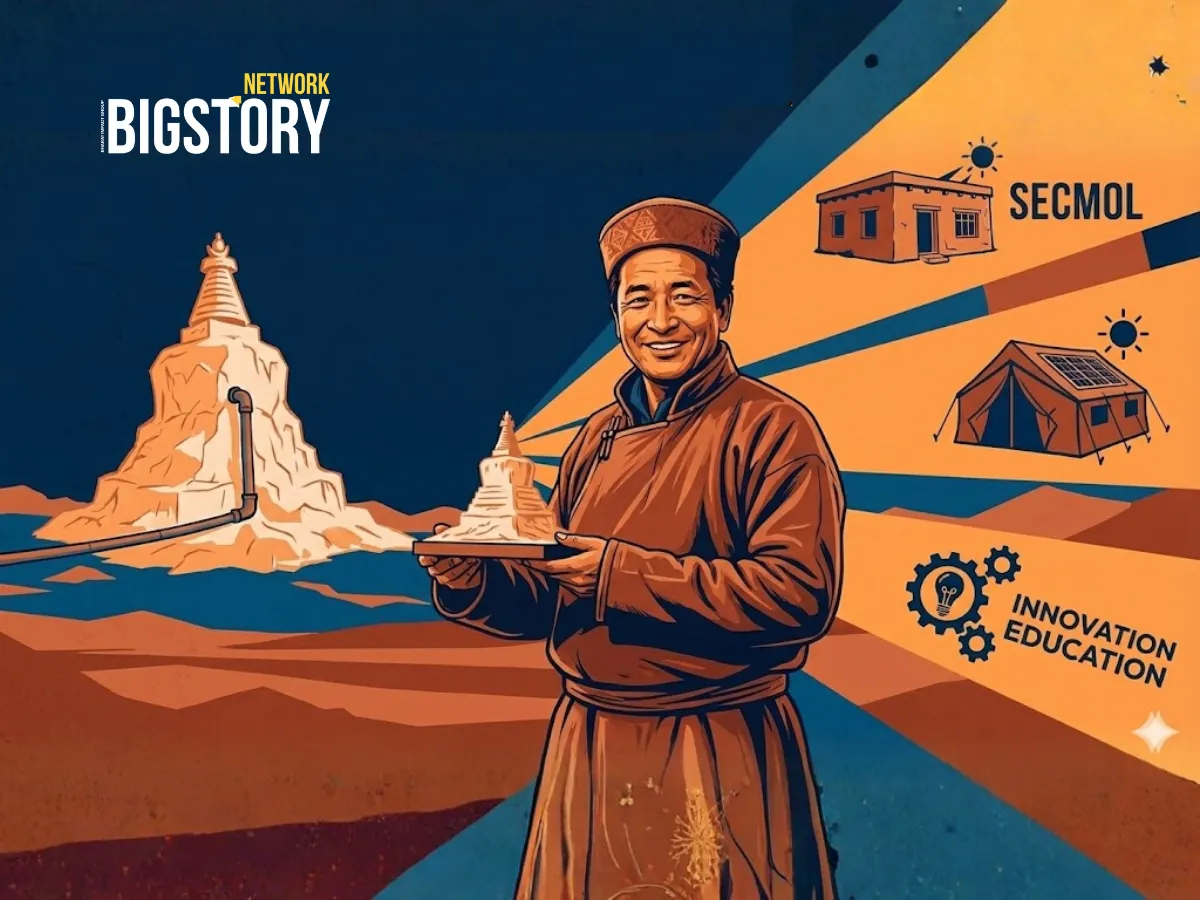
“Sonam Wangchuk, founder of SECMOL and innovator of the Ice Stupa, is transforming education and sustainability in Ladakh with courage and vision.”
 Rashmeet Kaur Chawla
India’s education story is often discussed through access: schools built, enrolment ratios, examination results. What receives far less attention is whether education, as designed, actually works for the environments and lives it is meant to serve.
Sonam Wangchuk grew up confronting that gap from the margins. Born in 1966 in Alchi, a remote village in Ladakh, his early years unfolded in a place where formal schools did not exist. Learning was informal, local, and closely tied to everyday life. When he later entered the formal education system, the transition did not feel like progress rather it felt like dislocation.
Language barriers, cultural disconnect, and an emphasis on rote learning placed him at odds with the classroom. Intelligence was assessed through conformity, success through memorization, with little room for context or lived experience. Over time, the problem became clear to him: education was not failing because students lacked ability, but because systems were indifferent to where those students came from.
What distinguished Wangchuk’s path was not early activism or rebellion, but a persistent discomfort with this mismatch. A sense that education, when detached from reality, could alienate the very people it claimed to empower.
That discomfort would go on to shape how he approached learning, innovation, sustainability, and development, not as separate challenges, but as expressions of the same structural flaw.
And it led him to the question that would define his work:
If education is meant to empower, why does it exclude so many capable students?
Sonam Wangchuk entered formal schooling late and when he was sent from Ladakh to Srinagar, the classroom did not meet him halfway. It assumed familiarity: with language, with method, with an environment far removed from his own.
The medium of instruction was unfamiliar. The curriculum was abstract. Learning was reduced to repetition and recall. For a student raised in a setting where knowledge was practical and contextual, the disconnect was immediate. He struggled not because of lack of ability, but because the system did not recognise where he came from.
What followed was not quiet adjustment, but repeated exclusion. He fell behind, not in understanding, but in compliance. At one point, he ran away to Delhi, attempting to persuade a school principal to admit him to less an act of defiance than desperation.
The experience clarified something essential.
Education, as it was structured, did not account for difference. It rewarded those already fluent in its language, literal, cultural and marginalised those who were not. Intelligence was filtered through conformity. Potential was measured by alignment, not capacity.
Wangchuk persisted. He eventually earned a degree in mechanical engineering from NIT Srinagar and later studied earthen architecture at the Craterre School of Architecture in France. But the qualifications mattered less than the pattern they revealed.
Across institutions, the same question returned, quietly, insistently: If capable students were repeatedly being pushed aside, what exactly was education optimised for?
For Sonam Wangchuk, the problem with education was not theoretical. It was structural and therefore fixable.
In 1988, he co-founded SECMOL (the Students’ Educational and Cultural Movement of Ladakh). The aim was not to outperform the existing system, but to expose its blind spots. SECMOL began as an effort to support students who had been written off by conventional schools, not because they lacked ability, but because they did not conform to a narrow definition of success.
The turning point came in 1994 with Operation New Hope, a collaboration between government, civil society, and local communities to improve Ladakh’s school outcomes. The initiative addressed teacher training, curriculum relevance, and local participation. But its most lasting impact lay in a more uncomfortable idea: that failure, as defined by the system, was often misplaced.
SECMOL’s alternative campus near Leh made that idea tangible. It admitted only those labelled “failures.” There were no conventional classrooms designed around memorisation. Instead, learning was embedded in daily responsibility. Students designed and built solar-powered mud houses. They managed farms, generated electricity, ran administrative systems, and took collective responsibility for the campus itself.
The campus was not a showcase. It was a test.
Built using passive solar mud architecture, it remained warm through Ladakh’s sub-zero winters without external heating. The design was not symbolic but was necessary. Comfort, sustainability, and survival were part of the curriculum.
What SECMOL challenged was not academic standards, but assumptions. It demonstrated that students excluded by formal education were not incapable of learning. They were incompatible with abstraction divorced from context. He shifted the question education asked of students—from Can you memorise what we teach? to Can you solve the problems around you?
If SECMOL redefined how learning could work, Wangchuk’s innovations addressed a parallel problem: how communities survive when development ignores context.
Life in Ladakh is shaped by extremes, altitude, temperature, and scarcity. For Wangchuk, technology that did not respond to those realities was not incomplete; it was irrelevant. Innovation, in his view, had to begin where people actually lived.
That belief took concrete form in 2014 with the creation of the Ice Stupa. Designed as a cone-shaped artificial glacier, it stored winter water in frozen form and released it gradually during spring, when farmers needed irrigation most. The idea was deceptively simple. The effect was not.
In a region facing accelerating glacial melt and unpredictable water cycles, the Ice Stupa offered a locally adaptable solution, one that required minimal energy, worked with natural conditions, and could be replicated by communities themselves. It treated climate not as an abstract crisis, but as a design constraint.
The same principle guided Wangchuk’s work in solar-heated earth buildings across Ladakh and Nepal. These structures were engineered to capture and retain solar heat, remaining habitable through sub-zero winters without external heating. Architecture here was not aesthetic. It was functional, economical, and responsive.
In 2021, the logic extended to high-altitude defence environments, with the development of solar-powered tents for soldiers stationed in icy terrains. Portable and energy-efficient, the tents absorbed heat during the day and released it at night—another instance of applying science to serve living conditions rather than override them.
Across these projects, the pattern was consistent. Wangchuk was not chasing novelty. He was responding to failure. Specifically, the failure of imported solutions to address local problems.
For him, innovation was not about pushing technology forward but It was about pulling it closer to the people it was meant to serve.
Over time, Wangchuk’s work moved beyond institutions and innovations into the public sphere. This shift was not a reinvention. It was continuity.
As Ladakh faced increasing ecological stress and questions of political representation, Wangchuk emerged as one of its most recognisable voices. His advocacy focused on two linked concerns: environmental protection and the preservation of local agency in decisions about development.
In 2013, he co-founded the New Ladakh Movement, calling for sustainable education and an economy aligned with the region’s ecological limits. In 2020, amid heightened border tensions, he urged Indians to boycott Chinese goods, framing consumer choice as “wallet power.”
More recently, his activism took on sharper form. In 2023, he attempted a fast at Khardung La to draw attention to climate vulnerability and the demand for Sixth Schedule protections. In 2024, he undertook a prolonged hunger strike calling for safeguards against unchecked industrial exploitation in Ladakh.
These actions were not a departure from his earlier work but were its public consequence.
For Wangchuk, activism was not performance. It was another form of education and forcing systems to confront the realities they preferred to abstract away.
Over time, Wangchuk’s work drew attention well beyond Ladakh. In 2018, he received the Ramon Magsaysay Award for community leadership and education reform. His campuses and buildings crafted from earthen, climate-responsive architecture have earned international recognition for combining tradition with engineering precision.
His ideas also entered popular culture. The character of Phunsukh Wangdu in 3 Idiots was inspired by Wangchuk’s philosophy: an unconventional teacher challenging rigid systems. The portrayal brought visibility, but it did not alter his direction. Recognition, in his work, has always been incidental. Durability has been the goal.
What sets Wangchuk apart is not the range of his interventions: education, climate, architecture, activism, but their coherence. Each effort answers the same underlying concern: systems fail when they ignore context. Whether in classrooms, campuses, or policy, abstraction without grounding produces exclusion.
His journey does not argue against institutions. It argues for rebuilding them from where the problem lives.
Sonam Wangchuk’s BIGSTORY is not about innovation for its own sake; It is about refusing to accept systems that mistake conformity for merit.
His belief is consistent and demanding:
"Education must serve life as it is lived—not life as systems assume it to be."
From a childhood without schools, to classrooms that excluded him, to institutions designed from scratch, that belief has been tested repeatedly. It has shaped how he teaches, how he builds, how he innovates, and how he resists.
In doing so, he represents the core spirit of a Challenger, not one who stands outside systems and critiques them endlessly, but one who enters them, exposes their blind spots, and rebuilds them with discipline.
In a world facing climate uncertainty, educational fatigue, and institutional inertia, Wangchuk’s journey offers a quiet reminder:
The most resilient solutions are not imposed from above. They are built from within and by people who refuse to let context be ignored.
Q1. Who is Sonam Wangchuk?
Sonam Wangchuk is a Ladakhi engineer, innovator, and education reformer, best known for founding SECMOL and inventing the Ice Stupa artificial glacier.
Q2. What is SECMOL?
SECMOL (Students’ Educational and Cultural Movement of Ladakh) is an alternative school founded by Wangchuk that focuses on practical, culturally relevant education for students who struggle in the conventional schooling system.
Q3. What is an Ice Stupa?
An Ice Stupa is a cone-shaped artificial glacier designed to store winter water in the form of ice, which melts slowly to provide irrigation water during dry spring months in high-altitude desert regions.
Q4. How is Sonam Wangchuk connected to the movie 3 Idiots?
The character Phunsukh Wangdu in the Bollywood blockbuster 3 Idiots was inspired by Wangchuk’s life, particularly his innovative teaching methods and engineering ingenuity.
Q5. Why has Sonam Wangchuk been protesting recently?
Wangchuk has been leading protests and hunger strikes to demand Sixth Schedule status for Ladakh, which would provide constitutional safeguards to protect the region's fragile ecology and indigenous tribal culture.
 Exclusive Content




Sign up for the Daily newsletter to get your biggest stories, handpicked for you each day.


 Trending Now! in last 24hrs