The high-stakes battle for West Bengal kicked off with massive crowds and several severe flashes of violence across 152 constituencies, as the BJP and TMC fight for dominance in the crucial North Bengal belt and Nandigram.
 Brajesh Mishra
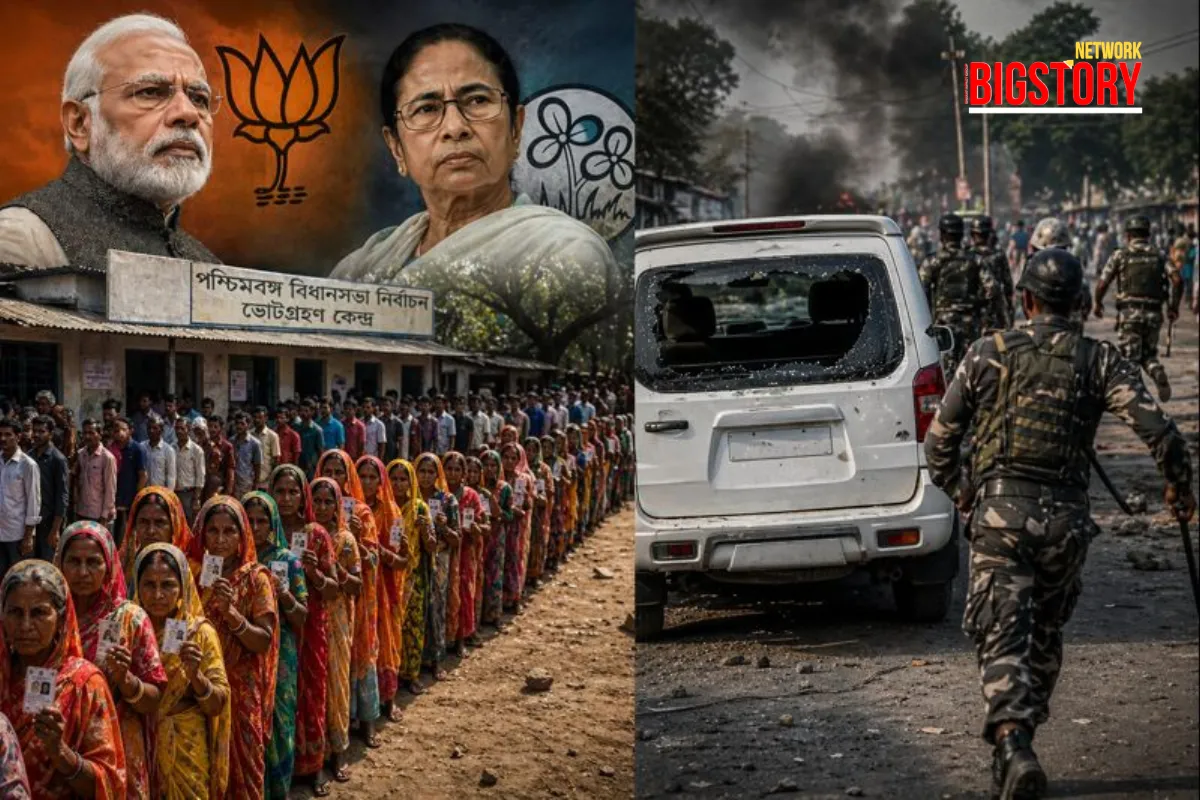
Phase 1 voting for the high-stakes West Bengal Assembly Elections has officially wrapped up, closing at the 6:00 PM deadline on Thursday, April 23, 2026. The day has been defined by absolutely massive voter turnout, long queues, and several severe flashes of political violence across the 152 constituencies in play.
With over 3.6 crore eligible voters deciding the fate of this critical opening phase, both the ruling Trinamool Congress (TMC) and the Bharatiya Janata Party (BJP) have thrown their full organizational weight into the fray.
The Election Commission of India reported an astronomical voter turnout of 89.93% by 5:00 PM. Districts like Dakshin Dinajpur and Paschim Medinipur witnessed relentless crowds from the moment polls opened at 7:00 AM.
Because election protocols mandate that anyone standing in line at the 6:00 PM cutoff must be given a numbered slip and legally allowed to vote, officials expect the final, formalized polling percentage to comfortably cross the 90% mark.
Today's voting heavily focused on the critical North Bengal belt—including Darjeeling, Siliguri, Jalpaiguri, and Cooch Behar—as well as several high-profile southern districts. All eyes were firmly fixed on Nandigram, the prestige epicenter where BJP's Suvendu Adhikari is seeking to aggressively defend his turf against the TMC's Pabitra Kar in a bitter, multi-cornered fight.
Despite the heavy, unprecedented deployment of 2,450 companies of central armed police forces, the day was severely marred by political violence and voter intimidation.
In Asansol Dakshin, BJP candidate Agnimitra Paul's convoy was violently attacked near Rahmat Nagar. As she exited a polling booth, her car was pelted with heavy stones, completely shattering the rear windowpanes.
Similar scenes unfolded in Kumarganj, where BJP candidate Subhendu Sarkar alleged that his polling agents were being forcibly removed from multiple booths. Upon arriving to intervene, Sarkar claimed that TMC workers vandalized his vehicle and physically assaulted his team while central forces allegedly stood by as spectators.
In the hotly contested battleground of Nandigram, the TMC officially accused the police and central forces of acting as outright "BJP agents." In response, Suvendu Adhikari countered that TMC "goons" were actively attempting to suppress turnout by threatening voters outside the booths. Further clashes and altercations were widely reported in Murshidabad's Domkal area.
While the violence captures the immediate headlines, the "Missed Angle" here is what a near-90% turnout actually signals for the ruling government.
Historically in Indian electoral politics, a sudden, massive surge in voter participation is a massive red flag for the incumbent. Chief Minister Mamata Banerjee's TMC is seeking a historic fourth term, but the BJP is heavily banking on a profound anti-incumbency wave, particularly in North Bengal—a region where the BJP successfully captured 59 seats in the last election cycle.
An 89.93% turnout by 5:00 PM suggests hyper-mobilization on the ground. If the TMC fails to crack North Bengal's defensive wall today, the sheer momentum shifting into Phase 2 (the remaining 142 seats voting on April 29) could permanently and decisively tilt the state's political axis.
News & Wire Coverage:
 Exclusive Content






Sign up for the Daily newsletter to get your biggest stories, handpicked for you each day.



 Trending Now! in last 24hrs