The ultimate political survivor of the Hindi heartland is finally changing his address. After a record-breaking ten terms governing a state of over 130 million people, Bihar Chief Minister Nitish Kumar signed his nomination papers for the Rajya Sabha on Thursday morning. Flanked by Union Home Minister Amit Shah, Kumar’s move effectively ends a two-decade era of JD(U) dominance and clears the path for the Bharatiya Janata Party (BJP) to claim the Chief Minister's chair for the first time in Bihar's history.
This matters because the transition fundamentally rewrites the political math of northern India. Despite Nitish Kumar leading the NDA to a landslide victory in the November 2025 assembly elections, the BJP emerged as the undeniable senior partner, capturing 89 seats. For months, reports of a high-pressure "succession plan" demanded by Delhi have circulated in Patna. Now, as Kumar packs his bags for the Upper House, the BJP secures total executive control of a vital electoral battleground ahead of the next General Election cycle.
The "BigStory" Angle (The "Forced Exit" Theory & Predictive Modeling)
Mainstream media is framing this as a peaceful, voluntary retirement to a national advisory role. They are ignoring the "Forced Exit" Theory.
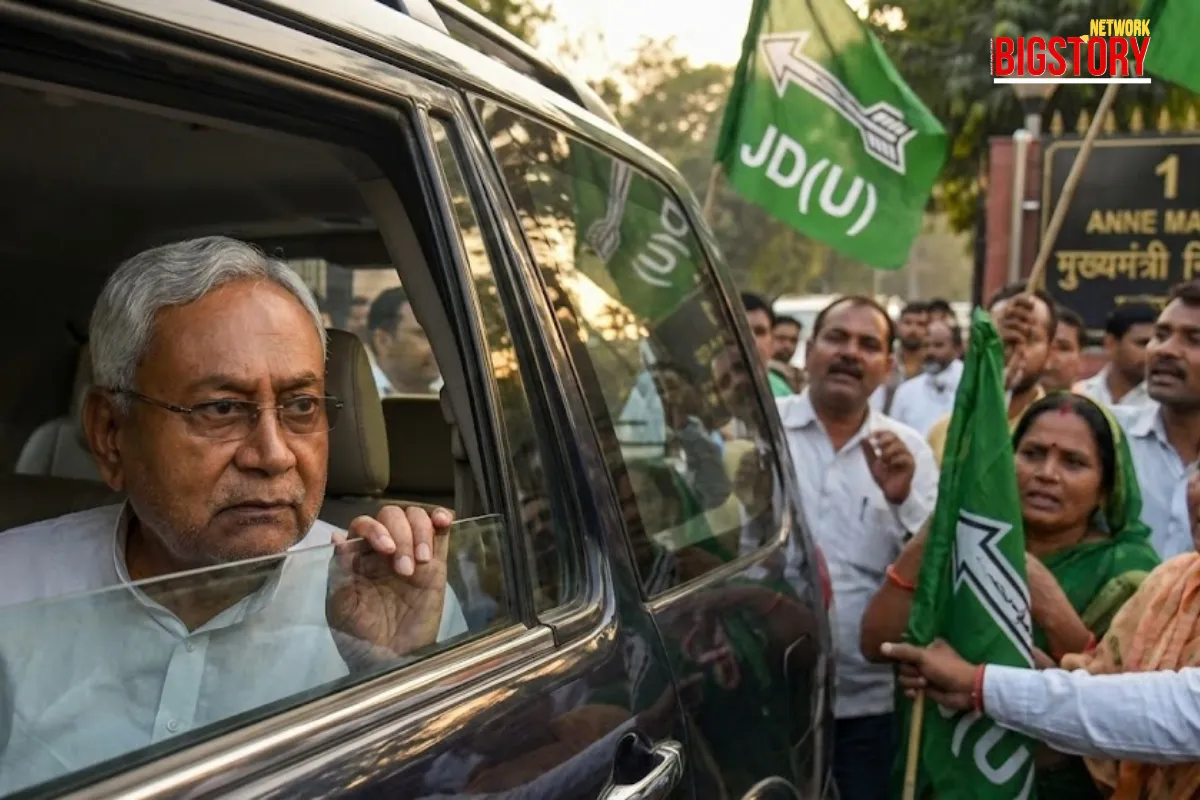
Opposition leaders and RJD insiders suggest Kumar's hand was forced. The presence of Amit Shah in Patna was not just a show of NDA unity; it was the physical manifestation of the BJP ensuring the regime change went smoothly. JD(U) supporters protesting outside the Chief Minister's residence echoed this sentiment, raising slogans demanding Kumar stay and insisting they voted for him, not a "Delhi-led puppet show."
Furthermore, watch the AI Predictive Modeling being utilized by political strategists. Data analysts are running simulations to see if a Nitish-less JD(U) can survive. EBC (Extremely Backward Classes) and OBC voters make up a combined 63% of Bihar's population. Without the "Nitish factor" anchoring the state government, models suggest this massive, decisive vote bank may fragment—either migrating to the RJD or being fully absorbed by the BJP's new state leadership. To stop this bleeding, the JD(U) is reportedly rapidly grooming Kumar's low-profile son, Nishant Kumar, to take a cabinet role and keep the family brand alive.
The Context (Rapid Fire)
- The Trigger: Intense political huddles at "1, Anne Marg" throughout the week culminated in Kumar officially confirming his Rajya Sabha bid on social media, prioritizing his goal to serve in the Assembly, Council, Lok Sabha, and Rajya Sabha.
- The Backstory: Speculation regarding Kumar's declining health and his grip on the state administration accelerated after the November 2025 elections, giving the BJP the leverage it needed to demand the top post.
- The Escalation: The transition is highly lucrative personally but risky politically. While Kumar secures a comfortable national role (with a revised Rajya Sabha monthly salary of ₹2.86 Lakh), his departure leaves his regional party highly vulnerable to being cannibalized by its larger ally.
Key Players (The Chessboard)
- Nitish Kumar (The Outgoing CM): The undisputed "Constant" of Bihar politics for 20 years, executing his final major political maneuver to secure a legacy in the Upper House.
- Amit Shah (The Facilitator): The Union Home Minister whose strategic presence in Patna guaranteed the BJP's long-awaited acquisition of the Chief Minister's seat.
- Nishant Kumar (The Successor): A software engineer and Nitish's son. While supporters chanted for Nishant to take the Rajya Sabha seat instead of his father, he is currently being positioned by the JD(U) as a potential Deputy CM to hold the party's ground.
The Implications (Your Wallet & World)
- Short Term (Administrative Freeze): State government operations in Patna are currently in a holding pattern. Contractors and civil servants should expect a massive bureaucratic reshuffle over the next two weeks once the new BJP Chief Minister assumes office and reallocates key portfolios.
- Long Term (The EBC Vote): The BJP must now walk a tightrope. To maintain the 63% OBC/EBC coalition that Nitish Kumar built, the party is expected to bypass upper-caste leaders and select an EBC face (such as Samrat Choudhary) or a prominent woman candidate as the new Chief Minister.
The Closing Question
Nitish Kumar's supporters claim they voted for his leadership, not for a BJP Chief Minister handpicked by Delhi. Will the JD(U) voter base accept this transition, or is this the beginning of the end for the NDA alliance in Bihar? Tell us in the comments.

FAQs
- Q: Why did Nitish Kumar resign as Bihar Chief Minister in 2026?
- A: Nitish Kumar resigned to file his nomination for the Rajya Sabha. While he stated it was a personal milestone to serve in all four legislative houses, political analysts note it was a strategic transition to allow the BJP to appoint its own Chief Minister after emerging as the largest party.
- Q: Who is the new Chief Minister of Bihar after Nitish Kumar?
- A: The official name will be decided at the BJP Legislative Party meeting tonight. Frontrunners include prominent EBC leaders like Samrat Choudhary, Nitin Nabin, or potentially a surprise woman candidate selected by the BJP central leadership.
- Q: Is Nishant Kumar joining the Bihar cabinet?
- A: Nishant Kumar, Nitish Kumar's son, is reportedly being groomed for a major active political role, with strong speculation that he may be appointed as a Deputy Chief Minister to represent the JD(U) in the new government.
- Q: What are the perks of a Rajya Sabha MP vs. a Chief Minister?
- A: While a Chief Minister holds immense executive state power, a Rajya Sabha MP enjoys a national legislative platform, residence in New Delhi, and a recently revised monthly salary of ₹2.86 Lakh, providing a highly comfortable and prestigious national role for the veteran leader.
Sources: