Poet. Prime Minister. Nuclear statesman. How Atal Bihari Vajpayee became India's greatest Challenger — leading with quiet strength, bold decisions, and an unbreakable soul.
 Rashmeet Kaur Chawla
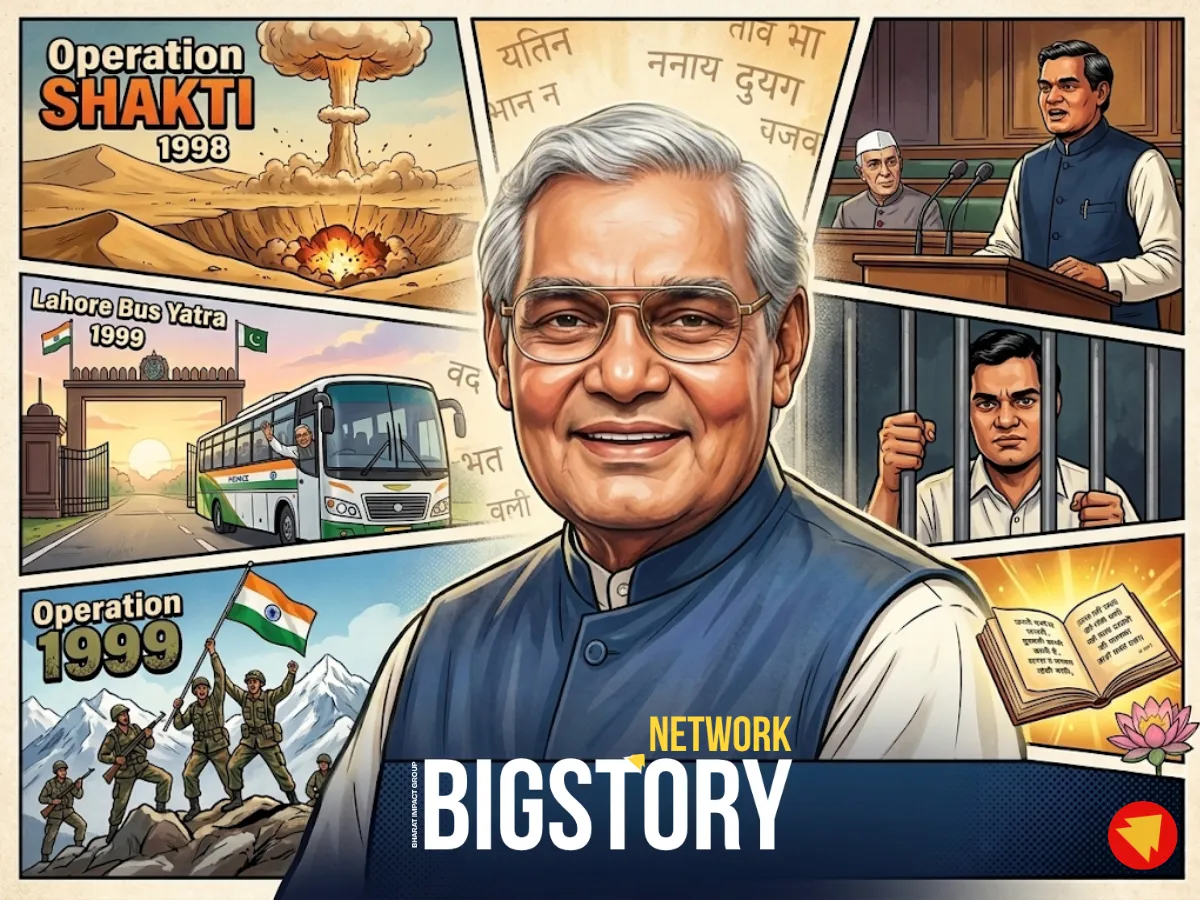
“My poetry is a declaration of war — not the defeated soldier’s drumbeat of despair, but the fighting warrior’s will to win.”
— Atal Bihari Vajpayee
Picture this. It is May 1998. The world is asleep. In the desolate Thar Desert of Rajasthan, deep beneath the dunes of Pokhran, a silent tremor shakes the earth. India has just detonated five nuclear devices simultaneously. The man who pressed that metaphorical button? A soft-spoken, Hindi-poetry-writing, kurta-clad politician from Gwalior who had never commanded an army and never married. A man whose voice quivered when he recited his verses — and remained rock-steady when he stared down the world.
That man was Atal Bihari Vajpayee. And he was no ordinary politician. He was a challenger — in the truest, most textured sense of the word. In a world that mistook loudness for strength and aggression for leadership, Vajpayee was the anomaly that history needed.
He proved that you don’t need to shout to be heard. You don’t need to be ruthless to be powerful. And you certainly don’t need to abandon your soul to lead a billion people.
This is his story. And it is, in many ways, the story of modern India itself.
Born on 25 December 1924 in Gwalior, Madhya Pradesh, into a Kanyakubja Brahmin family, Atal Bihari Vajpayee was not born into privilege. His father, Krishna Bihari Vajpayee, was a schoolteacher and a poet himself — a detail that would shape the son’s entire worldview. His mother, Krishna Devi, raised him in an environment that prized learning over luxury. The home was modest. The ambitions were not.
He completed his Master’s degree in Political Science and was drawn almost magnetically — to the idea of serving India at a time when the nation was still finding its feet. He was never a product of dynastic politics. He built himself, word by word, speech by speech, decision by decision.
He served as India’s Prime Minister three times — for 13 days in 1996, and then from 1998 to 2004, becoming the first non-Congress Prime Minister to serve a full five-year term.
He was awarded the Padma Vibhushan in 1992 and the Bharat Ratna in 2015. His birthday, December 25, is celebrated across India as Good Governance Day. He passed away on 16 August 2018, leaving behind not just policies and programmes, but an entire philosophy of what it means to lead.
Growing up in Gwalior in the 1930s was not an easy proposition. India was still under British rule, the Independence movement was reaching its fever pitch, and a young Atal was watching it all with wide, curious eyes. His father’s literary sensibility instilled in him a love for the Hindi language, for metaphor, for the power of words to move mountains.
At Victoria College (now Maharani Laxmi Bai College) and later DAV College in Kanpur, Vajpayee he was already a voice. He joined the Quit India Movement in 1942, briefly imprisoned alongside his father, learning early that conviction sometimes comes with a cost. This wasn’t a teenager showing off; this was the formation of a character that would one day define a nation.
He joined the Arya Kumar Sabha first, and then the Rashtriya Swayamsevak Sangh (RSS), becoming a full-time pracharak by 1947 — the same year India tasted independence. While his contemporaries were celebrating freedom, young Vajpayee was already thinking about what came next: what kind of India should this free country build?
Vajpayee’s political journey was not a sprint. It was a marathon, run with the patience of a monk and the resilience of someone who has been told ‘no’ enough times that it no longer sounds like a verdict.
He worked as a journalist and editor for Hindi publications including Rashtradharma, Panchjanya, Swadesh, and Veer Arjun — sharpening his ideas and his language every single day. In 1951, he joined the Bharatiya Jana Sangh (BJS). In 1957, he won his first Lok Sabha seat from Balrampur, Uttar Pradesh, and Parliament would never be the same again.
The legend goes that India’s first Prime Minister Jawaharlal Nehru — a man of towering stature and the polar ideological opposite of Vajpayee — sat in Parliament and listened to this young BJS MP speak. What he heard stunned him. Nehru reportedly told colleagues that this young man would one day be Prime Minister. For a man known for his opposition politics, this was an extraordinary prophecy — and history proved Nehru right.
Over his career, Vajpayee was elected to the Lok Sabha ten times from constituencies including Balrampur, Gwalior, New Delhi, and finally Lucknow — and twice to the Rajya Sabha. He became the president of the Jana Sangh in 1968 and, after the party transformed into the BJP in 1980, became its first president. He was not just a leader of a party; he was the architect of a movement.
“You can change friends, but not neighbours.”
— Atal Bihari Vajpayee — a line that became India’s foreign policy philosophy
What did Vajpayee actually believe in? That question has fascinated political scientists, journalists, and ordinary citizens alike for decades. The answer is both simple and layered.
At his core, Vajpayee believed in India — not as a geographical territory, but as a civilisational idea. He saw the country as a place where diversity was not a problem to be solved but a strength to be celebrated. He combined cultural nationalism with democratic pluralism in a way that his critics said was impossible, and his admirers said was visionary.
He believed that India should be free from hunger and fear. From the Red Fort, he articulated his vision as an India free of illiteracy and want, placing human dignity at the very heart of governance. He was not a man who confused religion with governance or strength with aggression. When the 2002 Gujarat riots happened under his watch, he publicly reminded his own chief minister about ‘Raj Dharma’ — the moral duty of a ruler to protect every citizen regardless of faith.
His poetry said it better than any policy paper ever could. His poem Kadam Milakar Chalna Hoga (‘We Must Walk Together’) captured something that political science books cannot teach: the idea that a nation’s progress is collective or it is nothing at all.
“Chote man se koi bada nahi hota. Tute man se koi khada nahi hota.”
With a small heart, no one becomes great. With a broken spirit, no one can stand.
For most of his political life, Vajpayee was in opposition. The Congress Party dominated India for decades, and being part of a Hindu nationalist party in a nation that had chosen secularism as its official creed meant that Vajpayee was always fighting on difficult ground.
When the Emergency was declared by Indira Gandhi in 1975 — one of the darkest chapters in Indian democracy — Vajpayee was imprisoned. He did not break. He did not capitulate. He came out more resolute than before.
His first stint as Prime Minister lasted just 13 days in 1996 — not because he failed, but because the numbers weren’t there. He chose to resign rather than compromise his ethics by cobbling together an unprincipled coalition. That 13-day tenure has become legendary precisely because of what Vajpayee chose not to do: he did not beg, borrow, or manipulate. He resigned with grace.
And then he came back. Twice.
Managing a coalition government of over 20 parties — the National Democratic Alliance — was arguably the hardest management challenge in Indian political history. Every decision required negotiation, persuasion, and patience. Vajpayee did it with such skill that political analysts still study his coalition management as a masterclass in inclusive leadership.
If there was a single stretch of time that defined Vajpayee’s prime ministership, it was the months between Pokhran-II and the Lahore bus journey — two events that perfectly capture the paradox of the man.
When Vajpayee’s government conducted the nuclear tests at Pokhran in May 1998 — codenamed Operation Shakti — India declared itself a nuclear-armed state. The tests were conducted with extraordinary secrecy, bypassing US satellite surveillance. The international reaction was swift and severe: sanctions, condemnations, and diplomatic pressure poured in from around the world.
Vajpayee stood firm. He understood that a nation’s security was non-negotiable. And the man who authorised these tests celebrated them not with military bravado, but with a poem. That tells you everything about who he was.
Barely nine months after Pokhran, Vajpayee boarded a bus to Lahore — the first Indian Prime Minister to visit Pakistan by road. He embraced Pakistani Prime Minister Nawaz Sharif at the Wagah border. He visited the Minar-e-Pakistan, acknowledging the complexity of Partition with quiet dignity. The Lahore Declaration that followed was a sincere attempt to reset the relationship between two nuclear neighbours.
When a journalist jokingly offered to give Kashmir as ‘Mehr’ (dowry) in exchange for marriage, Vajpayee’s wit flashed: he said he was willing to marry, but he wanted all of Pakistan as dowry. The room erupted. That was Vajpayee — disarming in conversation, unshakeable in conviction.
And then, just months after Lahore, Pakistani troops crossed the Line of Control in Kargil. The peace initiative had been betrayed. For a lesser man, this might have meant hesitation. Vajpayee authorised Operation Vijay immediately. In a letter to US President Bill Clinton, he was unambiguous: if Pakistan did not withdraw, India would get them out, one way or the other.
The war was won. But Vajpayee did not celebrate with triumphalism. He mourned the soldiers lost. He received them as heroes. And he continued to believe that peace was worth pursuing — even after betrayal.
That is the Challenger’s paradox: to pursue peace with full sincerity, and defend it with full force when necessary.
How do you describe a man who recited poetry before delivering nuclear policy? Who cracked jokes about marrying Pakistani journalists at diplomatic summits? Who wept openly for fallen soldiers? Who loved whisky, good food, Hindi music, and long evenings of literary conversation — and made no apologies for any of it?
Vajpayee’s communication style was one of a kind. He used pauses as punctuation. His silences in Parliament were as powerful as his words. He never spoke at his audience; he spoke with them. He made the complex feel accessible and the national feel personal.
He never married, but he treated the daughter of his close friend Rajkumari Kaul as his own — Namita Bhattacharya, who performed his last rites. He built family from friendship, love from choice rather than obligation.
He was called the Bhishma Pitamah of Indian politics — the grand patriarch who commanded respect across every political divide. In a world of fierce partisanship, he was the one person every party could disagree with while still respecting.
His poetry collection Meri Ekyavan Kavitayein (‘My 51 Poems’) and Nayi Disha (‘New Direction’) are not just political documents — they are windows into a soul that found governance too narrow a container for everything he felt about India.
You might be reading this as a young entrepreneur, a student leader, a first-generation professional trying to build something from nothing in a world that seems designed for insiders. Vajpayee’s story is for you.
Vajpayee’s voice quivered when he spoke poetry. And that same voice held its ground in the face of international sanctions. Volume is not authority. Clarity is.
Vajpayee’s 13-day government is one of Indian politics’ most celebrated ‘failures’. He came back twice. The question is never whether you fall — it’s whether you understand why, and come back smarter.
No one achieves anything significant alone. Vajpayee governed a 20-party coalition without letting it collapse. That required listening, compromising on tactics while protecting principles, and making every partner feel valued. These are startup skills. These are life skills.
In business, in relationships, in leadership — the strongest position is one that can afford to negotiate. But negotiation requires that the other side knows you’re serious. Vajpayee taught India to be both genuinely peaceful and genuinely strong.
Vajpayee’s National Highways Development Project, Pradhan Mantri Gram Sadak Yojana, Sarva Shiksha Abhiyan, and Pokhran-II decisions are still shaping India today. Build for decades, not quarters.
And most importantly — don’t let anyone tell you that being a poet makes you less of a leader. Vajpayee’s sensitivity was his superpower, not his weakness. The same depth that made him feel things deeply also made him understand people completely — and that is the beginning of all great leadership.
Talk softly. Think deeply. Act boldly. Stand firm. Leave something that lasts.
This is the manifesto Vajpayee never wrote but always lived. Let us put it into words:
Challenge the assumption that power requires arrogance.
Challenge the narrative that you must harden yourself to succeed.
Challenge the idea that poetry and policy cannot live in the same person.
Challenge the cynics who say peace is naive and strength is brutal.
Challenge yourself — every single day — to be bigger than your comfort zone and humbler than your success.
Vajpayee didn’t just challenge political rivals. He challenged the very idea of what a leader should look and sound like. And India — all of India — was better for it.
There is a reason Atal Bihari Vajpayee is remembered with warmth by political opponents, with reverence by supporters, and with awe by historians. He didn’t fit any mould. He was a right-wing leader who championed pluralism. A peace-seeker who ordered nuclear tests. A poet who ran the world’s largest democracy. A bachelor who became a father. A man who lost power gracefully and wielded it responsibly.
He was a Challenger — not because he fought loudly, but because he refused to become what the system expected of him. He bent the arc of Indian politics not through force, but through the quiet, irresistible weight of character.
When age and illness finally silenced his voice, it didn’t matter. The words he had already spoken — in Parliament, in poetry, in the silent resolve of Pokhran, in the open warmth of Lahore — those words had already made their home in the soul of a nation.
At BIGSTORY, we believe the most important stories aren’t always the loudest ones. The Challengers Section exists to celebrate the men and women who redefined the game without losing themselves in it — people who carried both vulnerability and vision, both tenderness and tenacity.
Atal Bihari Vajpayee is the ultimate Challenger because he proved something we need to hear now more than ever: that the softest voice in the room can carry the hardest truths. That poetry and power are not opposites. And that the measure of a leader is not how much they accumulate — but how much they leave behind for those who come after.
If his story moved you, share it. Not for nostalgia — but because India, and the world, still needs to learn what he already knew.
Q1. Why is Atal Bihari Vajpayee called the ‘Bhishma Pitamah’ of Indian politics?
The title, borrowed from the Mahabharata, refers to a figure of immense wisdom and moral authority who commands respect from all sides. Vajpayee earned this title because even his political opponents respected him deeply. He was seen as an elder statesman who rose above partisanship and stood for democratic values throughout his career.
Q2. How did Vajpayee manage a coalition government of 20+ parties?
Through patience, persuasion, and an extraordinary ability to find common ground. Vajpayee gave each coalition partner a sense of ownership and voice in the government without compromising on core national interests. Political analysts consider his NDA coalition management (1999–2004) one of the finest examples of inclusive governance in Indian democratic history.
Q3. Was Vajpayee’s Lahore bus journey a failure given the Kargil War that followed?
No — most historians and diplomats argue it was necessary and sincere. The Lahore Declaration was a genuine peace initiative. The Kargil intrusion was orchestrated by the Pakistani military without the knowledge of Prime Minister Nawaz Sharif. Vajpayee’s response — authorising Operation Vijay while maintaining diplomatic channels — is considered a model of proportionate, principled statecraft.
Q4. What were Atal Bihari Vajpayee’s most significant domestic contributions?
His government initiated the National Highways Development Project (Golden Quadrilateral connecting Delhi, Mumbai, Chennai, and Kolkata), the Pradhan Mantri Gram Sadak Yojana (connecting rural India through all-weather roads), and the Sarva Shiksha Abhiyan (universal elementary education). These programmes fundamentally changed India’s infrastructure and education landscape.
Q5. Did Vajpayee write poetry throughout his political career?
Yes. Poetry was never a hobby for Vajpayee — it was an integral part of how he processed the world. His notable collections include Meri Ekyavan Kavitayein (‘My 51 Poems’) and Nayi Disha (‘New Direction’). He reportedly wrote poems even during the most intense political crises. His verse style blended patriotism, philosophical depth, and deeply personal reflection.
Q6. Why is December 25 celebrated as Good Governance Day in India?
India’s Government declared December 25 — Vajpayee’s birthday — as Good Governance Day in 2014 to honour his legacy of transparent, accountable, and development-focused governance. The day serves as an annual reminder to public servants and citizens alike of the standards of ethical leadership Vajpayee embodied throughout his career.
1) https://en.wikipedia.org/wiki/Atal_Bihari_Vajpayee
7) http://litfind.bookscape.com/
 Exclusive Content



Sign up for the Daily newsletter to get your biggest stories, handpicked for you each day.

 Trending Now! in last 24hrs