On February 28, 2026, Iran launched ballistic missiles at Abu Dhabi — the first direct missile strike on UAE soil. One civilian is dead. Millions of Indian expats are watching in fear. Here's the full breakdown of what happened, why the UAE was chosen, and what comes next.
 Sseema Giill
Iran fired ballistic missiles at Abu Dhabi on February 28, 2026, killing one civilian and shaking the foundation of Gulf security that billions of dollars in air defense spending was supposed to guarantee. The missiles were intercepted — but the message Iran sent cannot be intercepted. Any nation that hosts U.S. military forces is now a declared battlefield.
Iran did not attack the UAE by accident. It attacked it by design.
The Islamic Revolutionary Guard Corps (IRGC) targeted Al Dhafra Air Base, a U.S. military installation 30 km south of Abu Dhabi that serves as the operational hub for American air assets across the Gulf region. By striking UAE soil — not just a U.S. warship or a base in Iraq — Iran executed what defense analysts are calling a "Host Nation Ultimatum": a deliberate signal to the UAE, Qatar, Bahrain, and Kuwait that the cost of hosting American military forces is no longer abstract. It is measured in ballistic missiles landing in your backyard.
The backdrop: at dawn on February 28, the U.S. and Israel jointly launched "Operation Epic Fury" — coordinated strikes on Iranian nuclear facilities and IRGC command infrastructure following the expiration of President Trump's 10-day diplomatic ultimatum. Iran's midday barrage was its answer.
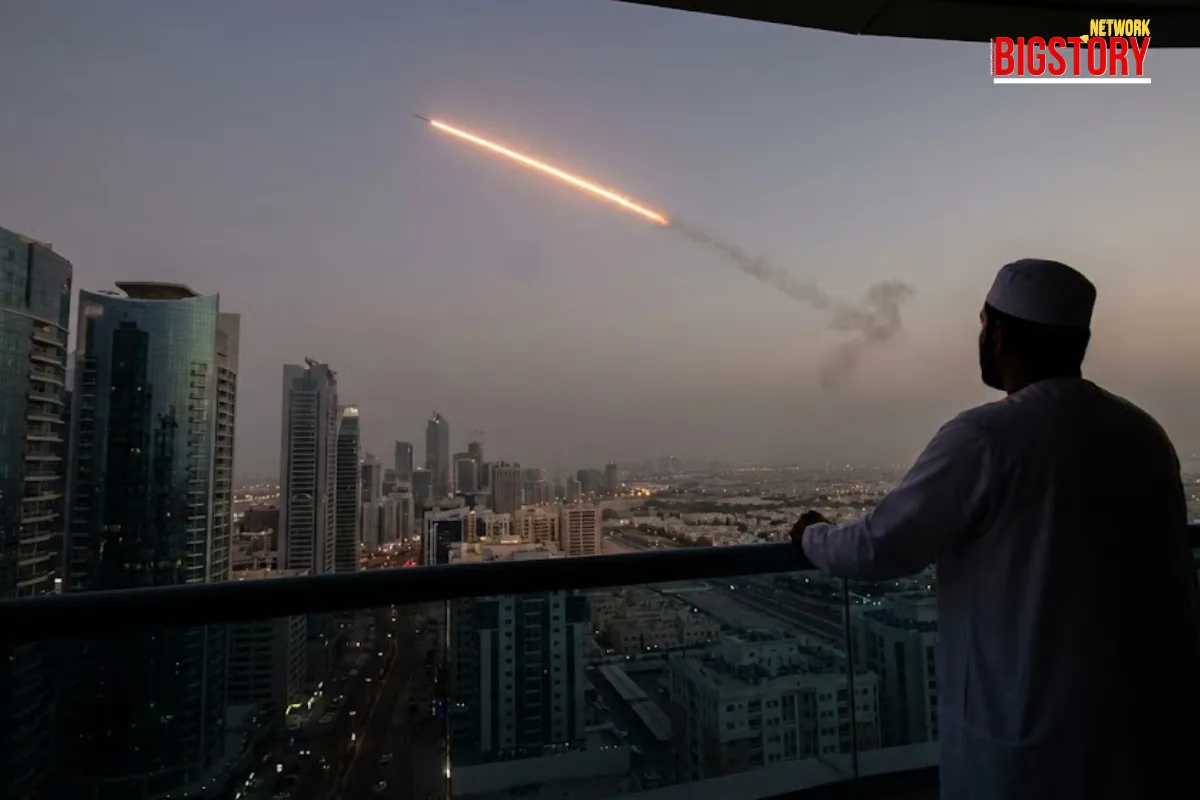
By choosing Abu Dhabi's Corniche skyline as the backdrop for that answer, Tehran forced a question onto every Gulf capital that no amount of diplomatic hedging can avoid: Do you want American bases enough to bleed for them?
Residents near the Abu Dhabi Corniche and the Al Raha Beach district heard rapid-succession explosions beginning around midday. The UAE's integrated air defense grid — built around a combination of U.S.-supplied Patriot PAC-3 batteries and domestically upgraded interception systems — activated immediately.
The UAE Ministry of Defence confirmed:
The fact that the missiles were intercepted is militarily significant. The fact that one person still died from falling debris is politically devastating. Iran achieved its psychological objective even in tactical failure.
Here is what mainstream coverage is missing: the UAE did not intercept a single missile with a single system. It intercepted a coordinated barrage using AI-driven predictive trajectory mapping.
Defense analysts briefed on UAE air defense architecture describe a system where algorithms simultaneously process multiple incoming ballistic signatures, assign threat-priority scores in milliseconds, and coordinate intercepts across layered battery positions — ensuring the densest civilian zones are shielded first. This is not 1991 Gulf War Patriot technology. This is 2026 machine-speed warfare.
The UAE's ability to prevent a mass-casualty event from a coordinated IRGC barrage will redefine procurement discussions across every Gulf state within weeks. Countries without this AI-integrated layering are now acutely aware of what they lack.
Every Gulf state is now staring at the same impossible calculation.
The UAE earns $17 billion annually from Dubai's status as a global trade and logistics hub. Abu Dhabi's sovereign wealth funds manage over $1.5 trillion in assets. The country's entire economic identity depends on being perceived as the one stable, investable corner of an unstable region.
Iran just attacked that identity directly.
The dilemma Iran engineered: expel U.S. forces and lose American security guarantees; keep U.S. forces and absorb Iranian missiles. There is no neutral option. Qatar hosts the largest U.S. air base in the Middle East (Al Udeid). Bahrain hosts the U.S. Fifth Fleet. Kuwait hosts Camp Arifjan. All of them watched Abu Dhabi burn on their news feeds today.
The UAE Ministry of Defence's statement that it "reserves the full right to respond to this escalation" signals that Emirati leadership is not prepared to quietly absorb the strike. Whether that translates into active military cooperation with the U.S.-Israel coalition — or a diplomatic push to expel American assets before the next barrage — is the defining decision of Gulf geopolitics in 2026.
This is where the story hits home.
Approximately 3.5 million Indian nationals live and work in the UAE — the single largest expatriate community in any country on earth. Kerala and Tamil Nadu alone account for over 1.2 million of them. The remittances they send home exceeded $18 billion in 2024, making the UAE the largest single source of India's $125 billion remittance economy.
When missiles land in Abu Dhabi, the first phone calls go to Ernakulam, Thrissur, Kozhikode, and Madurai.
India's Ministry of External Affairs has not yet issued a formal evacuation advisory as of this report, but the Embassy of India in Abu Dhabi has activated its emergency registration line: +971-2-4492700. Indian nationals in the UAE are advised to register immediately, stay indoors, avoid windows, and monitor the WAM News Agency app for official UAE government updates.
If the missile exchanges continue through the week, the Indian government may be compelled to coordinate one of the largest civilian evacuation operations in its history — dwarfing even the 1990 Kuwait airlift that evacuated 170,000 Indians following Iraq's invasion.
India's strategic calculus here is also significant: New Delhi has carefully maintained working relations with both Tehran and Washington. An open Iran-US war in the Gulf does not serve India's interests on any axis — it disrupts its oil supply chain, endangers its diaspora, and forces a binary choice between two relationships India has spent decades refusing to choose between.
Scenario 1 — Escalation Continues (Most Likely) Iran conducts a second wave of strikes within 72 hours, targeting additional Gulf host nations. The U.S. activates carrier strike group assets in the Arabian Sea for a retaliatory response. Gulf airspace intermittently closes. Oil prices spike past $110/barrel.
Scenario 2 — Gulf States Break from the U.S. Alliance Under Iranian pressure, one or more Gulf states begin quiet negotiations to request a drawdown of U.S. forces in exchange for Iranian guarantees of non-aggression. This fractures the U.S. deterrence architecture in the region — which is precisely what Iran is trying to achieve.
Scenario 3 — UAE Joins the Coalition UAE, pushed past its tolerance threshold, formally joins the U.S.-Israel military response against Iran. This is the least likely scenario in the short term — but the Ministry of Defence's language ("full right to respond") is keeping it on the table.
For India, all three scenarios carry serious implications. The MEA's response in the next 48 hours will signal which direction New Delhi leans.
 Exclusive Content






Sign up for the Daily newsletter to get your biggest stories, handpicked for you each day.



 Trending Now! in last 24hrs