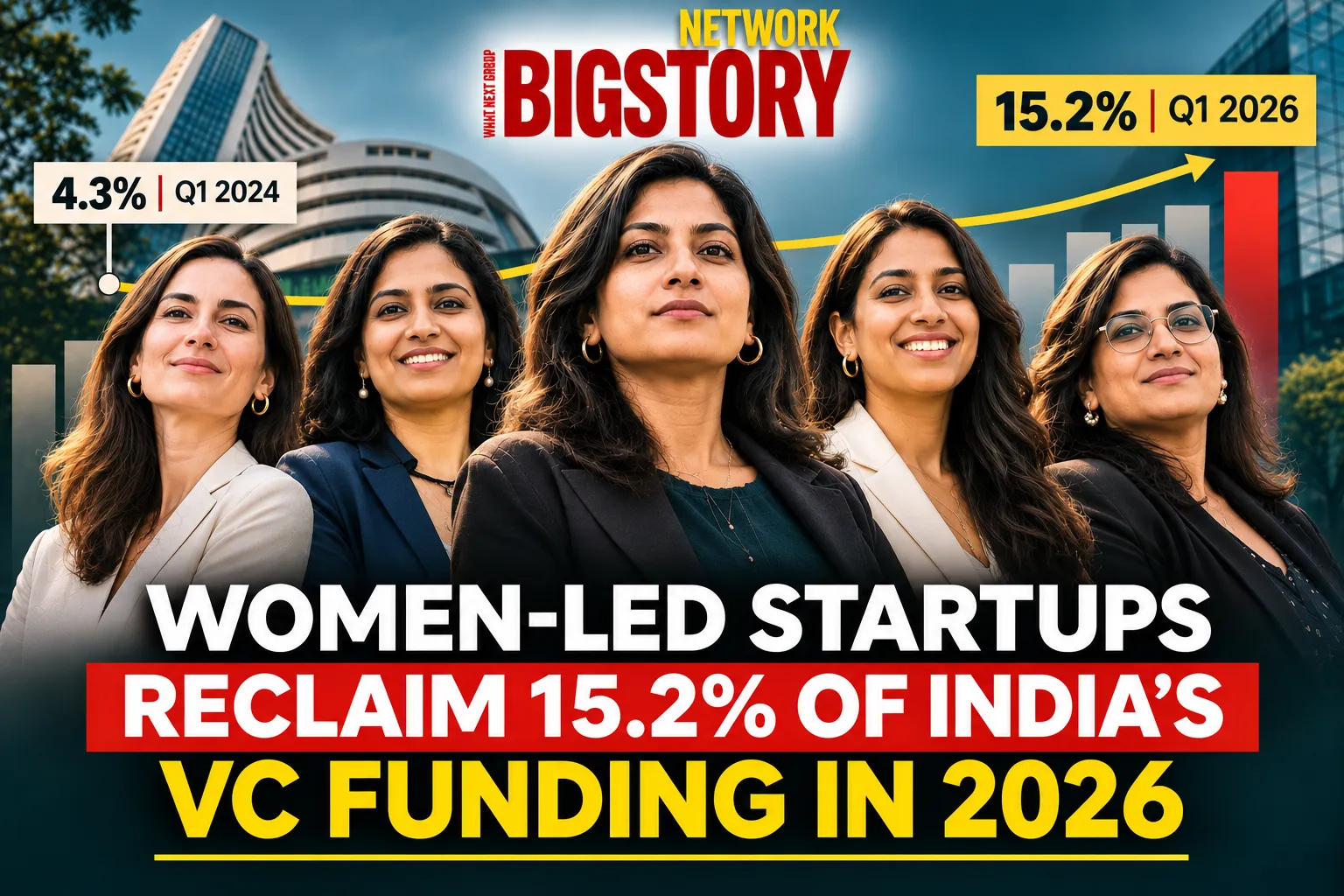
Women-led startups captured 15.2% of India’s Q1 2026 VC funding, drove a 175% jump in acquisitions, and pushed India to 2nd globally in all-time capital raised.
 Sseema Giill
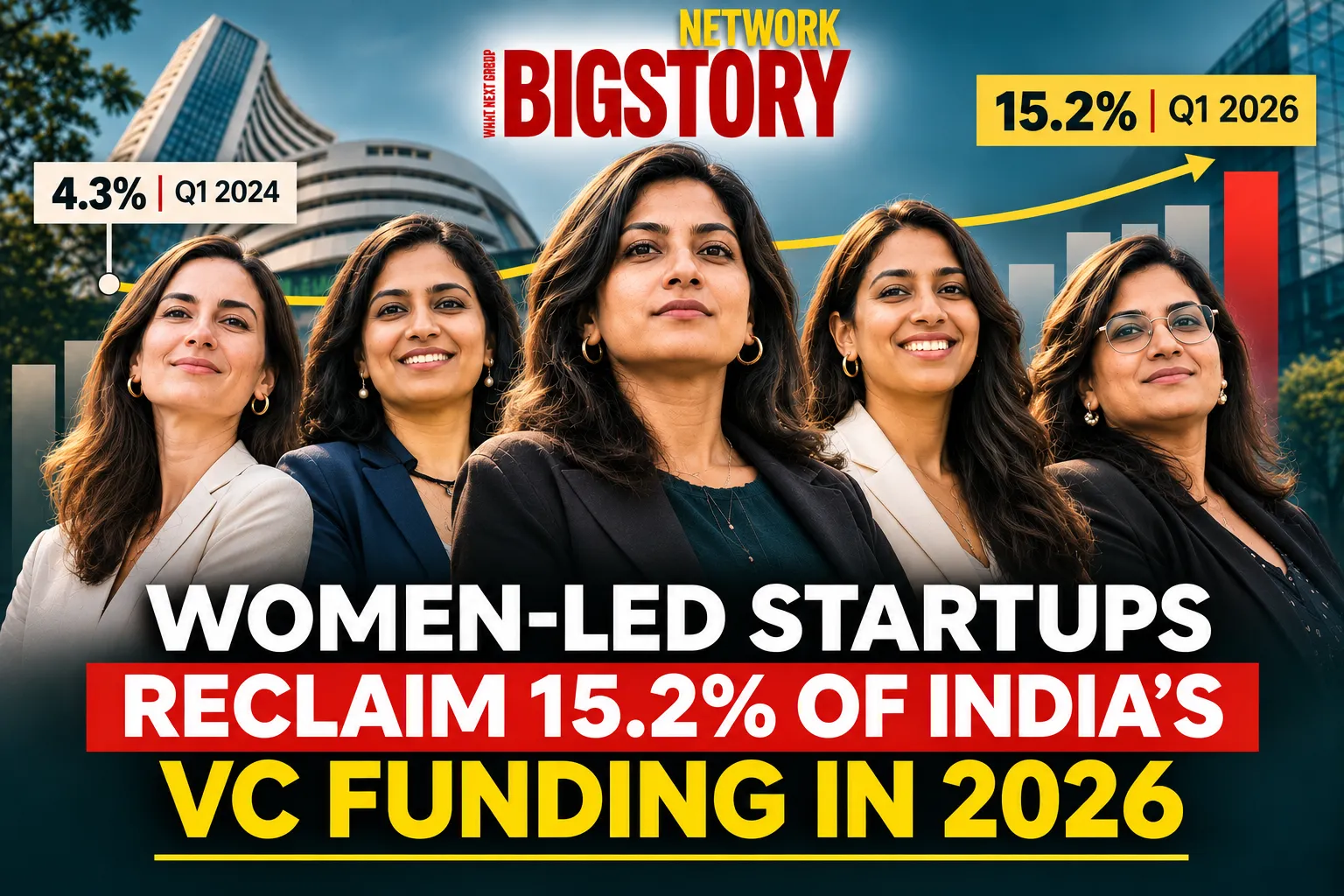
As Indian venture capital shifts from hype to unit economics, women-led startups are staging a major rebound. Reclaiming 15.2% of quarterly VC funding in Q1 2026—up sharply from 4.3% in Q1 2024—female founders are securing larger cheques across high-conviction sectors like fintech, climate finance, and healthtech. Backed by a 175% surge in acquisitions (33 deals in 2025), landmark IPOs like Lenskart and Zappfresh, and a $1.05 billion Resulticks-Diginex combination, India now ranks second globally in all-time funding for women-led tech startups at $26.4 billion.
For the past few years, the dominant narrative around Indian venture capital has been one of caution, tighter cheques, and prolonged funding winters. Yet beneath the broader market slowdown, a notable shift is taking shape. Women-led startups in India are not only weathering the capital reset—they are staging a decisive rebound, reclaiming investor share and proving that disciplined, revenue-backed businesses win in a selective market.
In the first quarter of 2026, women-led startups captured 15.2% of all venture capital deployed in India. That marks a dramatic turnaround from the trough of Q1 2024, when female founders received just 4.3% of the market ($95 million across 34 deals). At a time when investors are scrutinizing every rupee of burn, women founders have returned to pre-winter levels of market share by leaning into high-conviction, commercially resilient sectors.
The foundation for this 2026 surge was laid during a disciplined 2025. According to Tracxn’s India Women’s Day 2026 Report, funding for women co-founded tech startups stabilized at $1 billion to $1.1 billion in 2025. While overall deal volume contracted sharply by 29% across the year, median deal sizes climbed—signaling that institutional investors stopped spreading small bets thin and began writing larger cheques to founders with proven revenue and clear unit economics.
The early-stage data makes this shift even clearer. Early-stage funding for women-led tech ventures grew from $528 million in 2024 to $572 million in 2025, even as the total number of rounds narrowed from 98 to 82. Fewer companies raised capital, but the ones that did commanded stronger valuations and deeper investor conviction.
Geographically, the capital flow remains anchored by India’s premier startup hubs. Bengaluru led the country in 2025 with $447 million in funding for women co-founded tech startups, followed by Gurugram at $115 million and Mumbai at $112 million. Together, these corridors are anchoring a global powerhouse: India now ranks second in the world—behind only the United States—in all-time cumulative venture funding raised by women-led tech startups, having crossed $26.4 billion across more than 2,900 funded companies.
What makes the 2026 comeback particularly compelling is where the capital is landing. Historically, Retail ($7.8 billion), Edtech ($5.4 billion), and Enterprise Applications ($5 billion) have led all-time funding for women-led startups in India. Today, the momentum is expanding aggressively into fintech, climate-aligned finance, and healthtech—sectors defined by high regulatory bars, deep operational moats, and long-term institutional demand.
The standout 2026 funding rounds reflect this maturity:
Beyond equity, mature women-led enterprises are also using smarter capital stacks. Debt financing has emerged as a strategic tool for established companies looking to fund expansion without diluting ownership, with major historical debt rounds by companies like InMobi and MobiKwik totaling $370 million.
For any startup ecosystem, fundraising is only half the story; real wealth creation is measured by exits. On this front, women-led Indian startups delivered a breakout performance.
In 2025, acquisitions of women co-founded tech startups surged 175% year-on-year to 33 deals. The defining headline of this consolidation wave is the landmark all-share combination between NASDAQ-listed sustainability RegTech firm Diginex and Resulticks, an AI-driven customer engagement platform co-founded and led by CEO Redickaa Subrammanian. Built largely through self-propelled earnings rather than heavy VC burn, Resulticks reported $150 million in FY2025 revenue. Under amended terms valuing Resulticks at $1.05 billion—overwhelmingly approved by Diginex shareholders in October 2026 with 98.8% support—Subrammanian is set to take the helm as CEO of the combined global enterprise.
Public markets have opened up alongside M&A. Following a strong 2024 that saw five women-led startups—including MobiKwik and LawSikho—go public, 2025 delivered landmark listings with the public debuts of Lenskart (which launched a ₹7,278 crore IPO in late 2025) and Zappfresh. Every successful listing and strategic acquisition recycles capital, builds institutional trust, and creates a new generation of female angel investors and operators.
This venture-level rebound is supported by a widening grassroots and institutional base. As of January 31, 2026, out of 2,12,283 startups recognized by the Department for Promotion of Industry and Internal Trade (DPIIT), 1,02,054—roughly 48.1%—had at least one woman director or partner.
Complementing private venture funds is a growing layer of state-backed acceleration and grant infrastructure aimed at nurturing early-stage founders before they even pitch institutional VCs. Dedicated programs—such as Kerala Startup Mission’s WE START pre-incubation program, StartupTN’s V-FUND 6.0 accelerator, Bangalore Bioinnovation Centre’s WE-Escalate program for life sciences, and PIEDS’ Saksham initiative specifically targeting Tier-2 and Tier-3 women founders—are actively widening the top of the funnel.
The 2026 numbers tell a clear story: the narrative around women’s entrepreneurship in India is shifting from inclusion as an aspiration to execution as an asset class. By focusing on capital efficiency, solving hard problems in fintech, healthcare, and enterprise software, and delivering real liquidity through M&A and IPOs, India’s women founders are proving that they are built for the long haul. As venture capital continues to reward fundamentals over hype, women-led startups are no longer just participating in India’s growth story—they are setting its pace.
 Exclusive Content






Sign up for the Daily newsletter to get your biggest stories, handpicked for you each day.



 Trending Now! in last 24hrs