Operating as a 26-room commercial hotel under a 6-room residential license, the facility bypassed mandatory safety inspections, trapping guests behind sealed windows and locked exits when disaster struck.
 Brajesh Mishra
• What happened: The devastating fire at Flourish Stay B&B in South Delhi’s Malviya Nagar on June 3 has claimed 21 lives, including 17 foreign medical tourists.
• Why it matters: The tragedy was the direct result of severe structural and regulatory negligence. The facility illegally operated 25-26 rooms while masking itself as a small, 6-room residential homestay.
• The strategic play: By abusing the residential B&B license, the owners completely bypassed mandatory commercial safety inspections, operating without a Fire NOC, smoke detectors, or a sprinkler system.
• India's stake: The building’s design actively suffocated its guests; permanently sealed glass windows trapped toxic smoke, while critical escape routes—including the basement and the roof—were actively locked or blocked.
• The deciding question: With the co-owner arrested for culpable homicide, can a planned city-wide enforcement drive actually shut down hundreds of similar illegally operating hotels in Delhi's congested medical tourism hubs?
The catastrophic fire in Malviya Nagar’s Hauz Rani on June 3, 2026, which claimed 21 lives— including 17 foreign nationals, was not just a tragic accident. It was the devastating, inevitable result of severe structural engineering and regulatory negligence.
The Flourish Stay B&B became a lethal trap because it illegally operated as a massive commercial hotel while masquerading under a limited residential license, allowing it to bypass mandatory safety inspections and ultimately trapping guests behind sealed windows, a locked basement, and a blocked roof exit.
Here is a breakdown of why the building functioned as a virtual gas chamber when the fire broke out at the ground-floor Lemon Green Restaurant.
The most glaring failure was regulatory. The Delhi Fire Services (DFS) confirmed that the building did not possess a Fire No Objection Certificate (NOC).
The establishment deliberately exploited a massive administrative loophole. It was registered under the Delhi government's Bed & Breakfast (B&B) scheme, which is strictly intended for small, residential homestays and carries much laxer safety requirements.
While licensed for a maximum of only six rooms, the owner was illegally operating a massive 25 to 26 rooms, effectively running a full-scale commercial hotel in a residential zone. Because it was legally classified as a small B&B on paper, it completely evaded the strict commercial Fire NOC requirements. It lacked automatic smoke detectors, emergency sprinkler systems, and sufficient fire extinguishers.
The building's architectural design severely compounded the tragedy by intentionally eliminating natural ventilation.
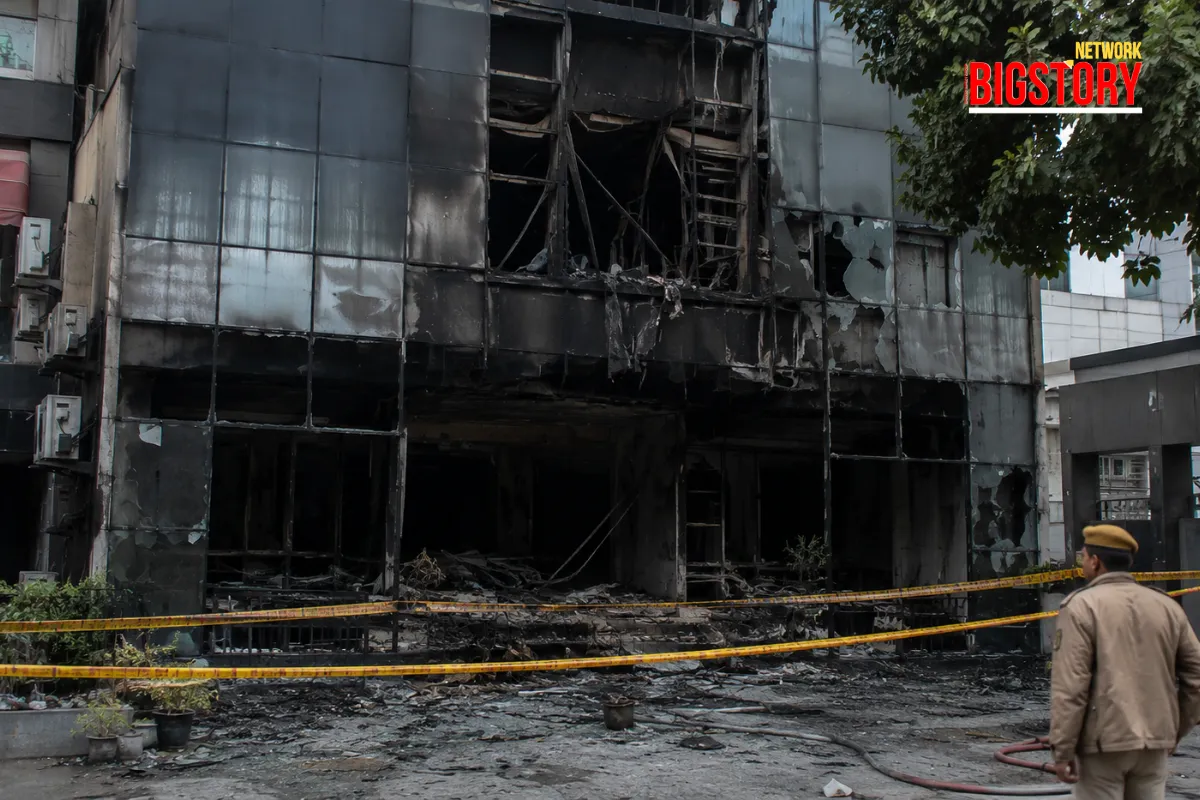
To give the facade a modern, premium look, the front of the building was covered with thick, permanently sealed glass panels. When the fire started (suspected to be near the central staircase), the heavy, toxic smoke had absolutely nowhere to escape.
The sealed structure created a lethal greenhouse effect, trapping the fumes inside. Panicked guests were forced to attempt to smash the thick glass or jump from the upper floors to the mattresses laid out by desperate locals below.
Under basic fire safety regulations, multi-storey commercial lodgings require multiple emergency evacuation routes. Flourish Stay had none.
The building featured only a single entry and exit point, which operated on a sensor-based mechanism. These systems frequently fail or become totally inaccessible during the electrical disruptions caused by a severe fire.
Even more disturbingly, critical secondary escape routes were intentionally obstructed. Witnesses and first responders reported that the basement—which illegally housed several guests—was locked from the outside. It took rescuers over 20 minutes to break open the gate, fatally delaying the evacuation. Furthermore, police investigations on June 4 revealed that the exit to the roof was also actively blocked, cutting off the only alternative upward escape route for those trapped on the higher floors as smoke surged up the central staircase.
While the immediate focus is on the building's owner, the "Missed Angle" here is the systemic failure within Delhi's lucrative medical tourism ecosystem.
The victims were primarily foreign nationals from Central Asia and Africa, drawn to the area by its proximity to super-specialty hospitals like Max Healthcare. These budget "B&Bs" thrive because there is immense demand for cheap, long-term accommodation for patients and their families. Local authorities have long turned a blind eye to the illegal conversion of residential plots into commercial death traps to keep this localized economy churning.
Delhi Police have arrested the co-owner, Lavkesh Bajaj, and booked him under serious charges of culpable homicide not amounting to murder. Following the tragedy, the Delhi government has announced a massive city-wide enforcement drive to inspect and seal other establishments operating without proper licenses and safety clearances in these congested medical hubs. But for the 21 victims trapped in Hauz Rani, that enforcement came far too late.
• Delhi Fire Service (DFS): Official Incident Reports and Safety Guidelines
• The Hindu: National and Regional Emergency Coverage
• The Indian Express: Delhi City News and Investigation Updates
 Exclusive Content






Sign up for the Daily newsletter to get your biggest stories, handpicked for you each day.



 Trending Now! in last 24hrs