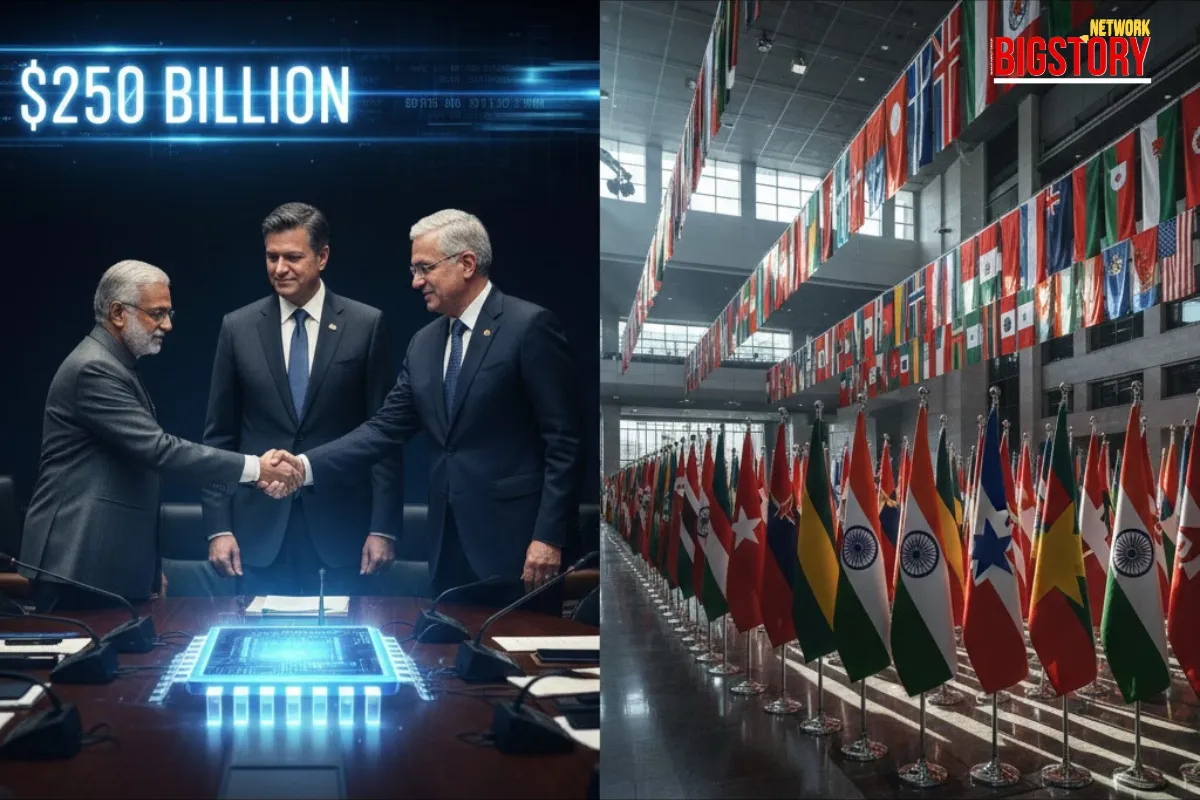
It started with a Guinness World Record and ended with a geopolitical earthquake. Today, the curtains closed on the India AI Impact Summit 2026 at New Delhi's Bharat Mandapam. The official headline is the adoption of the "New Delhi Leaders’ Declaration," a sprawling, non-binding global roadmap for ethical AI governance signed by over 75 nations, including the European Union.
This matters because beneath the diplomatic handshakes lay a much sharper strategic maneuver. IT Minister Ashwini Vaishnaw confirmed that infrastructure pledges crossed a staggering $250 Billion, but the most consequential signature of the day wasn't a check—it was a treaty. By officially signing the Pax Silica declaration with U.S. Under Secretary Jacob Helberg, India has officially walked away from technological neutrality.
The "BigStory" Angle (The "Silicon Geopolitics" Pivot)
Mainstream media is celebrating the "ethical AI" framework. They are missing the Supply Chain Realignment.
The "New Delhi Declaration" is diplomacy; Pax Silica is defense. The U.S.-led Pax Silica coalition is explicitly designed to secure the entire AI ecosystem—from rare earth mineral mining to semiconductor fabrication and advanced data centers—among "trusted, free societies." By joining this bloc (which includes allies like Japan, the UK, and South Korea), India is actively saying "no to weaponized dependency" on China. This is a massive shift that places India's booming tech sector under the protective, but restrictive, umbrella of Western semiconductor dominance.
The Context (Rapid Fire)
- The Trigger: The summit opened on February 16 with 2.5 lakh students taking an "AI Responsibility Pledge," setting the stage for PM Modi's "MANAV Vision," a human-centric approach to AI.
- The Backstory: The infrastructure momentum was anchored by Google CEO Sundar Pichai, who announced a $15 Billion AI Hub in Visakhapatnam and the "America-India Connect" subsea cable earlier this week.
- The Escalation: The summit wasn't without drama. Day 5 saw chaos in the expo halls as Youth Congress workers staged a "shirts-off" protest against the overarching India-U.S. trade agreements, briefly disrupting the high-profile tech demonstrations.
Key Players (The Chessboard)
- Ashwini Vaishnaw (The Architect): The IT Minister who engineered the $250 Billion investment drive. He framed the Pax Silica signing as the beginning of a "compounding growth cycle" for India's 2-nanometer chip ambitions.
- Uday Shankar (The Visionary): The JioStar CEO championed India's ultimate goal: to move from being the world's back-office to the "creative capital" and standard-setter of the AI era.
- Sundar Pichai (The Anchor): Google's CEO provided the physical backbone for the summit's promises, committing to train 20 million Indian public servants to bridge the digital divide.
The Implications (Your Wallet & World)
- Short Term (Startups & Founders): The government has opened the "New Delhi Frontier AI Commitments" portal. Indian deep-tech startups should apply immediately to join the "Shared AI" framework, granting them subsidized access to the massive new GPU clusters pledged this week.
- Long Term (Tech Independence): Expect immediate acceleration in domestic manufacturing. Breakthroughs showcased at the summit—like The E Plane Company’s AI-powered air taxi (capable of 36km in 8 minutes)—will now have a secure, Pax Silica-backed supply chain for critical microchips.
The Closing Question
India has successfully positioned itself as the voice of the Global South in AI governance, but joining Pax Silica firmly ties our hardware future to U.S. interests. Is this strategic alliance the only way to beat China's monopoly, or does it compromise India's strategic autonomy? Tell us in the comments.
FAQs
- Q: What is the New Delhi Leaders’ Declaration for AI 2026?
- A: It is a non-binding global roadmap adopted at the conclusion of the India AI Impact Summit. It focuses on inclusive, ethical, and human-centric AI governance, ensuring the technology benefits the Global South.
- Q: Which countries signed the India AI Summit declaration in Delhi?
- A: Over 75 countries endorsed the declaration, including major representatives from the European Union, France, Spain, the United States, Bhutan, and Sri Lanka.
- Q: What are the key highlights of the India AI Impact Summit Day 5?
- A: Day 5 featured the adoption of the New Delhi Declaration, India's formal entry into the U.S.-led Pax Silica semiconductor coalition, confirmation of $250 Billion in total investments, and brief political protests inside the expo hall.
- Q: What does India joining Pax Silica mean for AI chips?
- A: Pax Silica is a strategic coalition aimed at securing the "silicon stack" from hostile actors. India's entry ensures it will have a trusted, resilient supply chain for critical minerals, semiconductor fabrication, and advanced AI infrastructure, reducing its reliance on China.
Sources: PIB India, The Hindu, Economic Times, NDTV, Times of India.
 Brajesh Mishra
 Exclusive Content