After wrapping up negotiations in record time, New Delhi has successfully secured 100% duty-free access for Indian exports, a 5,000-person visa quota, and a massive $20 billion investment pledge—all without sacrificing its domestic dairy farmers.
 Brajesh Mishra
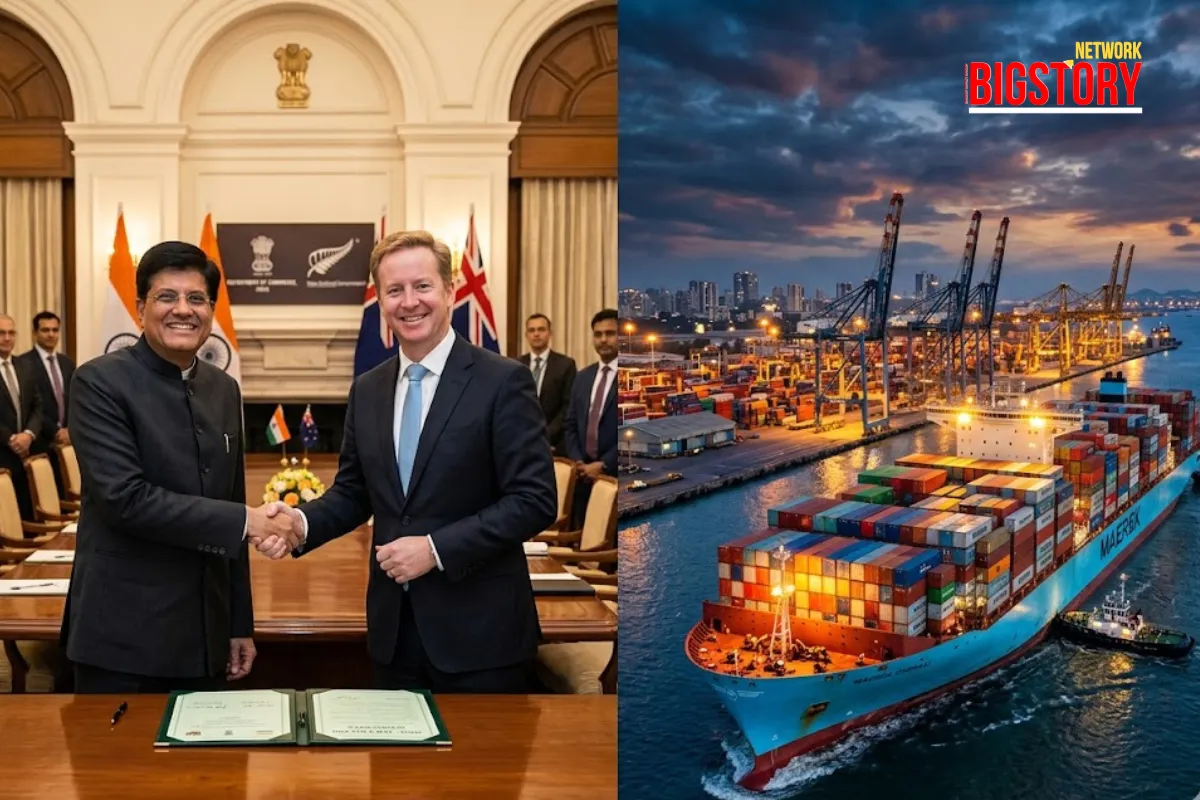
This is breaking news for the Indian economy. After wrapping up negotiations in record time, India and New Zealand officially signed a historic Free Trade Agreement (FTA) today, Monday, April 27, 2026, in New Delhi.
The sweeping pact—signed by Union Commerce Minister Piyush Goyal and New Zealand's Trade Minister Todd McClay—promises to fundamentally reshape the economic corridor between the two nations, aiming to double bilateral trade to $5 billion over the next five years.
The absolute centerpiece of the agreement for New Delhi is the complete elimination of export tariffs. India has successfully secured immediate, 100% duty-free market access for all of its 8,284 export product lines.
Crucial, labor-intensive sectors such as textiles, apparel, leather, pharmaceuticals, and engineering goods will no longer face New Zealand's average 2.2% import tariffs (which previously peaked up to 10% on certain goods). This instantly levels the playing field, making Indian manufactured products highly competitive in the Oceania market.
In return, India is opening up approximately 70% of its tariff lines. New Delhi is offering duty reductions or outright elimination on 95% of New Zealand's current exports to India, providing significant market access for New Zealand wood, wool, sheep meat, and specific agricultural goods like kiwifruit and apples.
Moving beyond basic goods trading, the agreement leans heavily into capital investment and human mobility.
New Zealand has formally committed to facilitating a staggering $20 billion in foreign direct investment (FDI) into India over the next 15 years, targeting manufacturing, infrastructure, renewable energy, and technology sectors.
Simultaneously, the FTA opens highly coveted immigration pathways. A dedicated Temporary Employment Entry Visa pathway has been established, allowing a rolling quota of 5,000 skilled Indian professionals to work in New Zealand for up to three years. This spans high-demand sectors like IT, healthcare, and engineering, while carving out specialized, culturally significant roles for AYUSH practitioners, yoga instructors, and Indian chefs.
For younger demographics, Indian students studying in New Zealand can now legally work up to 20 hours a week, and STEM graduates are eligible for extended post-study work rights of three to four years. Furthermore, a new Working Holiday Visa will allow 1,000 young Indians annually to live and work in the country for 12 months.
While the $20 billion investment captures the business headlines, the "Missed Angle" here is how aggressively—and successfully—India managed to ring-fence its domestic agriculture while closing a massive trade pact with a global agricultural powerhouse.
Historically, trade talks with New Zealand have repeatedly collapsed directly over the dairy sector. New Zealand's economy is heavily reliant on dairy exports, while India is fiercely protective of its millions of small-scale milk farmers.
In this FTA, India drew a hard line and built a "Dairy Wall." Negotiators successfully kept nearly 30% of India's tariff lines—including all dairy products (milk, cheese, butter), edible oils, sugar, and sensitive vegetables like onions—completely excluded from the agreement. New Delhi pulled off a rare diplomatic victory: securing 100% duty-free export access for its own goods without sacrificing a single domestic dairy farmer to foreign competition.
News & Wire Coverage:
 Exclusive Content






Sign up for the Daily newsletter to get your biggest stories, handpicked for you each day.



 Trending Now! in last 24hrs