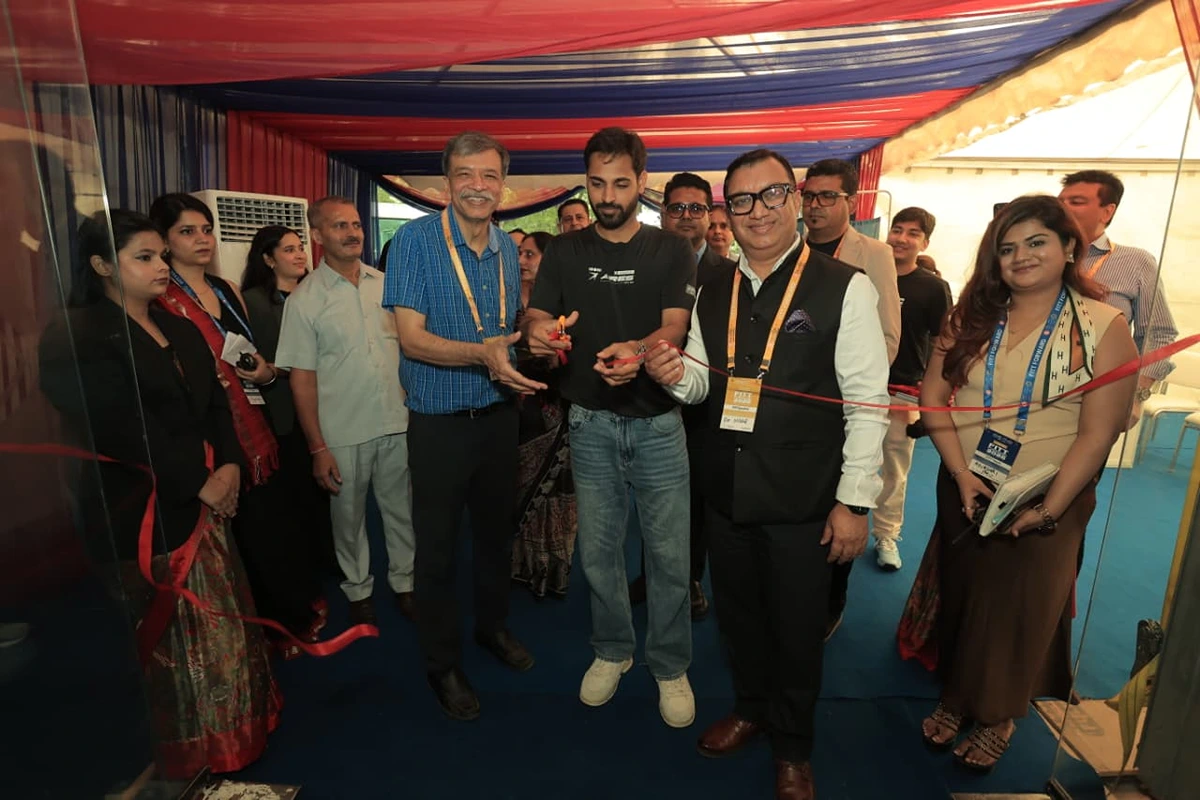
At IILM University's international conference on AI and education diplomacy, envoys from four continents agreed on one thing — the countries that shape AI's rules will shape the world's next economy, and India is at the table.
 Sseema Giill
What happened: Ambassadors from 7 nations debated AI, jobs and education diplomacy at IILM University, New Delhi — March 31, 2026.
Why it matters: AI governance is moving from government summits to university corridors — and diplomats are following. The strategic play: Malaysia has a live 5-year national AI plan. Most G20 nations don't. The execution gap is widening.
India's stake: Sri Lanka, Panama and Spain all cited India as an AI model. India has no formal framework to leverage that influence.
Watch for: Whether IILM's embassy conversations convert into signed MOUs — that's when dialogue becomes policy.
The AI and education diplomacy conference hosted by IILM University in New Delhi drew ambassadors and senior diplomats from Europe, Asia, Africa and Latin America to a single room and to a single, uncomfortable question: as artificial intelligence reshapes every economy on earth, who writes the rules, and who gets left behind? The answer, from the envoys in that room, was not a technology company, not a government algorithm, and not a boardroom in San Francisco. It was, they argued, institutions like the one hosting them universities operating as bridges between nations, embedding AI into the fabric of international cooperation before market forces do it for them.
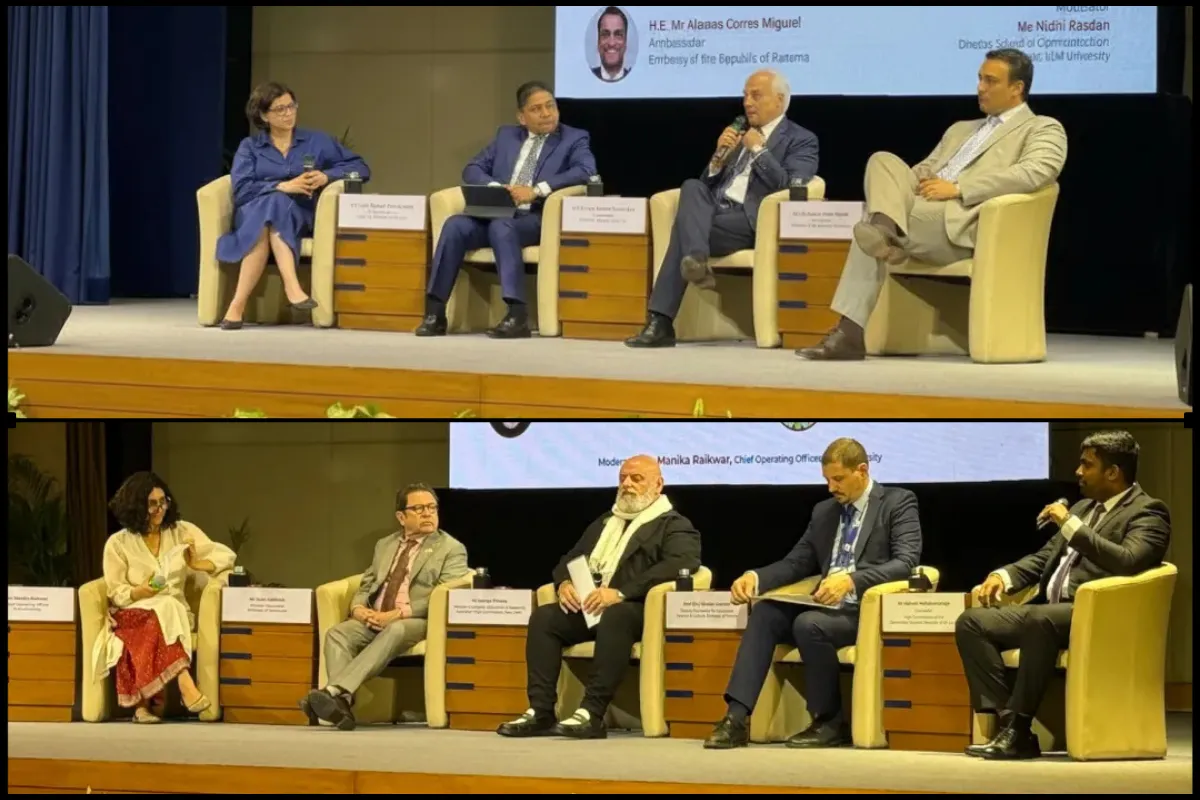
The conference, titled "Harmonising AI Innovation and Education Diplomacy," was no ceremonial rubber-stamp event. Two substantive panel discussions — the first on AI and the future of global economies, the second on education diplomacy — pulled representatives from embassies that rarely share a platform: Spain, Malaysia, Panama, Sri Lanka, Venezuela, Australia and France, each carrying a different national posture toward AI and each candid about the pressure their governments face to get the response right. The first panel was moderated by Nidhi Razdan, Director of the School of Communication at IILM University. The second was led by Manika Raikwar, Chief Operating Officer of the university: a structural choice that signalled something deliberate, this institution was not hosting diplomats as guests. It was convening them as partners.
H.E. Juan Antonio March Pujol, Ambassador of Spain, set the intellectual temperature early. The world, he said, is entering "an era of intelligence beyond human thinking": a phrase that could have landed as alarm. He followed it with something more grounded: jobs will not disappear; they will narrow and deepen. Specialisation, he argued, becomes the dominant profession of the AI era. For India, a country producing millions of graduates annually with generalist degrees, that reframe carries a direct policy implication. H.E. Dato Muzafar Shah Mustafa, High Commissioner of Malaysia, brought the most concrete national blueprint to the table. Malaysia's government is mid-execution on a five-year AI action plan running from 2025 to 2030, with explicit mandates across three pillars: economic growth, healthcare transformation and job security for the next generation. That a Southeast Asian nation of 33 million has a more codified AI national strategy than several G20 members is a fact the conference did not let pass without note. H.E. Alonso Correa Miguel, Ambassador of Panama, reframed the global stakes from a different direction. Underdeveloped nations are not passive recipients of AI disruption — they hold what AI needs most: natural resources. His argument was that AI could serve as a bridge between the developed and developing world, but only if the terms of that bridge are negotiated now, in forums exactly like this one, before they are dictated by capital. Mahesh Mahakumarage, Minister Counsellor from Sri Lanka, offered the most direct acknowledgement of India's standing in the region. Sri Lanka, he noted, is introducing AI across government divisions slowly, structurally and doing so by drawing on the experience of India, which he described as "a very, very long partner." For New Delhi, that framing is not sentiment. It is strategic leverage. Juan Goldnick, Minister Counsellor from Venezuela, pushed back against any narrative that AI makes traditional intellectual labour redundant. Research, he said, will not slow in any sector, under any technological condition. The statement carries particular weight in a room discussing education diplomacy: if research remains irreplaceable, universities are not threatened by AI. They are made more necessary. George Thiveos, Minister Counsellor (Education and Research) from Australia, closed the panel's argument with a word that has fallen out of fashion in an era of bilateral deals and trade walls: multilateralism. In education, in AI, in trade, the path forward, he said, runs through dialogue between nations, not around it.
Every major outlet covering AI diplomacy focuses on the same cast: the G7 summits, the UN AI Safety Institute, the EU AI Act. What the IILM conference surfaced and what those frames routinely miss is the role of the university itself as geopolitical infrastructure. When Malaysia designs a five-year national AI plan with job security as a stated pillar, it does not implement that plan through ministries alone. It implements it through educational institutions that train the workforce, host international researchers, and sign bilateral exchange agreements. When Sri Lanka says it draws on India's experience, the transmission channel is not a government white paper it is faculty partnerships, shared curricula, and the informal networks built in university corridors. The IILM conference was not a side event to diplomacy. For the envoys in that room, it was diplomacy. India's position in this architecture is underappreciated domestically. No fewer than three nations represented at this conference Sri Lanka, Panama and Spain framed their AI positioning in terms that explicitly referenced either India's model or India's partnerships. At a moment when India seeks permanent UNSC membership and expanded multilateral influence, its universities are already functioning as embassies. The question is whether Indian policy acknowledges that and funds it accordingly.
India's AI workforce policy needs a specialisation doctrine. The Spain-Malaysia consensus at this conference — that AI expands jobs through deepened expertise, not broad headcounts — runs directly counter to how India's higher education system currently produces graduates. If the next employment wave rewards specialists, India's generalist degree pipeline is a structural liability. The Sri Lanka framing is an opportunity India must formalise. Being cited as a model for structured AI adoption by a neighbouring nation is not a compliment to acknowledge politely it is a platform. India's Ministry of Education and Ministry of External Affairs have the architecture to convert informal regional influence into formal AI cooperation frameworks. The window, before China or the US fills it, is narrowing. Multilateralism in AI is not a soft-power luxury. Australia's explicit call for multilateral AI dialogue in a room that included Panama and Venezuela — signals that even Indo-Pacific partners find the current bilateral-only approach to AI governance insufficient. India, which has championed multilateralism in other contexts, holds a credibility advantage here it has not yet fully deployed.
In the immediate term, the statements made at IILM, particularly Malaysia's five-year AI plan and Sri Lanka's citation of India as a model are primary-source material for India's own AI policy review, which is ongoing. Indian policymakers not reading conference outputs from multilateral academic forums are building strategy in an information gap. Over the next one to three months, watch for whether bilateral conversations started at IILM translate into formal MOU signings between the university and participating embassies. Education diplomacy, when it works, produces paper not just photographs. The longer India waits to formalise its position as a regional AI education hub, the more that role gets filled by institutions in Singapore, the UAE or Malaysia — all of which are already executing national AI plans with university partnerships as a core plank. If the university has already replaced the embassy as the frontline of AI diplomacy — and the envoys at IILM on Tuesday suggested it has — then India's answer to the AI age will not be written in Parliament or at a bilateral summit, but in the international partnerships its academic institutions choose to build, and the ones they let others build first.
 Exclusive Content


Sign up for the Daily newsletter to get your biggest stories, handpicked for you each day.



 Trending Now! in last 24hrs