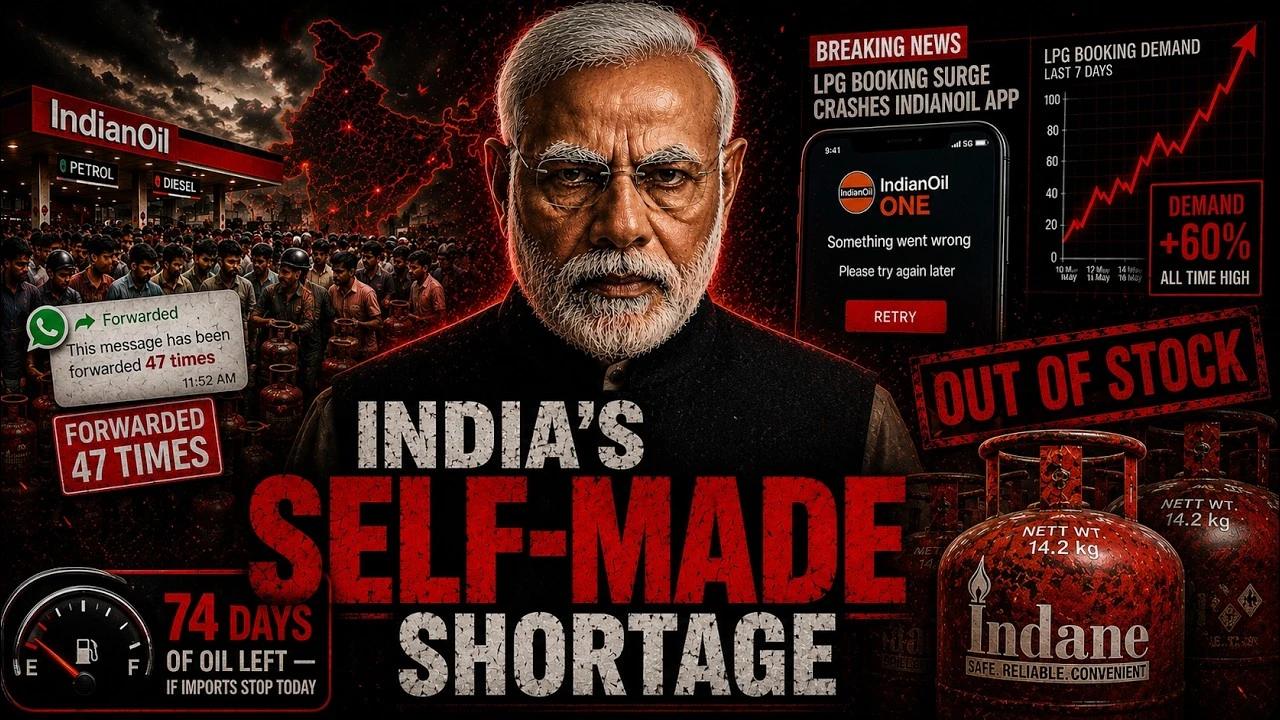
With 20 percent of global LNG trade halted by the Middle East war, the hard numbers reveal a catastrophic supply shock forcing India to cannibalize its industrial sector to keep household stoves burning.
 Sseema Giill

The catastrophic scale of the Middle East conflict has finally been quantified, and the strait of hormuz gas crisis data for early 2026 reveals a terrifying reality for the global economy. As the US-Israel-Iran war effectively paralyzes the world's most critical energy chokepoint, shipping and energy data shows that 20 percent of the world's LNG trade has been abruptly severed.
This unprecedented supply wipeout has driven European gas prices up by nearly 75 percent and forced India to implement massive, ruthless rationing across its domestic and industrial sectors. The data proves that the maritime blockade is no longer just a geopolitical threat—it is an active, physical chokehold that has instantly breached India's energy defenses.
QatarEnergy As the world's second-largest LNG exporter, the state-owned petroleum company was forced to shut down its massive Ras Laffan facility and declare force majeure. This single action instantly removed a critical, foundational pillar of global gas supply.
Petronet LNG Ltd India's largest LNG importer found itself entirely paralyzed. Unable to safely send transport vessels through the blockaded Strait of Hormuz, the company was forced to invoke its own force majeure on downstream Indian clients, officially triggering the domestic gas shortage.
Ministry of Petroleum and Natural Gas, India Responding to data showing an absolute collapse in import volumes, the ministry activated extreme emergency measures. They are actively slashing gas supplies to fertilizers, petrochemicals, and broad industry simply to ensure household stoves remain functioning.
International financial press and global media are heavily fixated on $120-per-barrel crude oil spikes and the broader geopolitical standoff between Washington and Tehran. This crude-centric perspective misses the far more dangerous vulnerability currently tearing through the Indian economy: the absolute absence of a natural gas buffer.
While the media discusses India's strategic oil reserves for about 50 days, the data reveals there is zero equivalent strategic storage for Liquefied Natural Gas (LNG). With 85 to 90 percent of imported LPG and 40 percent of all LNG (specifically from Qatar) cut off overnight, India has no safety net. The cascading effect is immediate and destructive. Because there are no reserves to tap, the government is actively cannibalizing industrial gas supplies to feed residential households. This emergency rationing threatens to paralyze city gas distribution networks and domestic fertilizer production simultaneously, effectively trading industrial survival for retail political stability.
If the Indian economy physically cannot function without a maritime chokepoint controlled by foreign powers currently at war, can the nation legitimately claim to possess energy security?
News & Wire Coverage:
Official Statements & Data:
 Exclusive Content





Sign up for the Daily newsletter to get your biggest stories, handpicked for you each day.



 Trending Now! in last 24hrs