India doesn't have a planting problem — it has a dying problem, and Vaibhav Rathore just cracked it. By turning saplings into fruit-bearing responsibilities for schoolkids, Faldaar is quietly rewriting what 'Green' actually means: not more trees in the ground, but fewer left to die.
 Rashmeet Kaur Chawla
Each year, India grows millions of trees. Each year, more than we can imagine, they quietly die. Between the ribbon cutting and the monsoon, the tree falls into no man’s land, and it is this vacuum, not a lack of intent, which is the true problem with afforestation efforts in India. Vaibhav Rathore, a 28-year-old from Uttar Pradesh, set out to bridge that void. What he did was not yet another plantation drive; rather, he developed a model wherein trees were not merely planted, but owned.
Planting trees isn’t an issue for India. Governments at the state level, corporations, and schools plant lakhs of saplings during each plantation season, sometimes even accompanied by grand photoshoots. The problem is in the survival rate.
According to various studies and reports, the survival rates in big plantation campaigns range from 10-20 percent. This means that most of the “planted” trees don’t survive the year following their planting. No one will water them after all the pictures are taken, no one will notice when they’re being eaten to the stump.
The dangers faced by the young trees are mundane and constant. Animals wander around eating saplings until they are able to establish deep roots that allow them to withstand this attack. There is an acute shortage of tree guards which should protect all saplings from outside dangers for their formative years. And of course, the vagaries of weather make everything worse: unpredictable monsoons ranging from droughts to floods, droughts damaging weak roots, and unexpected heat waves which might damage the saplings in just a few days of exposure.
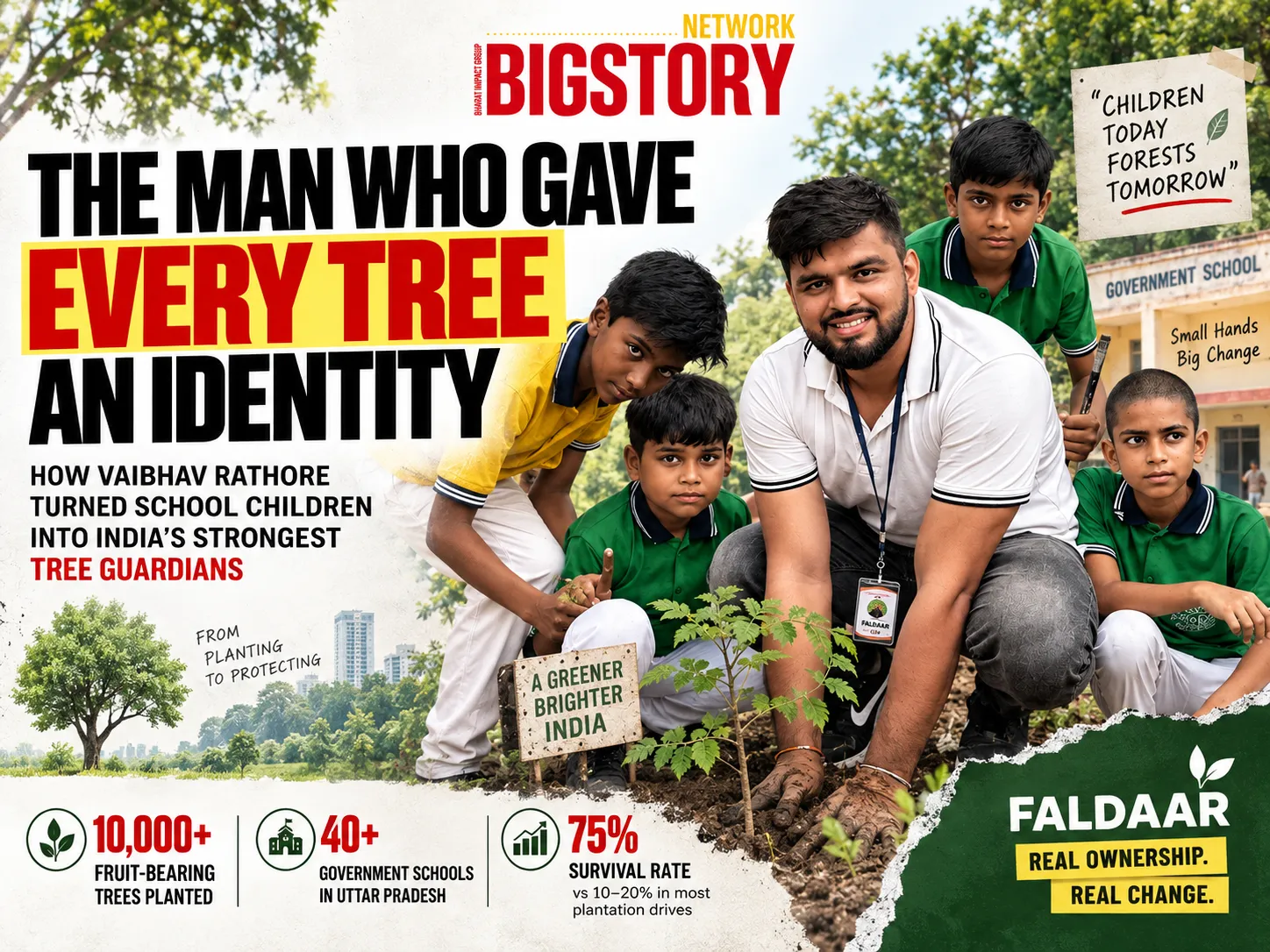
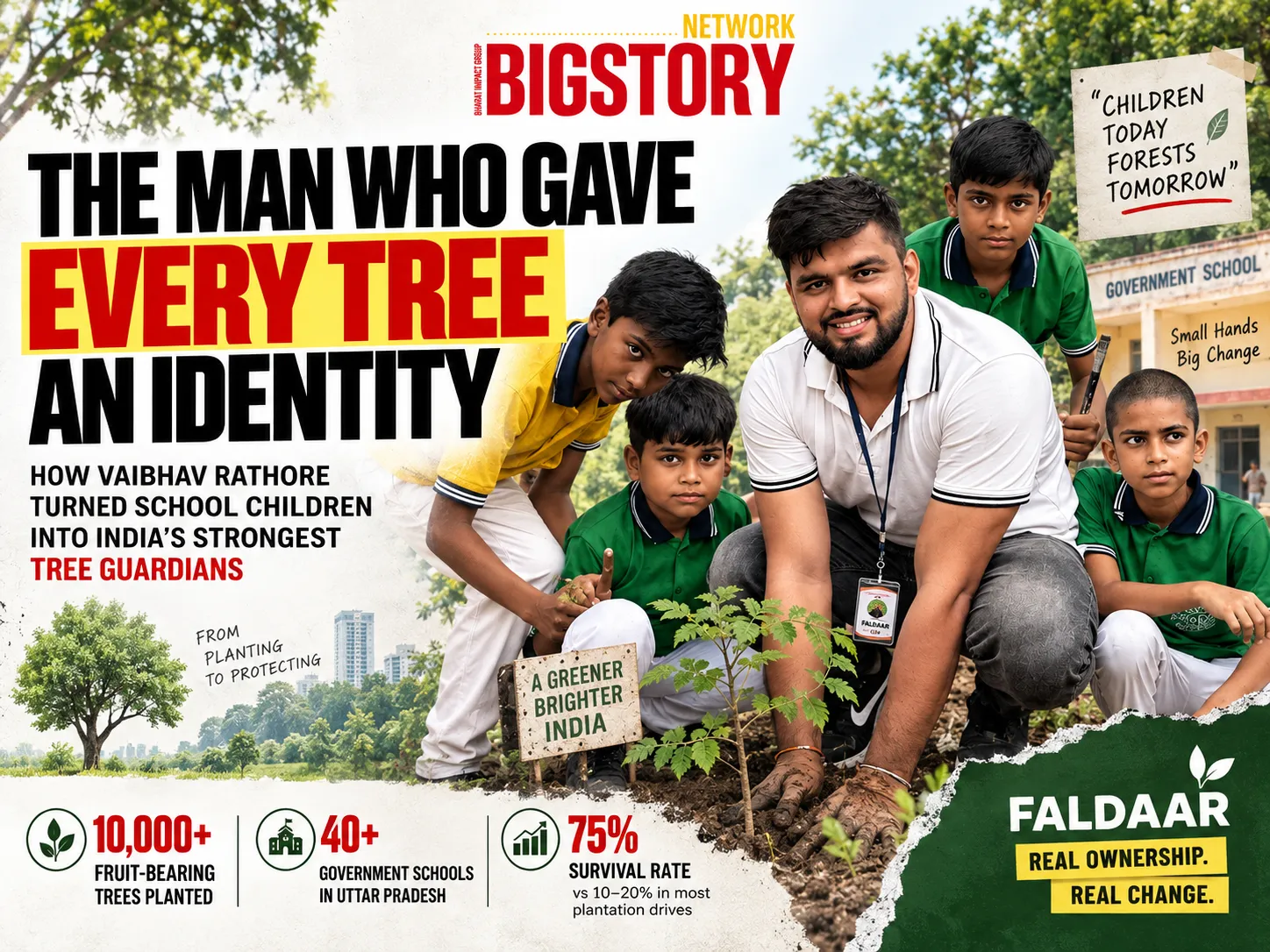
However, his solution to the problem, created through the Revamp India Foundation organization, is Faldaar, which involves planting trees within government schools, where there are children everyday. Each sapling has its own identity. Each child or group of children has the responsibility to take care of the trees- watering them, protecting them, and watching them grow. The trees, on their part, are intentionally fruit-bearing, be it mangoes, guavas or jamuns, because children know that fruit will be there for them in the future years and thus are committed to planting.
The statistics prove how well the initiative is working: more than 40 government schools, more than 10,000 fruit-bearing trees and a survival rate of almost 75 percent, which is much higher compared to usual plantation projects in India.
Faldaar's strength lies not in sentiment, but in the way incentives have been created. The reason why most programs for afforestation usually do not succeed is that nobody will be held responsible for the long-term survival of trees, which is an example of diffuse responsibility being no responsibility at all.
What Faldaar achieves is the allocation of ownership of individual trees to people who will actually be around in the location on a daily basis for years.
This also explains why the project can scale when many grassroots efforts cannot. Schools provide an automatic and renewable body of people who will take care of the trees each year, and the fact that the organization tracks how many trees survive rather than get planted is a sign of accountability uncommon in nonprofits in India.
Faldaar is one part of the larger effort made by Revamp India Foundation to instill environmental consciousness in the students’ daily lives as opposed to conducting such programs annually. The foundation encourages volunteerism to increase the number of schools it works with and has a consistent campaign to solicit money from citizens, with ₹200 being enough to purchase a tree guard for one sapling, solving the issue of animals grazing on the saplings which is the main reason for loss in the entire initiative.
Environmental reports always rely on scale: numbers of trees, number of hectares, cost in crores. Faldaar's story gets into Green India because it demonstrates that survival, not scale, is the measure that decides whether the green cover of India grows or appears to be growing only on paper. Green India can never come from planting more trees; it must come from ensuring that the trees planted do not simply die in the first year after the event.
Faldaar has every right to make the news under a Green India framework because it is one of the rare replicable solutions to the survival issue, which plagues virtually every afforestation project in India.
Green India stories at the BIGSTORY Network do not include plantation day ceremonies. Rather, such pieces must tell stories of actual sustainable impact that can be measured through time. And in this regard, Faldaar is a perfect fit as it is a founder-driven project that brings tangible results through people and numbers. In addition, Faldaar aligns itself with BigStory’s storytelling style of featuring changemakers who work on solving less glamorous yet important issues.
In other words, Vaibhav Rathore does not pretend to have grown a forest; instead, he created something that allows a child, a school and a sapling to exist together long enough for this tree to grow, which is far more important than mere numbers of plantations in any Green India story.
 Exclusive Content





Sign up for the Daily newsletter to get your biggest stories, handpicked for you each day.


 Trending Now! in last 24hrs