
Discover the inspiring story of Ramesh Kumar, a teacher in Hardoi, UP, who turned a waterlogged government school into a viral sensation through discipline and dedication.
 Rashmeet Kaur Chawla
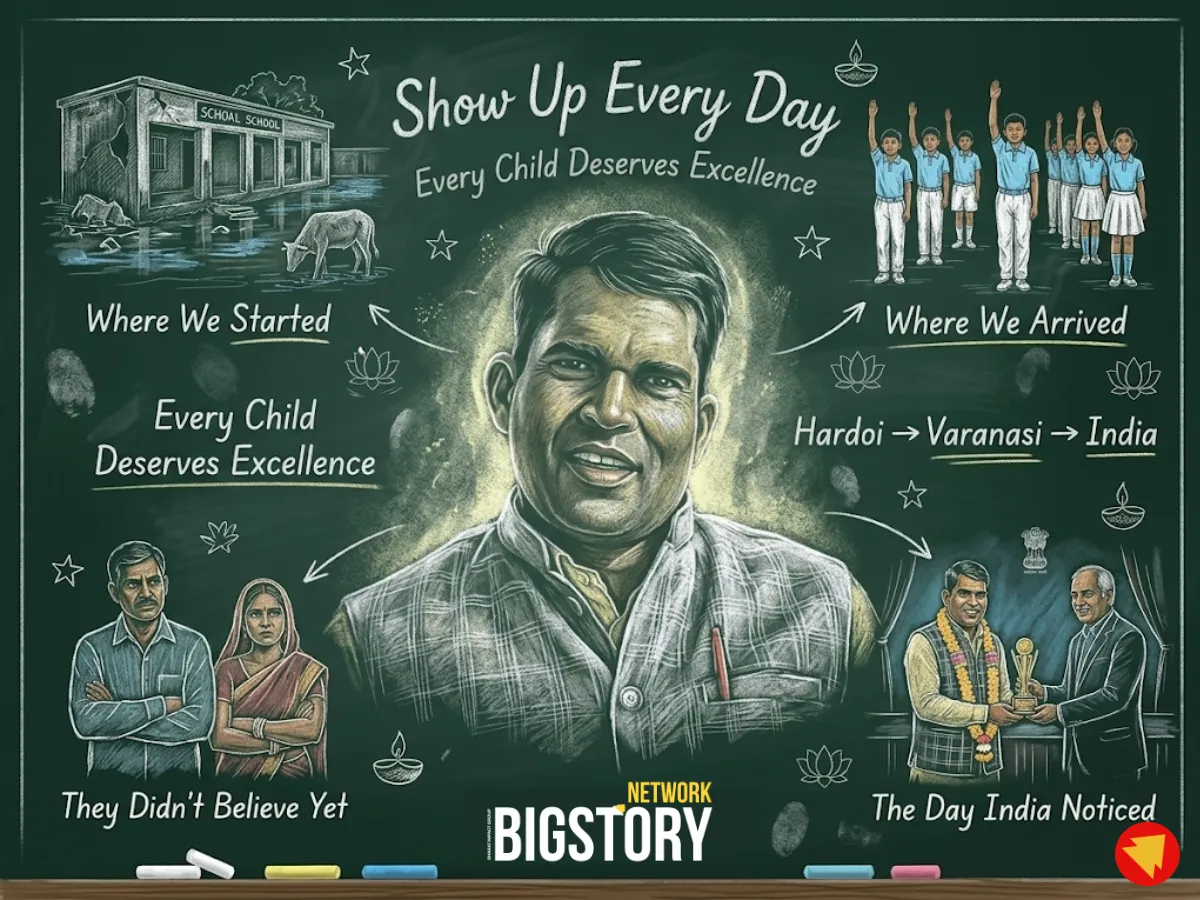
What transforms an ordinary teacher into an extraordinary force of change? In a small corner of Hardoi district, Uttar Pradesh, where government schools often struggle with basic infrastructure and attendance, one educator refused to accept mediocrity as destiny.
His name is Ramesh Kumar, and his story challenges everything we think we know about educational transformation in rural India.
Picture this: a government primary school with waterlogged grounds, neglected infrastructure, and students who saw attending class as a chore rather than an opportunity. Parents had lost faith. The community had moved on. This wasn't just a failing school — it was a symbol of everything broken in India's rural education system.
Most educators would have blamed the system, cited lack of resources, or simply gone through the motions until retirement. But Ramesh Kumar saw something different: potential masked by neglect, waiting for someone who cared enough to act.
Ramesh Kumar is not a celebrity teacher with viral TED talks or book deals. He's a government school teacher in Hardoi, Uttar Pradesh — a region where educational challenges are as common as they are daunting. What sets him apart isn't his credentials or connections; it's his belief that every child deserves dignity, discipline, and the chance to discover their potential.
Unlike reformers who wait for policy changes or funding increases, Kumar took ownership of what he could control: his presence, his consistency, and his ability to inspire. His approach wasn't about grand gestures—it was about showing up every single day with purpose.
While specific details about Ramesh Kumar's childhood remain private, those who know his work describe a man shaped by the values of perseverance, service, and grassroots empowerment. Growing up in a region where educational opportunities were limited, he understood firsthand the transformative power of a committed teacher.
His journey into teaching wasn't driven by prestige or financial gain—government teaching jobs in rural India are neither glamorous nor lucrative. Instead, it was fuelled by a conviction that education is the most powerful equalizer, and that teachers hold the keys to unlocking entire communities' futures.
The State of Affairs: Confronting Reality
When Ramesh Kumar began his transformation mission, the school was a case study in systemic neglect. Reports describe waterlogged grounds where animals roamed freely, infrastructure that had deteriorated beyond basic functionality, and an atmosphere of resignation that had infected everyone from students to parents.
Attendance was abysmal. Engagement was non-existent. The school had become a place children were forced to attend rather than wanted to be part of. For a teacher committed to excellence, this wasn't just disappointing—it was a call to action.
The Method: Discipline as Liberation, Not Punishment
Kumar's breakthrough came from reconceptualizing discipline. In most schools, discipline means compliance—silent students, rigid rules, punishment for deviation. But Ramesh Kumar understood something deeper: true discipline creates freedom.
He introduced synchronized physical training sessions that became the school's signature. These weren't just exercises; they were carefully designed experiences that built:
Students didn't participate because they were forced to — they participated because it felt good to be part of something excellent. The viral video that eventually brought national attention captured exactly this: children performing with precision, energy, and genuine joy.
The school's transformation didn't happen overnight, and it didn't require massive funding. What changed was culture—the collective mindset about what the school represented.
Kumar involved students in improving their environment. Together, they addressed the waterlogged grounds, organized cleaning initiatives, and established maintenance systems. The crucial shift was psychological: students began to see the school as their space, not a building that belonged to the government.
Attendance improved dramatically. Parents noticed their children actually wanted to go to school. The community began talking about the school with pride rather than resignation. Word spread beyond Hardoi.
Ramesh Kumar's approach rests on several foundational beliefs that challenge conventional educational wisdom:
1. Ownership Trumps Resources
Kumar believes that teachers waiting for perfect conditions will wait forever. Instead of complaining about what's missing, he focused on maximizing what was available: his time, his energy, and his students' potential. "A motivated teacher with basic resources," his work demonstrates, "can achieve more than an indifferent teacher in a state-of-the-art facility."
2. Consistency Beats Intensity
The school's transformation wasn't the result of dramatic interventions but of small, consistent actions repeated daily. Morning exercises. Regular encouragement. Steady expectations. Over months and years, these habits compounded into extraordinary results.
3. Discipline Creates, Rather Than Constrains, Freedom
Kumar rejects the false dichotomy between discipline and creativity. His students' synchronized movements required both rigorous practice and creative expression. The structure of routine created space for confidence to flourish.
4. Every Child Has Inherent Dignity
Perhaps most importantly, Kumar treats every student as someone worthy of excellence. Rural government school students often internalize societal messages that they're somehow less deserving than their urban or private school counterparts. Kumar's standards communicate a different message: you are capable of greatness.
Initial Resistance
When Kumar first introduced structured PT sessions and higher expectations, not everyone was enthusiastic. Students accustomed to low standards resisted. Parents questioned why a government school teacher was "making such a fuss." Colleagues, worn down by years in a difficult system, were skeptical about whether change was even possible.
Resource Constraints
Government schools in rural Uttar Pradesh operate under severe resource constraints. Kumar couldn't simply purchase new equipment or renovate facilities. Every improvement required creativity, community involvement, and making do with whatever was available.
Sustaining Momentum
Perhaps the hardest challenge was maintaining energy and commitment day after day, especially during periods when progress seemed invisible. Transformation is slow. There were undoubtedly days when Kumar questioned whether his efforts mattered. But he showed up anyway.
The breakthrough moment came when a video of students performing synchronized exercises went viral on social media. Viewers across India watched in amazement as children from a rural government school demonstrated discipline, coordination, and joy that rivaled anything from elite private institutions.
But the video was just documentation of years of patient work. The real turning point had happened much earlier—the first day Kumar decided the status quo was unacceptable, the first morning he led students through exercises despite skepticism, the hundredth time he showed up when progress felt impossible.
Educational authorities took notice. Ramesh Kumar was invited to Varanasi for a public felicitation ceremony recognizing his innovative engagement methods. The honour represented more than personal recognition — it validated grassroots educational reform and demonstrated that impactful teaching isn't confined to privileged settings.
What distinguishes Kumar's pedagogical approach is his refusal to separate physical, emotional, and intellectual development. Traditional education compartmentalizes: PT is for the body, classroom instruction is for the mind, and emotional development is often ignored entirely.
Kumar integrates all three:
His students don't just learn — they belong. The school isn't merely a place they attend; it's an institution they represent with pride. This psychological shift is the foundation of every other improvement.
The transformation in Hardoi reveals patterns that extend beyond one school or one teacher. Several principles emerge from examining this case:
The Question of Resources
The school's evolution challenges common assumptions about resource requirements. While adequate funding matters, the Hardoi experience suggests that utilization of existing resources—time, consistency, personal engagement—can create significant impact even in constrained environments.
The Time Dimension
Educational transformation operates on extended timelines. The viral recognition moment represented years of accumulated small actions. This pattern appears across successful institutional change: dramatic visibility often documents long periods of invisible foundational work.
Proximity and Trust
The integration of leadership with participation created conditions for trust-building that hierarchical distance typically prevents. When those guiding change remain actively involved in daily operations, different relational dynamics emerge.
Cultural Foundations
Metrics like attendance and engagement improved, but these represented surface indicators of deeper shifts. The underlying change involved how students, parents, and community members conceptualized the school itself—from external obligation to shared ownership.
Purpose and Sustainability
Sustained effort over years without immediate validation requires clear motivation. In this case, the focus remained on student potential rather than external recognition. This orientation appears to have provided the psychological foundation for persistent action during periods when outcomes remained uncertain or invisible.
Replicability Considerations
The approach doesn't depend on unique individual charisma or exceptional circumstances. The methods — structured routines, participatory improvement, consistent presence—are transferable. The variable becomes willingness to invest sustained effort rather than access to special conditions.
The Challengers' Manifesto
"We don't wait for systems to change. We change what we can control, where we stand, with what we have. We understand that transformation isn't about dramatic breakthroughs but about showing up consistently, day after day, until the impossible becomes inevitable. We know that resources matter less than commitment, that credentials matter less than character, and that one person refusing to accept the status quo can reshape an entire community's future. We are teachers, activists, social entrepreneurs, and community organizers who challenge the assumption that excellence requires privilege. We prove, through our daily work, that greatness can emerge anywhere — if someone cares enough to nurture it."
Why does Ramesh Kumar belong in the Challengers series?
Because he challenges fundamental assumptions about what's possible in India's government education system. While policy experts debate reforms and critics highlight failures, Kumar simply proved that one committed teacher can transform lives.
He challenged the narrative that rural government schools are destined to fail. He challenged the idea that systemic change must come from the top down. Most importantly, he challenged students to see themselves as worthy of excellence.
Why does this story matter to BIGSTORY Network?
Because the biggest stories aren't always found in boardrooms or on stages. Sometimes they're happening in classrooms in Hardoi, led by teachers whose names you've never heard. BIGSTORY exists to ensure these narratives — stories of quiet courage, persistent effort, and transformative impact — receive the attention they deserve.
Ramesh Kumar didn't set out to become famous. He set out to honour his students' potential. The recognition came later, almost as an afterthought. But his example matters precisely because it reminds us that extraordinary impact doesn't require extraordinary platforms—it requires ordinary people making extraordinary commitments.
At BIGSTORY Network, we believe the most powerful narratives often remain untold — not because they lack significance, but because they unfold far from spotlight and media centers. Our Challengers series exists to illuminate the work of individuals who challenge systems, assumptions, and limitations through consistent action rather than loud proclamation.
Ramesh Kumar represents everything this series stands for: innovation, persistent excellence, and the courage to believe that one person's commitment can create ripples that become waves. His story isn't finished — the students he's inspiring today will shape tomorrow's India. But his journey thus far demonstrates a truth we hold sacred: change begins when ordinary people refuse to accept ordinary standards.
That's the challenger spirit.
SOURCES
https://m.facebook.com/ramesh.kumer.545/about/
 Exclusive Content



Sign up for the Daily newsletter to get your biggest stories, handpicked for you each day.


 Trending Now! in last 24hrs