Following the total collapse of ceasefire negotiations, Washington has severely escalated the West Asia conflict by placing all Iranian ports under maritime siege, trapping billions of dollars in global energy trade.
 Sseema Giill
The escalating U.S.-Israel-Iran conflict has officially spilled over into global shipping lanes, threatening to trigger a massive, worldwide energy shock. Following the complete collapse of U.S.-Iran ceasefire talks in Pakistan, the United States Central Command (CENTCOM) announced the immediate enforcement of a total naval blockade on all Iranian ports starting today, Monday, April 13, 2026.
The unprecedented military maneuver has immediately stranded dozens of international vessels in the Persian Gulf and sent shockwaves through global energy markets.
The blockade covers all Iranian coastal areas and port infrastructure across the Arabian Gulf and the Gulf of Oman. The trigger for this maritime siege was the total failure of the temporary ceasefire negotiations held in Islamabad, where Iran flatly rejected U.S. demands and insisted on a permanent end to the war.
While the CENTCOM directive technically allows for the continued passage of non-Iranian commercial traffic through the broader Strait of Hormuz, Washington warned of strict, immediate military enforcement against any vessels attempting to enter or leave Iranian ports.
Despite these U.S. assurances for non-Iranian traffic, early maritime tracking reports indicate a sudden, sharp drop in crossings through the critical chokepoint. International freight and maritime insurance companies have slammed the brakes on Gulf transits, refusing to sail their multi-million-dollar vessels into the crossfire.
The sudden blockade has placed Indian energy and trade assets in immediate, physical jeopardy.
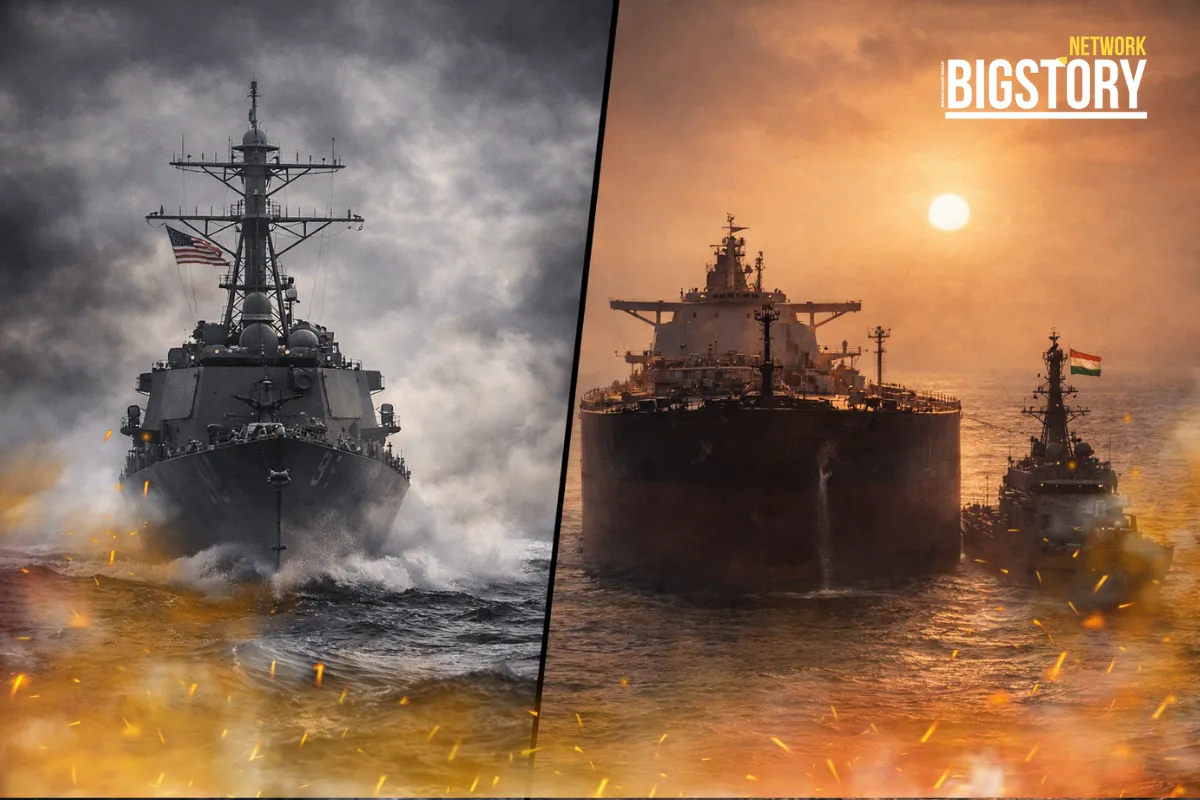
At least 15 Indian-flagged vessels—including highly volatile Liquefied Natural Gas (LNG) and LPG carriers, crude oil tankers, a chemical tanker, and various container ships—are currently stranded west of the Strait of Hormuz chokepoint, unable or unwilling to risk the crossing.
In response, the Indian Navy has rapidly stepped up its forward presence. At least six Indian naval warships are currently positioned near the Persian Gulf to monitor the volatile situation, provide secure communications, and offer safe passage advisories to the merchant fleet.
The rapid deployment is already yielding results. The Indian Navy successfully escorted the LPG tanker Jag Vikram—carrying 20,400 tonnes of highly flammable LPG and a crew of 24—through the Strait on April 11 before the formal blockade took full effect. It is currently in the Arabian Sea under heavy naval escort and is expected to safely reach Mumbai by April 15. Defense officials confirm that 10 out of the 25 Indian-flagged vessels operating in the region have safely cleared the strait so far.
While Iran has vowed severe retaliation—with former Revolutionary Guard Commander Mohsen Rezaei warning that Tehran possesses "major untouched levers" to counter President Donald Trump's "tweets and imaginary plans"—the true "Missed Angle" here is the sheer economic collateral damage of this blockade.
The Strait of Hormuz handles roughly 25% of the world's maritime oil trade. While the U.S. claims it is strictly blockading Iranian ports, the physical reality of deploying warships, conducting at-sea boardings, and the constant threat of Iranian anti-ship missile retaliation turns the entire strait into an active combat zone.
Insurance premiums for vessels entering the broader Gulf will now skyrocket to untenable levels. This effectively creates a "de facto" blockade on all Gulf oil—including vital energy exports from staunch U.S. allies like Saudi Arabia, Kuwait, and the UAE.
News & Wire Coverage:
 Exclusive Content






Sign up for the Daily newsletter to get your biggest stories, handpicked for you each day.



 Trending Now! in last 24hrs