India isn't facing a water shortage — it's facing water bankruptcy. 21 cities, collapsing aquifers, and a crisis hiding underground. The full story.
 Minaketan Mishra
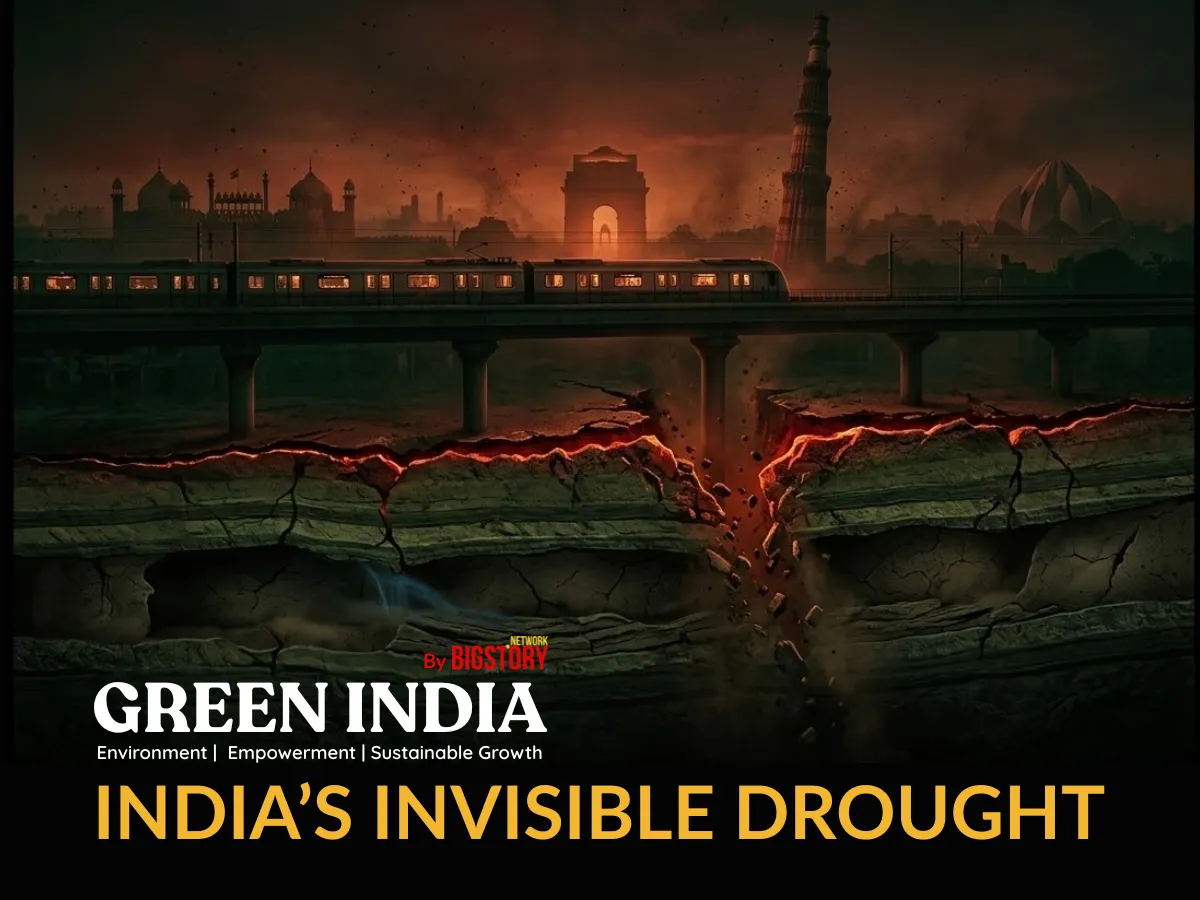
India isn't facing a water shortage — it's facing water bankruptcy. 21 cities, collapsing aquifers, and a crisis hiding underground. The full story.
In January 2026, the United Nations University Institute for Water, Environment and Health published a warning that reframed everything: the world has entered a state of global water bankruptcy.
Not a shortage. Not a seasonal drought. Bankruptcy.
The distinction matters. A shortage can be managed. Bankruptcy means the withdrawals have already exceeded what the earth can replenish — and the debt is now structural, compounding, and in many places, irreversible.
For India, this is not an abstract global statistic. It is the precise condition of the ground beneath our feet.
India supports nearly 18% of the world's population on just 4% of its freshwater resources. It is the world's largest extractor of groundwater — pulling out more than the United States and China combined. And according to NITI Aayog, 21 major Indian cities — including Delhi, Bengaluru, Chennai, and Hyderabad — are on a direct trajectory toward exhausting their viable groundwater reserves entirely.
This is the Invisible Drought. It does not look like cracked riverbeds or empty reservoirs. It lives underground, in collapsing aquifers and desiccating soil — silent, accelerating, and largely out of public sight.
Until the taps run dry.
Traditional drought is visible. Rivers shrink. Reservoirs drop. Governments declare emergencies.
The Invisible Drought is different. It is the systemic depletion of ancient underground aquifers — water stored over thousands of years — being extracted in decades. There are no visible warning signs until the damage is done.
When groundwater is pumped out at rates that exceed natural recharge, the geological layers that held the water begin to compact and collapse — a process called aquifer compaction. Once this happens, the storage capacity is permanently destroyed. Even if rainfall increases, the container has physically shrunk. The damage cannot be undone.
This is not a future scenario. It is happening now, beneath Punjab, Haryana, Rajasthan, Delhi, and dozens of other regions, measured and documented by the Central Ground Water Board (CGWB) in its Dynamic Ground Water Resource Assessment Reports of 2024 and 2025.
India's total annual groundwater recharge is estimated at 448.52 billion cubic meters (BCM). Total extractable resources stand at 407.75 BCM. Gross annual extraction in 2025: 247.22 BCM — a national Stage of Extraction (SoE) of 60.63%.
On paper, 60% sounds sustainable. It is not — because the national average conceals catastrophic regional collapses.
The CGWB classifies groundwater units into four categories:
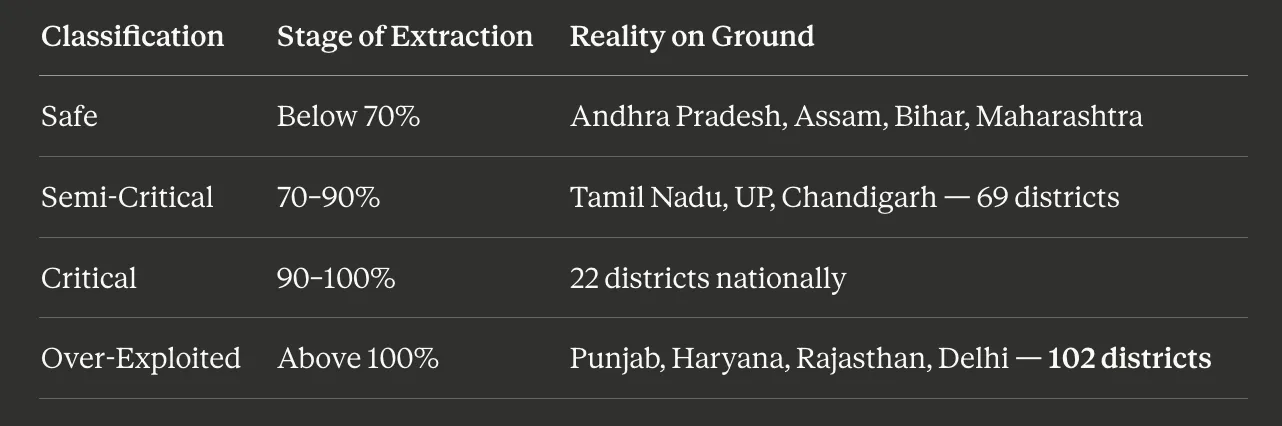
102 districts in India are already extracting more water than the earth can return. In these zones, the aquifer is not being depleted — it is being destroyed.
India's groundwater crisis is not uniform. It has distinct regional characters, each with its own driver of collapse.
Northwest India — Punjab, Haryana, Delhi, western Uttar Pradesh — sits on highly permeable alluvial aquifers. These can theoretically recharge well. But decades of free electricity for farmers have removed every financial incentive to conserve. Borewells run continuously, day and night, extracting water for paddy and sugarcane cultivation that the region's hydrology was never designed to support. Extraction here has crossed 100% of annual recharge — and keeps going.
Western India — Rajasthan and parts of Gujarat — faces the opposite geological problem. Arid climates mean natural recharge is minimal even in good monsoon years. Any significant agricultural extraction here is structurally unsustainable. Yet the pattern continues.
South Peninsular India — Karnataka, Tamil Nadu, Telangana, Andhra Pradesh — sits on hard crystalline rock formations. These aquifers have naturally low porosity and drain fast. One bad monsoon, and they fail suddenly, with little warning. Bengaluru's recurring pre-monsoon crises are a direct consequence of this geology.
India's water planners have historically built their models around monsoon rainfall. That baseline no longer holds.
Research presented by scientist Arpit Tiwari at the Anil Agarwal Dialogue 2026 describes India's transition into a "novel climate regime" — combinations of temperature and precipitation patterns that fall entirely outside anything recorded in historical data since 1951.
The most dangerous feature of this new regime is the hot drought.
Previously, drought in India meant insufficient rainfall. Now, rising temperatures function as an independent drought trigger — even in years when rainfall is statistically normal. Extreme heat dramatically increases evaporative demand: the atmosphere's capacity to pull moisture from soil, plants, and surface water. The ground desiccates. Crops wilt. Water bodies shrink — not because it didn't rain, but because the heat consumed the moisture before it could be stored or used.
This is happening across all three agricultural seasons:
In Uttarakhand, researchers have documented severe winter hydrological droughts from exceptional lack of seasonal snow. Without winter snowpack, glaciers lose more mass than they gain. Glaciologist Manish Mehta warns that this directly threatens the long-term water security of the entire Indo-Gangetic Plain — the agricultural heartland that feeds hundreds of millions.
"Day Zero" entered the global vocabulary in 2018, when Cape Town, South Africa nearly became the first major city to shut off its municipal water supply entirely.
India has already had a preview.
In 2019, Chennai's four primary reservoirs ran completely dry. Millions of residents and businesses survived entirely on expensive, unregulated private water tankers for months. It was not a warning shot. It was a demonstration.
Bengaluru, India's technology capital and third-largest city with over 12 million residents, faces this threat every pre-monsoon season. Its borewells are dropping more than a meter annually in some zones. Its dependence on the contested Cauvery River leaves it perpetually exposed. Luxury apartments crossing ₹2 crore in its tech corridors now face direct questions from buyers about long-term water security — a question that would have seemed absurd a decade ago.
Delhi presents a different scale of failure. An estimated 20% of Delhi's population — nearly 2 million people — have no access to safe piped water. The city's official municipal supply falls short of actual demand by 207 million gallons every day. Up to 60% of intended supply is lost to infrastructure leaks, theft, and collection failures.
Hyderabad is projected to face an acute shortage of 909 million liters per day by 2028 for domestic and industrial use — and is simultaneously being developed as a major AI and data center hub.
Here is a contradiction that deserves far more public scrutiny than it receives.
India is racing to become a global artificial intelligence superpower. The government has offered substantial incentives — 20-year tax holidays, accelerated depreciation, massive infrastructure support — to attract hyperscale data centers to cities like Mumbai, Chennai, Hyderabad, Bengaluru, and Pune. India's installed data center capacity is projected to nearly double from 950 MW in 2024 to 1,800 MW by 2026.
What the investment announcements rarely mention: data centers are among the most water-intensive industrial facilities on earth.
A standard 100 MW data center consumes between 1 and 5 million liters of freshwater every single day — for cooling alone. India's total data center water consumption is projected to surge from 150 billion liters in 2024–25 to over 350 billion liters by 2030.
Reports from S&P Global and Planet Tracker deliver the critical finding: between 60% and 80% of India's current and planned data centers are located in regions already classified as high water-stress zones.
Amazon is expanding major AI infrastructure in Hyderabad — the same city facing a 909 million liter daily deficit by 2028. Microsoft is investing heavily in Pune — a city where water shortages recently triggered widespread public protests. These are not coincidences. They are the geometry of a collision between the global digital economy and local hydrological survival.
Where formal infrastructure collapses, parallel economies emerge. India's water mafia is not metaphorical — it is organized, politically protected, and enormously profitable.
In Delhi, informal networks source water by drilling illegal deep boreholes or siphoning directly from pressurized municipal pipes. Tanker employees can earn approximately $90 per day — roughly $2,700 per month — against a local minimum wage of $185 a month. The economics of manufactured scarcity.
In Gurugram, following a disruption at the Chandu Budhera water treatment plant in mid-2025, a standard 5,000-liter tanker that normally costs ₹750–₹1,200 surged to ₹5,600 during the shortage. In Bengaluru, pre-monsoon tanker prices routinely breach the civic price cap of ₹1,200, climbing to ₹1,500–₹1,700 with continuous upward pressure as summer deepens.
These cartels are not fringe actors. They operate with the backing of local legislators, municipal corporators, and political figures — using control over water distribution as a mechanism for electoral leverage and social control. They have a direct financial interest in ensuring formal water networks remain inadequate. The public health cost is severe: water from illicit tankers is entirely unregulated, untested, and frequently contaminated.
The extraction of groundwater does not just deplete the water. It collapses the ground above it.
A Nature Sustainability study using satellite radar data (InSAR) from 2015 to 2023 documented alarming land subsidence rates across India's major cities:
CitySinking RateKey Risk ZonesDelhi51 mm/yearBijwasan, Faridabad, GhaziabadChennai31.7 mm/yearAdyar River flood plainsMumbai26.1 mm/yearDharavi and dense extraction zonesKolkata16.4 mm/yearSoft sedimentary structuresBengaluru6.7 mm/yearAccelerating despite harder rock
As ground sinks, structural integrity of buildings, roads, bridges, and sewage systems is compromised. More critically, subsidence alters drainage gradients — trapping cities in a paradox where they suffer catastrophic urban flooding during the rains and acute water scarcity in summer. For coastal cities, subsidence accelerates saltwater intrusion into freshwater aquifers, permanently destroying them.
NITI Aayog's Composite Water Management Index states that approximately 70% of India's total water supply is contaminated.
As shallow aquifers collapse, users drill deeper — into ancient geological strata where naturally occurring toxins concentrate:
The World Bank estimates these contamination burdens drag India's GDP down by 6–8% annually through healthcare costs, lost productivity, and environmental degradation.
India's water crisis is not solely a hydrological problem. It is a governance failure that has been structurally embedded since 1882.
The Indian Easements Act of 1882 — a colonial-era law — ties groundwater extraction rights to land ownership. Whoever owns land owns the water beneath it, unlimited. The state has no legal authority to cap how much a wealthy landowner, large farmer, or industrial entity extracts. A fundamental common-pool resource is legally treated as private property.
Compounding this, state governments across India have historically provided free or heavily subsidized electricity to farmers. With no cost to pumping, there is no financial signal to stop. Combined with Minimum Support Prices that favor water-intensive paddy and sugarcane cultivation even in arid regions, farmers in Punjab and Haryana are financially incentivized to export their region's water in crop form — pumping their own aquifers to destruction.
The Jal Jeevan Mission, launched to provide functional tap connections to every rural home by 2024, has faced a severe credibility crisis. In districts like Mahoba, Uttar Pradesh, official dashboards report 98% connection rates. Field reality: PVC pipes installed, no water flowing. The Jal Shakti Ministry acknowledged over 17,000 official complaints across 32 states. Uttar Pradesh alone accounted for 84% of grievances. Nearly ₹50,000 crore allocated for JJM remained entirely unspent in 2025–26, forcing a sharp revision of outlays from ₹66,770 crore to ₹16,944 crore.
The infrastructure exists on paper. The water does not exist in the pipe.
Over 95% of India's wheat cultivation and 65% of its rice cultivation depend entirely on groundwater irrigation. As water tables fall, agriculture in these regions is becoming economically impossible.
In 2024 alone, India recorded an estimated 5.4 million internal displacements — the highest in over a decade — driven by floods, coastal erosion, and persistent droughts.
In Marathwada and Vidarbha, surface temperatures frequently exceed lethal thresholds in May, inducing total crop failures. Farming families — already in debt — take advance payments of ₹50,000 to ₹5 lakh to migrate hundreds of kilometres as seasonal sugarcane harvesters, a form of bonded labour directly driven by the collapse of their home water systems. These are known as koita couples in Maharashtra's water-starved districts.
Those who reach cities like Bengaluru, Mumbai, and Delhi do not escape. They settle in unauthorized slums on dried lake beds and floodplains. In north Bengaluru's Maruti Layout, migrant domestic workers live in 8x8 foot tin-roofed shanties — furnaces in summer, sewage-flooded in monsoon. Because social protection schemes lack portability across state lines, these migrants remain invisible to policy. No welfare. No healthcare. No clean water. Again.
While federal programmes struggle, the most resilient responses to the water crisis are coming from the ground up.
Dr. Rajendra Singh — the "Waterman of India" — has spent nearly five decades reviving traditional rainwater percolation ponds (johads), check dams, and subterranean storage systems in Rajasthan's semi-arid terrain through his organisation Tarun Bharat Sangh. TBS now conserves approximately 100 billion litres of water annually, has restored water security across 15,800 villages, rejuvenated 13 dead rivers, and facilitated the reverse migration of over a million farmers who had previously abandoned their land. Singh received the Sanctuary Lifetime Service Award in 2025.
Odisha's CHHATA scheme is systematically installing rooftop rainwater harvesting systems on 1,160 government buildings across 52 water-stressed blocks, injecting monsoon runoff directly back into depleted aquifers.
In Kerala's Thuruthikkara village, residents built low-cost multi-layer PVC rainwater filters. A standard 1,000 sq ft roof harvests up to 300,000 litres annually — exceeding an average household's full yearly need of 200,000 litres — channelled directly into traditional open wells.
In Keylong, Himachal Pradesh, where winter temperatures drop to -20°C and conventional pipes freeze, residents partnered with NGO BORDA to build insulated, copper-wire heat-traced water systems with community recharge trenches — achieving 24x7 pressurised supply at half the standard infrastructure cost.
The Jal Prahari Samman 2025 honoured 33 grassroots water warriors nationally. The Ministry of Jal Shakti has begun formally integrating these leaders as "WaSH Warriors" into federal frameworks — a rare acknowledgement that local knowledge must drive national policy.
India cannot drill its way out of water bankruptcy. The only viable path is a structural pivot from supply-side extraction to demand-side discipline.
Three reforms are non-negotiable:
The grassroots evidence is clear: johads, check dams, rooftop rainwater harvesting, wetland restoration, and community aquifer budgeting work. They need to be scaled with the same political will and capital that has been directed toward pipelines and dams.
India's race against Day Zero will not be won by drilling deeper. It will be won — if it is won at all — by catching rain where it falls, respecting the hydrological limits of the landscape, and treating water not as an infinite resource to be extracted, but as a finite inheritance to be protected.
 Exclusive Content





Sign up for the Daily newsletter to get your biggest stories, handpicked for you each day.

 Trending Now! in last 24hrs