India's cities are trapping deadly heat underground and overhead. Concrete is killing us. Here's the science, the crisis, and what's actually working.
 Minaketan Mishra
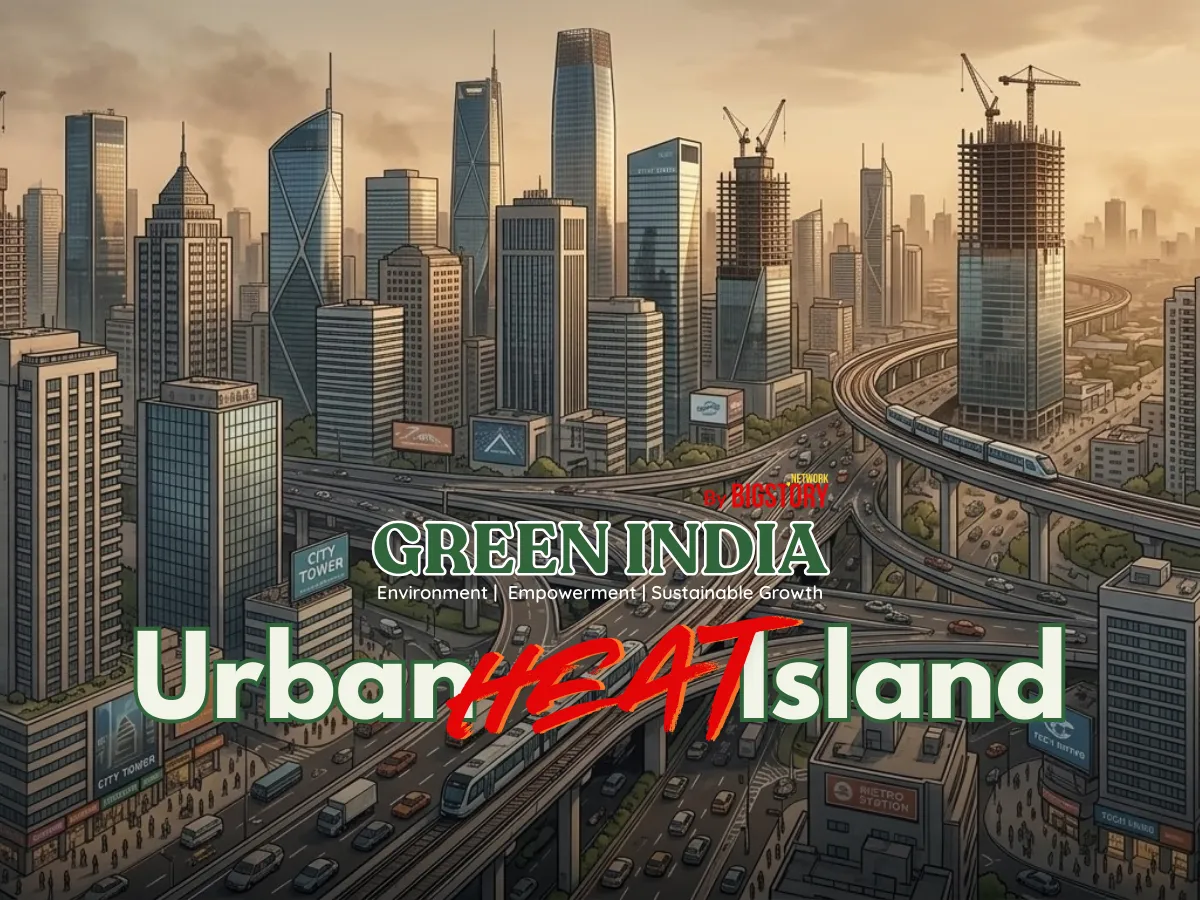
India's cities are trapping deadly heat underground and overhead. Concrete is killing us. Here's the science, the crisis, and what's actually working.
In 2024, India recorded severe weather events on 322 days — nearly 90% of the entire calendar year. Over 71% of the Indian population reported direct exposure to severe heatwaves. These are not anomalies. They are the new baseline.
But here is what most climate coverage misses entirely: a significant portion of the heat killing people in Indian cities is not coming from the sky. It is being generated, stored, and re-emitted by the cities themselves.
This is the Urban Heat Island effect — and it is transforming India's megacities into inescapable thermal ovens that cook their residents from below, above, and all sides simultaneously.
The Urban Heat Island effect refers to the measurable temperature difference between urban areas and their surrounding rural or peri-urban landscapes. Cities run hotter — significantly, dangerously hotter — not just because of climate change, but because of what they are made of.
Asphalt, concrete, brick, tar, and steel all share two critical properties: high thermal mass and extremely low albedo — meaning they absorb massive quantities of solar radiation during the day and refuse to let it go. Instead of reflecting sunlight back into the atmosphere, the urban fabric stores it, then slowly re-emits it as heat throughout the night.
The result is a city that never cools down.
Satellite data from MODIS Land Surface Temperature observations spanning 23 years — 2000 to 2023 — confirms a nighttime warming trend across India's major cities ranging from 2.04°C to 3.7°C over urban cores. Core city zones routinely record ambient temperatures 3°C to 5°C higher than surrounding rural areas.
Here is the finding that deserves far more public attention than it receives.
Between 1981 and 2022, heat extremes increased steadily. But the last decade has seen a disproportionate and alarming acceleration — specifically in nighttime warming. Nearly 70% of Indian districts now experience five or more additional very warm nights per summer season. By comparison, only 28% of districts saw an equivalent increase in very hot days.
From July to October 2024, India recorded its highest average monthly minimum temperatures since 1901 — sustained thermal anomalies of +1.78°C above baseline.
Why does this matter so profoundly? Because the human body recovers from heat stress at night. Warmer nights eliminate that recovery window entirely. For the urban poor, outdoor workers, and informal settlement residents who have no access to air conditioning, there is literally nowhere to escape. The city has become a 24-hour thermal trap.
New Delhi records maximum temperatures of 47.3°C with an average of 39.9°C — a historical severity increase of 1.5% since 2010. Pune has seen a dramatic 4.1% increase in severity over the same period. Ahmedabad — a city that has experienced some of India's deadliest heat events — shows no statistically significant change, suggesting its baseline was already catastrophically high.
The eastern belt tells a different story — one of humidity compounding everything.
The fast-growing urban agglomeration of Bhubaneswar and Cuttack serves as one of India's most precise case studies in heat island expansion.
In Cuttack — an older, organically grown city with narrow streets and compact layout — mean Land Surface Temperature was recorded at 29.90°C in 1990. By 2020, driven by the replacement of natural landscapes with dense concrete, that average had surged to 37.98°C, with peak surface temperatures hitting 41.40°C. A rise of over 8 degrees in three decades.
Cuttack's unique geography worsens things further. Bounded by the Mahanadi and Kathajodi rivers, the city features massive sand bars. Unregulated sand mining has transformed these bars into localized thermal hotspots — absorbing immense solar radiation and radiating it directly into the adjacent urban canopy.
Bhubaneswar, despite being a planned city with wider roads and designated open spaces, has experienced relentless built-up expansion. Between 1990 and 2010, high UHI values ranged from 3.54°C to 4.12°C. By 2020, as deforestation pushed populations to peripheral fringe areas, peak UHI values reached 4.3°C. The removal of agricultural land and wetlands has eliminated the natural thermal buffers the city depended on.
There is one flicker of hope in the data. Localized improvements in the Urban Thermal Field Variance Index were observed in specific sectors between 2010 and 2020, where rooftop gardening and isolated green space development produced measurable cooling. The evidence is clear: targeted greening can reverse macro-thermal trends — even in a city spiralling toward thermal collapse.
Kolkata covers roughly 1,480 square kilometres of low-lying terrain barely five metres above sea level. Remote sensing analyses using Landsat-9 thermal data reveal an alarming average temperature rise of 4.4°C over historical baselines. Intense UHI hotspots concentrate in the densely packed northern and eastern corridors — Sinthi, Bagbazar, Maniktala, Beleghata, and Taltala.
The primary driver is ecological devastation.
Between 1999 and 2021, Kolkata lost an estimated 39% of its surface water bodies to illegal land conversion and real estate encroachment. Simultaneously, the city's tree canopy collapsed from 23% to a mere 7.3% over two decades. Without aggressive intervention, projections suggest green cover will decline further to 3.37% by 2030.
Cyclone Amphan in May 2020 delivered a catastrophic blow, tearing down thousands of mature trees and decimating the city's remaining urban lungs in a single night.
The mechanism is what urban ecologists call a double thermal penalty. First, the city loses evapotranspiration and solar shading from trees. Second, the permeable organic surface that once occupied that space is replaced by impervious, heat-absorbing concrete. The city loses its cooling and gains a heater simultaneously.
Then comes the feedback loop: rising temperatures drive air conditioning demand. Air conditioning units eject waste heat directly into the urban canopy layer. Street-level temperatures rise further. Those who cannot afford cooling suffer more. Mortality climbs.
In response to spatial constraints and soaring land values, traditional parkland models are increasingly unviable. What is gaining extraordinary traction across India is the Miyawaki method — a technique explicitly engineered to cultivate dense, native, self-sustaining micro-forests in spaces as small as 30 square feet.
Pioneered by Japanese botanist Dr. Akira Miyawaki in the early 1970s, the method is built on the theory of Potential Natural Vegetation — identifying and planting the specific indigenous climax species that would naturally dominate a landscape without human interference. Native species are inherently adapted to local soil, rainfall, and climate, building ecosystems that are genuinely resilient rather than cosmetically green.
The biological mechanics are designed to bypass the slow early stages of ecological succession and advance directly to planting robust climax forest species. The process begins with intensive soil preparation — excavating and enriching with coconut husks, paddy straw, and local compost to optimize water retention and root penetration. A microbial wash brewed from native forest soil, cow dung, and urine inoculates the earth with symbiotic mycorrhizal fungal networks that function as a secondary root system.
Saplings are then planted at an extreme density of three to five trees per square metre, intermingled across four layers — canopy, tree, sub-tree, and shrub — mimicking the architecture of a mature natural forest. Deliberate overcrowding forces intense competition for sunlight, driving rapid upward growth. The grove requires maintenance for two to three years, then becomes entirely self-sustaining.
The results are extraordinary:
.webp)
Bhubaneswar's Eco-Restoration Movement
The impetus for Bhubaneswar's greening was forged in the devastating aftermath of Cyclone Fani in 2019, which uprooted over 100,000 mature trees and stripped the city of its thermal shielding overnight. Citizens quickly understood that replantation was insufficient — the city needed resilient urban forest planning.
Subrat Pradhan of NGO Sathi Paribaar mobilized volunteer networks to transform barren wastelands into thriving ecosystems — planting 1,200 drought-resistant trees on a two-acre wasteland in Kumunda village, integrated with mini-wetlands to support local wildlife. The Bakul Foundation, famous for its library movement, pivoted its vast volunteer network toward environmentalism through its My Tree Campaign, drawing in international volunteers and local youth.
Responding to this citizen momentum, the Bhubaneswar Municipal Corporation adopted the Miyawaki method institutionally — planting 11,000 saplings over 3.7 acres in Patia, followed by 15,000 saplings across five acres at the Odisha University of Agriculture and Technology. The flagship achievement is the Ananda Bana (Forest of Joy) — an 89.05-acre ecological restoration project featuring a 1.5-hectare Miyawaki plantation of 12,000 trees across 35 local species, functioning as a massive thermal sink in the heart of the capital.
Kolkata's Defenders
The SwitchON Foundation has launched widespread Miyawaki urban forest campaigns in Newtown, partnering with the New Town Kolkata Development Authority and corporate CSR funding to counter the catastrophic projection of 3.37% green cover by 2030. Their Move for Earth symposiums mobilize youth and install real-time air quality monitors across schools.
Nature Mates-Nature Club focuses on biodiversity integration — developing specialized butterfly conservatories in Banabitan and Narendrapur, conducting comprehensive tree censuses at Rabindra Sarobar Lake, and ensuring that Kolkata's Miyawaki forests function as genuine wildlife corridors, not just carbon tallies.
Urban forestry addresses the canopy. But the full mitigation of the Urban Heat Island effect is inseparable from urban hydrology. Water bodies possess massive thermal mass — absorbing ambient heat without significant temperature elevation themselves, and continuously cooling the surrounding atmosphere through natural evaporation.
The East Kolkata Wetlands: A Global Model Under Siege
Spanning roughly 12,000 hectares on Kolkata's eastern fringe, the East Kolkata Wetlands are the world's largest organic wastewater recovery system — a Ramsar-designated site that biologically treats hundreds of millions of litres of the city's raw sewage daily through a network of shallow wastewater-fed fish ponds. The system provides direct livelihoods for over 62,000 people while producing massive yields of fish and agricultural produce.
From a climate perspective, geospatial studies demonstrate a verified thermal cooling gradient of 1.14°C per 100 metres directed outward from the wetland shoreline into the city. The temperature variance between the innermost and outermost buffer zones around the wetlands reaches up to 3.41°C — a massive, irreplaceable shield against urban heat.
This ecosystem is under perpetual siege from real estate developers and illegal land conversion. Its primary defender has been grassroots judicial activism. The NGO PUBLIC, led by environmentalist Bonani Kakkar, initiated a landmark Public Interest Litigation in the Calcutta High Court in 1992 — securing formal prohibition of land-use changes, Ramsar status in 2002, and the East Kolkata Wetlands Conservation and Management Act of 2006. Institutional enforcement, however, remains critically weak.
Bhubaneswar's Hydrological Revival
In Bhubaneswar, authorities are increasingly recognizing that trees alone cannot cool a city. The planned rejuvenation of the Gangua Nullah — once a vital natural drainage artery, degraded into a polluted hazard by unchecked urban sprawl — represents a paradigm shift toward restoring natural water infrastructure as climate resilience. A multi-departmental coordination committee is working to transform it into a functioning urban wetland designed to mitigate extreme weather and restore micro-climatic cooling.
Across Odisha, youth-led wetland reclamation movements are demonstrating the power of community action. In Mangalajodi on the northern banks of Chilika Lake, local youth and fishermen cooperatives transformed a degraded, poaching-plagued water body into an ecotourism icon. At Ansupa Lake near Cuttack, community-driven desilting has restored a dying freshwater lake to its natural state as a thermal and ecological anchor for the region.
Over 250 cities and districts across India now have operational Heat Action Plans. The Bhubaneswar Heat Action Plan 2024–2025 demonstrates genuine proficiency in short-term emergency responses — color-coded thermal alerts, altered working hours for outdoor laborers, dedicated heat-stroke wards with ice packs and mobile ambulances. These measures unquestionably save lives.
But short-term emergency management and long-term structural resilience are not the same thing.
The Energy Conservation Building Code and Eco-Niwas Samhita mandate better thermal insulation, reflective cool roof coatings, and heat-resistant construction materials — measures capable of reducing a building's annual cooling energy intensity by over 10%. Enforcement remains critically weak.
Master city planning must legally integrate blue-green public spaces into municipal zoning — mandatory green buffers around new developments, permeable pavements for aquifer recharge, and strict legal protection of remaining water bodies against rezoning. The political will to enforce these requirements against powerful real estate interests remains the defining gap between policy on paper and thermal resilience on the ground.
The concrete heat island is not an inevitable consequence of human development. It is a catastrophic design failure — and design failures can be corrected.
Three actionable pathways stand above all others:
Redirect CSR funding away from cosmetic single-species tree-planting drives toward verifiable, science-backed Miyawaki forests and mechanical desilting of community ponds — interventions with measurable temperature drops.
Mass civic volunteerism in local biodiversity mapping, habitat restoration, and crucially the post-plantation maintenance — weeding, watering, mulching — required during the first three years of an urban forest's life to ensure survival.
Rigorous policy enforcement of the Wetlands Conservation and Management Rules — heavily penalizing illegal conversion of natural thermal sinks into concrete real estate, with zero tolerance for the land conversion mafias that systematically dismantle urban cooling infrastructure for profit.
India's cities can be cooled. The science, the grassroots models, and the policy frameworks all exist. What is required now is the political courage to enforce what is already known — before the urban oven becomes inescapable.
 Exclusive Content





Sign up for the Daily newsletter to get your biggest stories, handpicked for you each day.


 Trending Now! in last 24hrs